
Between the patches of dappled sunlight and shadows that the overhanging Alder leaves cast on the slow-moving river a flash of iridescent blue catches the eye.
This is the Banded Demoiselle (Calopteryx splendens), a damselfly of such striking beauty that it seems more like a fragment of stained glass than a creature of flesh and wings.
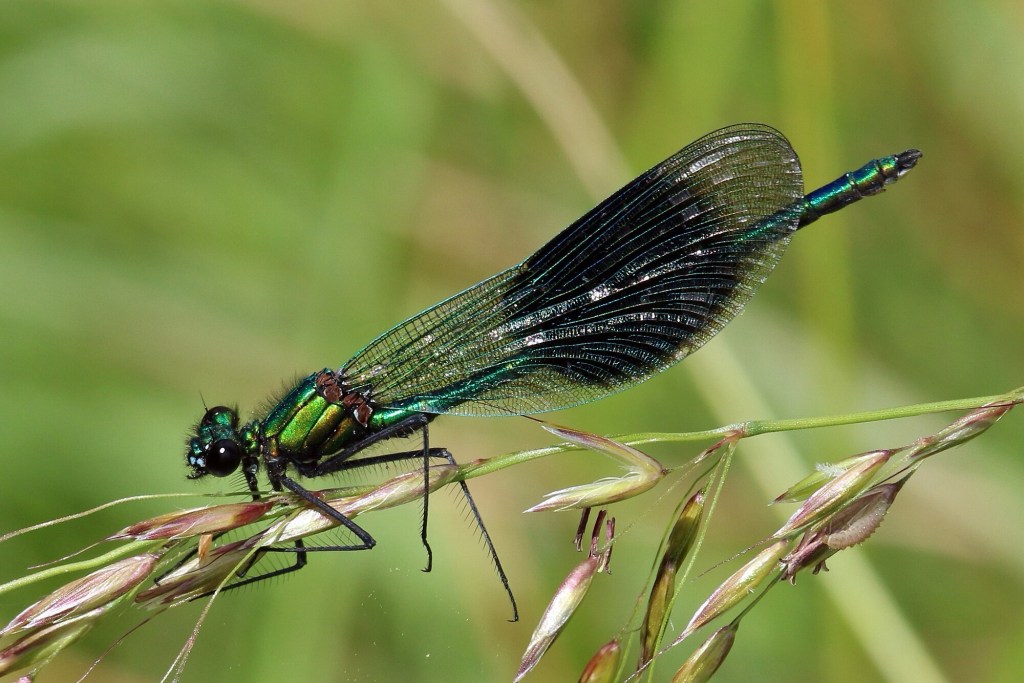
(Charles J Sharp)
Damselfly of Distinction
The Banded Demoiselle is one of our most elegant Odonata, the order of insects that includes Dragonflies and Damselflies. Unlike their chunkier dragonfly cousins, Demoiselles are slender, almost fragile in appearance, with a body that seems to hover on the edge of weightlessness.
Males are particularly eye-catching, sporting wings with a broad, inky-blue band across the middle, framed by transparent tips and bases. Their bodies gleam with a metallic green-blue sheen, making them unmistakable as they dart and drift over the water.
Females, while less flamboyant, are no less beautiful, with their greenish wings and bronze-tipped bodies that blend subtly with the reeds and rushes.
Found across much of Europe, the Banded Demoiselle is a frequent sight in the Northwest of England, particularly along rivers like the Lune, Ribble, and Eden, where clean, slow-flowing water and abundant vegetation provide ideal habitat.
They prefer sunny spots with emergent plants like Watercress and Brooklime, where they perch with wings half-open, ready to take flight in pursuit of prey, mates or to defend their territory.

(BJ. Schoenmakers)
Dancing Damsels
The life of a Banded Demoiselle is a brief but vibrant affair, tied intimately to the rhythms of the river. Emerging in late spring, typically from May, these damselflies begin their short adult lives, of only two weeks, after a larval stage spent underwater.
For two years, their nymphs—voracious little predators—hunt small aquatic creatures in the silty beds of rivers and streams. When the time comes, they crawl onto a reed or stone, split their larval skin, and emerge as winged adults, ready to take to the air.
The males are the showmen of the species, performing a fluttering, almost butterfly-like display flight to attract females.
These courtship dances, often seen in the warm haze of a June afternoon, are a spectacle of precision and grace. Males will also fiercely defend their stretch of riverbank, engaging in aerial duels with rivals, their wings flashing like tiny swords in the sunlight.
Once a female is won, she lays her eggs directly into submerged plants, using a needle-like ovipositor to pierce the stems.
Then the cycle begins anew, with the next generation biding its time beneath the water’s surface.

(Gail Hampshire)
A Barometer of River Health
The presence of Banded Demoiselles is more than just a visual delight, it’s a sign of a healthy ecosystem, as this species is sensitive to pollution and habitat degradation, requiring clean, well-oxygenated water to thrive.
In the Northwest, where our industrial history has left its mark on many rivers, their shimmering wings are a testament to ongoing efforts to restore and protect our waterways. Across the rest of the country, from the chalk streams of Hampshire up to the meandering rivers of Cumbria, conservation work has helped ensure that these delicate creatures continue to grace our landscapes.
Yet, the Banded Demoiselle faces challenges, as agricultural runoff, urban development, and climate change threaten the clean waters and stable temperatures they depend on.
Protecting their habitats means safeguarding not just the Demoiselles but the countless other species; fish, birds, and invertebrates, that share these aquatic ecosystems.

Jan Baninec)
Questing for a Calopteryx
For those endeavouring to spot a Banded Demoiselle, a summer walk along a riverbank is the place to start.
Look for them on warm, sunny days, particularly in June and July, when they’re most active. The River Lune near Lancaster or the Eden in Cumbria are reliable spots, where you might see males patrolling their territories or females delicately ovipositing in the shallows.
I have also seen them at home right here in Padiham, flitting over the Calder where it passes through the town centre. This tells us that the river’s water quality must have improved a great deal since the mill-town’s industrial peak, when 22 cotton mills discharged a variety of dyes and other toxic chemical compounds into the river.
Binoculars can help you appreciate the intricate details of their wings and bodies, but often, simply sitting quietly by the water will reward you with a close encounter, and you may espy other riverine residents, like Otters or Water Voles.
As you watch, take a moment to consider the deeper story these creatures tell, as the Banded Demoiselle is not just a beautiful insect but a reminder of the fragility and resilience our natural heritage.
In its fleeting, jewel-like existence, it carries the weight of centuries, surviving and adapting through the changes we have made to its world to continue dazzling us with its quiet splendour.
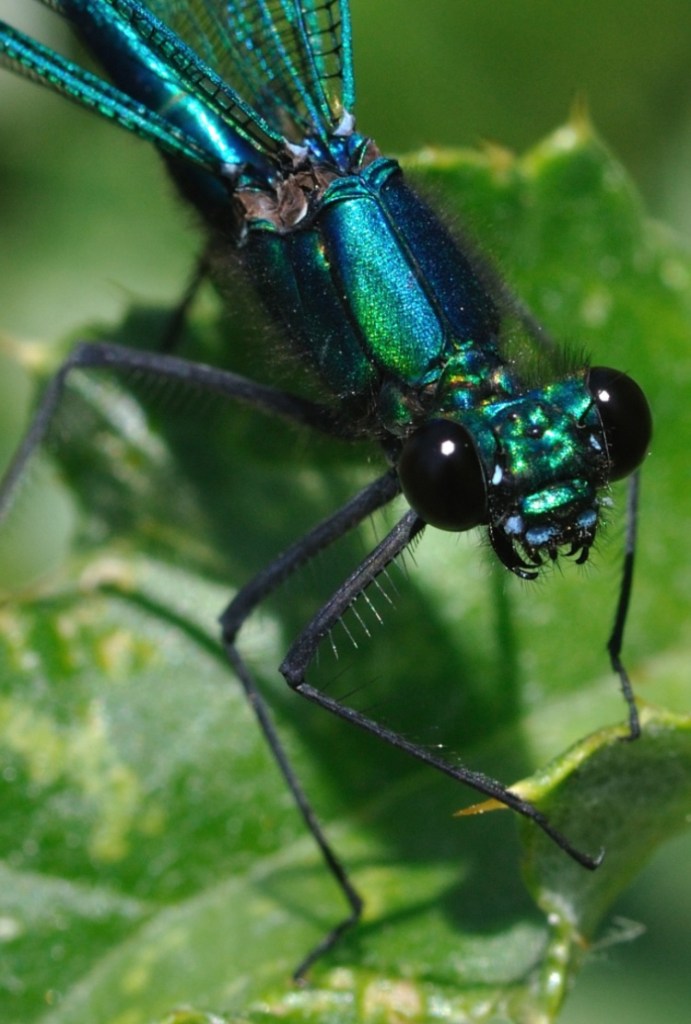
Can dragonflies hurt you?
By Matt Howard
“Can dragonflies hurt you?”
The man with the long-handled dustpan asked me,
While I was passing the riverside bar first thing this morning, as his eye caught mine, twitchy,
pointing at a little flap among the fag-butts and papers.
“You’re fine” I said, moving closer, smiling
“and anyway, that’s a damselfly,
a banded demoiselle; blue, a male
downed in the wind or just near to being done”.
Long-leg-wary, he lifted it clear,
stooped with too much information.
The day glinted between harm and care and now, if asked again, man to man, I’d answer the same to my dear ones or any stranger –such hurt lands in the way love or its absence can.
If you enjoyed this article please consider showing your appreciation by buying me a coffee, every contribution will go towards researching and writing future articles,
Thank-you for visiting my site,
Alex Burton-Hargreaves
June 2025


Great images and information Alexander, I was lucky to find and photograph Beautiful Demoiselle down in S. Wales a few weeks back we don’t get either up here (much) but Banded have been seen in Fife so, fingers crossed.
LikeLiked by 1 person
Thank-you, yes I think Banded are another species that is moving north, I haven’t seen Beautiful Demoiselle so I’m a bit jealous to be honest!
LikeLike
Sirhowy Country Park in S. Wales if you’re ever down that way, none up here at all so, we’re even 🙂
LikeLiked by 1 person