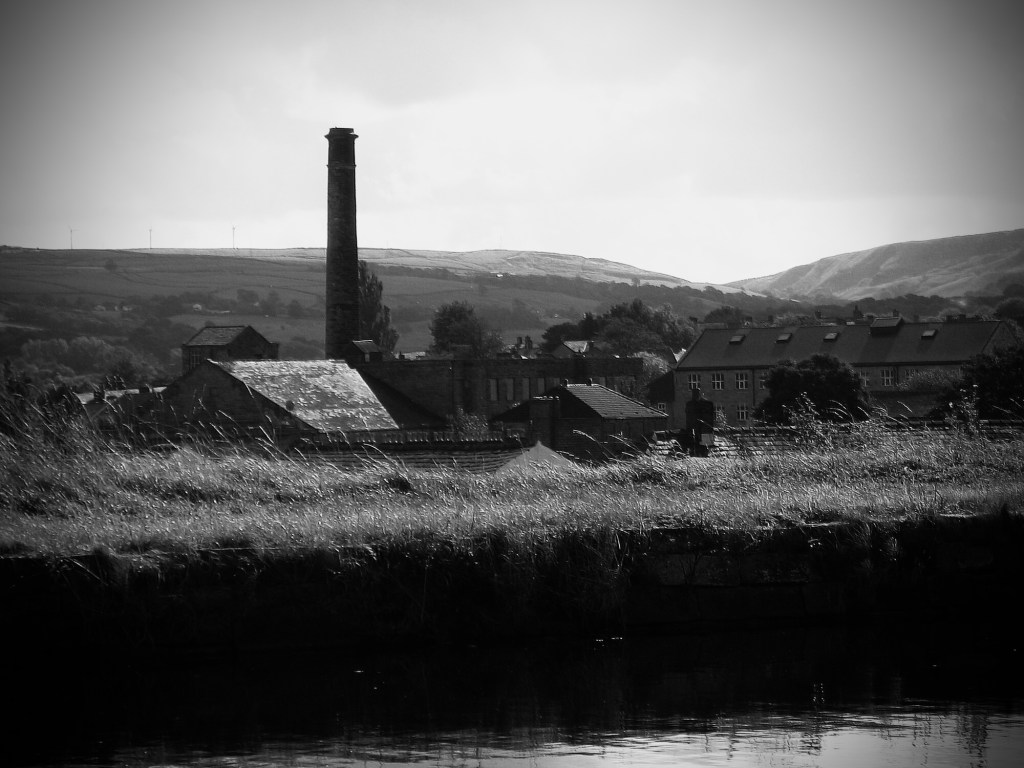
By the mid-19th century, the Lancashire town of Burnley had developed into a thriving centre of industry, dominated by the booming cotton trade, its skyline pierced by the chimneys of mills that churned out cloth for the world.
Around 1854, Pentridge Mill rose on land bordered by Todmorden Road, Holmes Street, and Oxford Road, built for a Mr. Lomas, a local entrepreneur with a sharp eye for business opportunities. The four-storey structure, constructed from the region’s characteristic sandstone, a symbol of the architectural pragmatism of the era; sturdy, functional, and designed to house the clattering looms and spinning frames that powered Burnley’s economy.
By 1872, the mill was in the hands of Lomas & Tunstill, a partnership that saw it do very well as a cotton spinning and manufacturing business. With over 55,000 spindles whirring in tandem with nearby Fulledge Mill, Pentridge was a giant in its day, employing hundreds of local workers.
The mill’s proximity to the Leeds and Liverpool Canal, completed in Burnley by 1801, ensured easy transport of raw cotton and finished goods, linking it to global markets. Its early years were marked by the hum of machinery and the rhythm of its workers’ lives, many of whom lived in the tightly packed terraces of Burnley Wood and Fulledge, where corner shops and cobbled alleys buzzed with community life.
Yet, like many mills, Pentridge was not immune to the volatility of the cotton trade. By 1883, the Lomas & Tunstill partnership dissolved, and the mill passed to E.F. Bleakley & Bros, who focused solely on cotton spinning. This shift reflected the broader evolution of Burnley’s textile industry, where specialisation became key to survival amid growing competition.

From Looms to Limelights
As the 20th century dawned, Burnley’s cotton industry began its slow decline, hastened by global competition and the devastation of two world wars. Pentridge Mill, however, found a new lease on life, not as a factory, but as a cultural centre.
In 1909, J. Palmer & Sons Ltd received approval to convert the mill’s second floor into a skating rink, capitalising on the era’s fascination with leisure. By 1910, the ground floor had been transformed into the Pentridge Picture Hall, a “snug little hall” boasting a Pathé projector and tip-up chairs, where locals flocked to watch silent films for 3d to 6d.
The mill’s reinvention as a cinema was a bold move, combining its industrial heritage with modern entertainment. By 1912, three internal floors were removed to create a grander space, and in 1920, architect William Heap oversaw extensive remodelling, adding a balcony and a new frontage. With a seating capacity of 1,530, the Pentridge Cinema became a cornerstone of Burnley’s social scene, screening “talkies” from 1929 with the installation of Electrocord sound equipment, later upgraded to Western Electric.
The cinema’s golden age spanned the interwar years, when families from Burnley Wood and beyond gathered to escape the hardships of the Great Depression. Yet, by the 1960s, the rise of television and changing leisure habits saw the cinema’s decline. The building morphed again, becoming the Embassy Club, a nightlife venue with a risqué reputation, offering gaming tables and live entertainment.
This phase, too, faded with the 1968 Gaming Act, which tightened regulations on such establishments.

(Historic England)
Decay and Unfulfilled Dreams
By the late 20th century, Pentridge Mill had fallen into disuse, its once-vibrant halls echoing only with the ghosts of its past. The surrounding Burnley Wood district, once a hive of terraced housing and corner shops, faced urban clearance in the 1970s, leaving the mill increasingly isolated.
Part of the original structure was demolished around 1920 to accommodate cinema expansions, and by the 2000s, the remaining building was a shadow of its former self, its sandstone façade crumbling and its interiors exposed to the elements.
Plans to revive Pentridge surfaced periodically, reflecting Burnley’s broader struggle to repurpose its industrial relics. In 2015, proposals emerged to convert the site into modern student accommodation, a vision that promised to breathe new life into the derelict structure.
Yet, these plans stalled, leaving the mill vulnerable to neglect and vandalism. The building’s notoriety grew as a hotspot for arson, with fires reported in 2010, 2014, and 2022, each underscoring its precarious state.

The Fire of 2025
On May the 31st, 2025, Pentridge Mill was engulfed in flames once more, in what became one of Burnley’s most dramatic recent fires. The blaze, believed to have started in the derelict building on Holmes Street, tore through the former nightclub known as The Circulation Club (colloquially called “The Circ”), a later incarnation of the mill’s entertainment phase.
Eight fire engines, supported by a drone unit and two aerial ladder platforms, descended on the site, battling the inferno as thick smoke billowed across the town, visible as far away as Cliviger.
Firefighters worked tirelessly, using hose reel jets and ground monitors to contain the fire, but the building’s dilapidated state, five floors of rotting timber and debris, fuelled the blaze’s ferocity. Road closures on Oxford Road and Holmes Street persisted for days, and by June 4, crews were still tackling pockets of fire within the structure.
Lancashire Police expressed concern for a homeless man, Ayhan Daudov, known to sleep rough near the site, who remains unaccounted for, adding a human dimension to the tragedy.
The cause of the 2025 fire remains under investigation, but its history of arson attacks, four separate blazes in 2010 alone, points to a pattern of vulnerability.
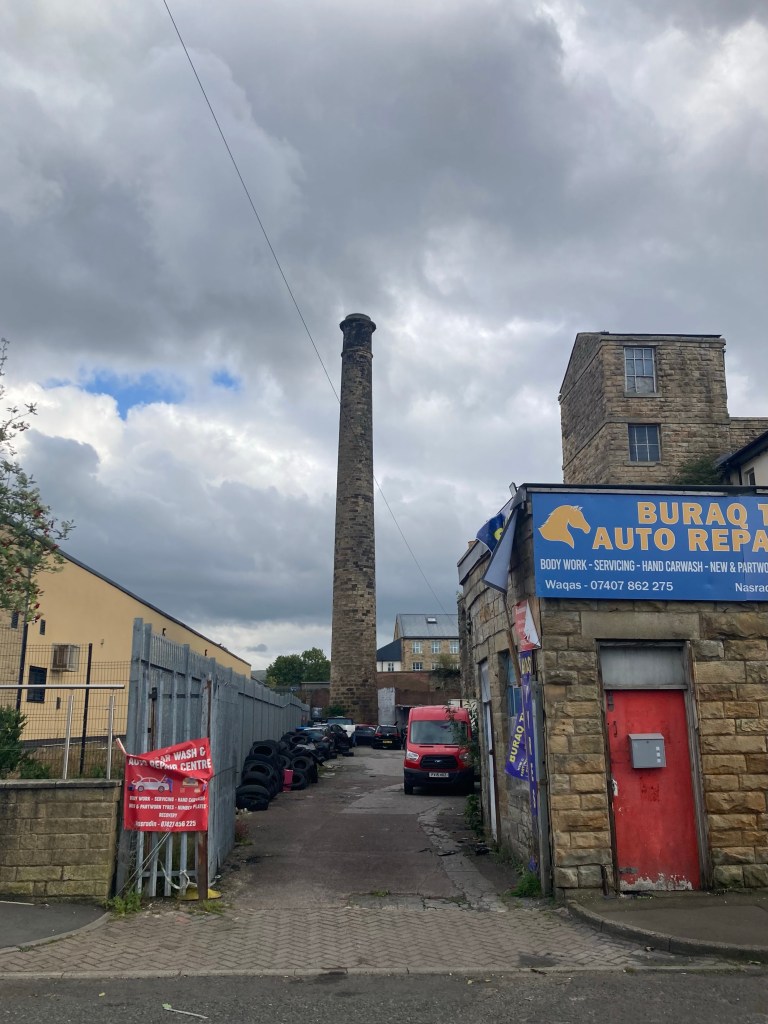
(photo by author)
The Future
Pentridge Mill’s scarred and scorched walls might still whisper of Burnley’s industrial might, when the town was the “cotton weaving capital of the world” yet its recent history raises urgent questions about how to preserve such sites in an era of economic uncertainty and urban change.
Burnley has seen other mills reborn, like those transformed into educational hubs by Barnfield Construction and Visions Learning Trust. Could Pentridge have followed suit? The 2015 student accommodation plan hinted at a future for the mill where heritage and modernity could coexist, but its failure left it exposed to decay and destruction. As the town looks to projects like Weaver’s Lodge, where 73 homes are rising on another former mill, there’s some hope that lessons from Pentridge’s loss will shape future regeneration.
For now, Pentridge Mill stands as a cautionary tale, its charred remains a reminder of the fragility of history. Yet, in Burnley’s resilient spirit, forged by canals, looms, and the unyielding grit of its people, there lies the potential for renewal.
Perhaps, one day, the site will rise again, not as a mill or cinema, but as a new chapter in the town’s ever-evolving story, where the past is honoured and the future embraced, but only time will truly tell.

To read more articles about Lancashire’s cotton industry, including one about Burnley’s very own Queen St Mill, the last functioning steam-powered cotton weaving mill in the world, please see my Cotton Chronicles series.
Ah’m Nobbut a Cotton Wayver
Ah’m nobbut a cotton wayver
An’ ah wark in a Lankisheer mill
What wi’ piecing ‘eels an’ ends out,
Me legs, they’re nivver still.
Ah gets sa tired an’ weary
I could do ta run away
Bur if ah did, they’d verra soon find me
‘Cos a’m covered i’ china clay!
Ah gerrup in a mornin’ Me ‘ead’s sa bloomin’ leet
A’hm wishin’ it wur Satdy
Afore ah strike a leet
Thur’s t’knocker-up at t’winder
An’ me muther’s rattlin’ t’sturs
An’ a’m wundrin’ weer me brat is
All t’time a’m sayin me prurs.
A’m nobbut a cotton wayver
An’ ah wark in a Lankisheer mill.
(Anon)
If you enjoyed this article please consider showing your appreciation by buying me a coffee, every contribution will go towards researching and writing future articles,
Thank-you for visiting my site,
Alex Burton-hargreaves
(July 2025)
 Northwest Nature and History