The Snow Bunting; Biology, Ecology and Occurrences in the Forest of Bowland
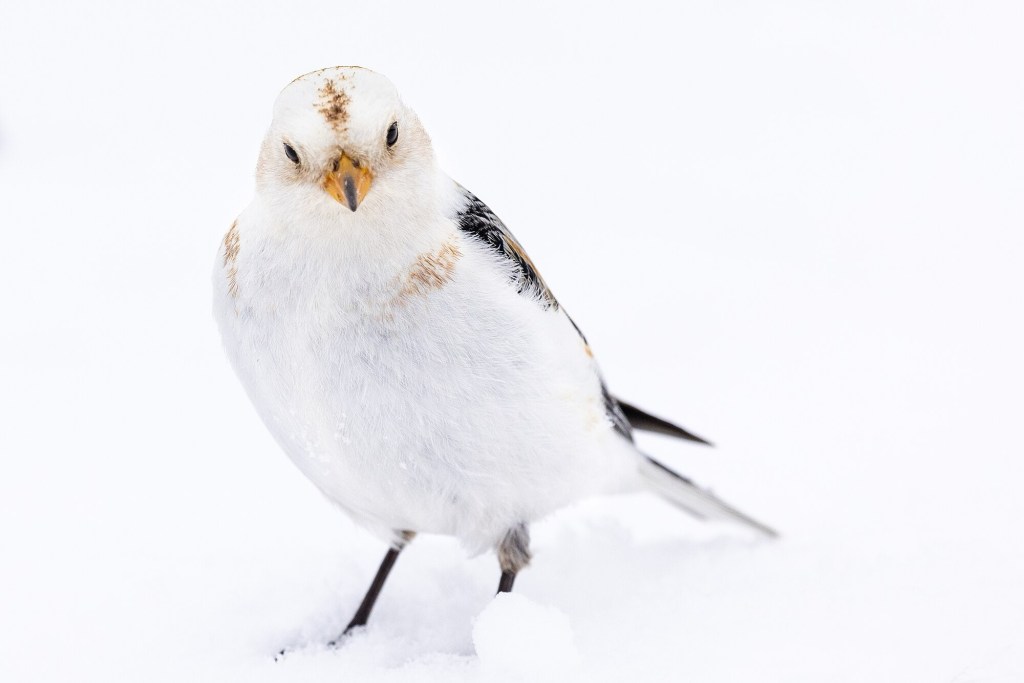
The Snow Bunting, Plectrophenax nivalis, is a medium-sized passerine bird belonging to the Calcariidae family, known for its striking plumage that adapts to seasonal changes.
In the breeding season, males sport a pristine white head, underparts, and wings contrasted with a black back and wingtips, while females, as is quite common in passerines (songbirds), are more subdued with brownish tones.
During winter, both sexes adopt a more mottled appearance, with rusty-brown edges on their feathers providing camouflage against snowy or rocky terrains. These birds measure about 15 to 18cm in length, with a wingspan of 32 to 38cm, and weigh around 30 to 40 grams.
Native to circumpolar Arctic regions, being our most northerly recorded passerine, Snow Buntings breed in remote, rocky crevices where their white plumage blends seamlessly into the snow-covered landscape.
As there is a distinct lack of trees and shrubs at these latitudes they are of course ground-nesters, laying 4 to 6 eggs in shallow scrapes lined with feathers and moss. They feed primarily on seeds, insects, and small invertebrates.
Their song, a cheerful, tinkling warble, signals the arrival of spring in the tundra, but in winter, they form nomadic flocks that can roam surprisingly far in their search for food and shelter.

Arctic Specialists
Snow Buntings are true Arctic specialists, thriving in barren, open habitats with sparse vegetation. They breed in high-latitude tundras but undertake impressively long migrations southward during winter to avoid the perpetual darkness and sub-zero temperatures. In the British Isles, they are primarily winter visitors, arriving from Iceland, Fennoscandia, and Greenland between October and March.
While most head to coastal areas, some venture inland to upland moors and mountains, where they forage on exposed ground for seeds from grasses and weeds.
Their migratory behavior is influenced by weather; harsh winters push larger flocks further south. In flight, they resemble swirling snowflakes, often calling with a soft “per-re-ree” as they wheel over fields or hillsides.
This adaptability makes them hardy, but climate change may pose threats by altering food availability and breeding grounds.

(Charles J. Sharpe)
Factors Influencing Migration
Weather plays a pivotal role in Snow Bunting migration, as harsh Arctic winters or strong northerly winds can push flocks further south, leading to irruptions (sudden increases in population or movement) in atypical areas.
For instance, strays south of their usual winter range are more common in November during cold snaps and food scarcity, such as reduced seed availability due to snow cover, also drives nomadic behavior within wintering grounds.
Climate change may be altering these patterns, as warmer Arctic temperatures shift breeding ranges northward, while changing weather could disrupt traditional routes and timing. Studies using tracking devices reveal complex, variable paths, demonstrating the birds’ adaptability but also its vulnerability to environmental changes.

(Mike Pennington)
Buntings in Bowland
Northern England’s Forest of Bowland, with its expansive fells rising to over 500 meters, provides an ideal winter haven for Snow Buntings, as the highest reaches of the area, often blanketed in snow during colder months, mimic the birds’ Arctic home, attracting passing flocks.
They are frequently spotted near the summits of Pendle, Fairsnape and Ward’s Stone, especially when north-easterly winds bring frigid conditions. The birds preferring the open, windswept plateaus with their bare rock and minimal vegetation, where they can scratch for seeds amid the heather and grasses.
Sightings in Bowland are more common during severe winters, with flocks of 20 to 50 individuals not uncommon. They often associate with other finches like Twite or Meadow Pipit, forming mixed feeding groups and local birdwatchers have reported peaks in observations from December to February, particularly after snowfall.
Here are some previous records;
2012: A single Snow Bunting was recorded on Fair Snape Fell on the 11th of February, as part of broader winter visitor patterns at Lancashire’s inland sites. This fell, located on the windswept, western fringe of the Bowland Fells, is a favored spot due to its exposed plateau.
• 2019: This year saw multiple inland sightings, including in Bowland. On Fair Snape Fell, two birds were observed on the 5th of February, another two on the 30th of October, and a single on the 3rd of December. You can clearly see the species’ preference for upland areas during both early and late winter periods. Nearby Pendle (1,827ft above sea level and adjacent to Bowland) also had sightings, such as eight birds on the 20th of November, suggesting movement between these hills.
• 2023: A male Snow Bunting was spotted on Ward’s Stone, the highest point in Bowland at 561 meters, on 30 January. This sighting was shared by the Lancaster & District Birdwatching Society and emphasises the bird’s presence here during mid-winter cold snaps.

(Mike Pennington)
Hunting for Buntings
To spot a Snow Bunting yourself head up to elevated parts of the fells, the Trough of Bowland is a good starting point or the paths leading up to Bowland Knotts.
Early morning or late afternoon is best, when flocks are most active foraging, and when you’ve found a quiet spot out of the wind sit still, listen for their distinctive rippling calls and watch for white flashes in flight against the dark moorland.
Binoculars or a spotting scope are essential, as these birds can be skittish and of course it goes without saying that you must dress warmly and check weather forecasts, as Bowland’s uplands can be surprisingly harsh.
Please be responsible and stick to paths to avoid disturbing the fragile habitat.
Finally joining local groups like the Lancashire Wildlife Trust is a good idea as they provide guided walks and up-to-date sighting reports, with luck you’ll be able to submit a record yourself!

Plectrophenax nivalis, by Magnus Körner for Sven Nilsson’s “Skandinaviens fåglar” (Birds of Scandinavia). Lund, published 1830-1840.
Lund University Library.
Snow Bunting, Tatsuji Miroshi
At this division in the road where day darkens the sleigh has started . . .
Behind the stopping place a snow bunting is crying and singing.
Over the snow where dusk gathers it is crying and singing.
On the twig of a leafless tree, ah it is burning, a single song, a single life.
If you enjoyed this article please consider showing your appreciation by buying me a coffee, every contribution will go towards researching and writing future articles,
Thank-you for visiting,
Alex Burton-Hargreaves
 Northwest Nature and History
I really must make the effort this season, they can’t be that far from me 🙂 (Perthshire)
LikeLiked by 1 person
You have a resident population up there don’t you? I can remember seeing them when skiing on Cairngorm years ago, I’d love to see them this winter!
LikeLike
I’ve seen them in Scotland, but never in Bowland. Must try harder.
LikeLiked by 1 person
Ditto, I’ve been up on the fells in the snow but no luck, I was lucky enough to see a few on Cairngorm years ago
LikeLiked by 1 person