
The spindle tree, Euonymus europaeus, is an attractive-looking deciduous shrub, or small tree, that graces hedgerows, woods and wasteland throughout the British isles.
Although it is often overlooked in spring and summer, it bursts into prominence during autumn with its striking display of colorful foliage and unique fruits.
The plant, belonging to the Celastraceae family, has been a part of human history for centuries, valued for its hard wood and admired for its ornamental qualities, though it is sometimes shunned for its toxicity.

Description and Characteristics
Typically growing to heights of 10 to 20 feet, though it can reach up to 30 feet in ideal conditions, the Spindle usually forms a bushy, upright shape with smooth, gray-brown bark, and ts leaves are opposite, elliptical to lance-shaped, measuring 2 to 4 inches long, with finely toothed edges. In spring, small, inconspicuous greenish-yellow flowers appear in clusters, attracting pollinators like bees. But it’s in autumn that the spindle truly shines, as the leaves turn brilliant shades of red, orange, and pink, creating an outstandingly fiery natural spectacle.
The most distinctive feature, however, is its fruit, the plant developing outlandish-looking four-lobed capsules which are a bright pink and split open to reveal vibrant orange seeds coated in an aril. These dangling fruits resemble tiny lanterns or, as some describe, “fairy hats,” adding an exotic touch to our hedgerows and woods.
Birds, such as Robin, Blackbird, Fieldfare, Redwing and Mistle Thrush are drawn to these bright seeds, aiding in dispersal, while the fruits provide a vital food source late in the year.
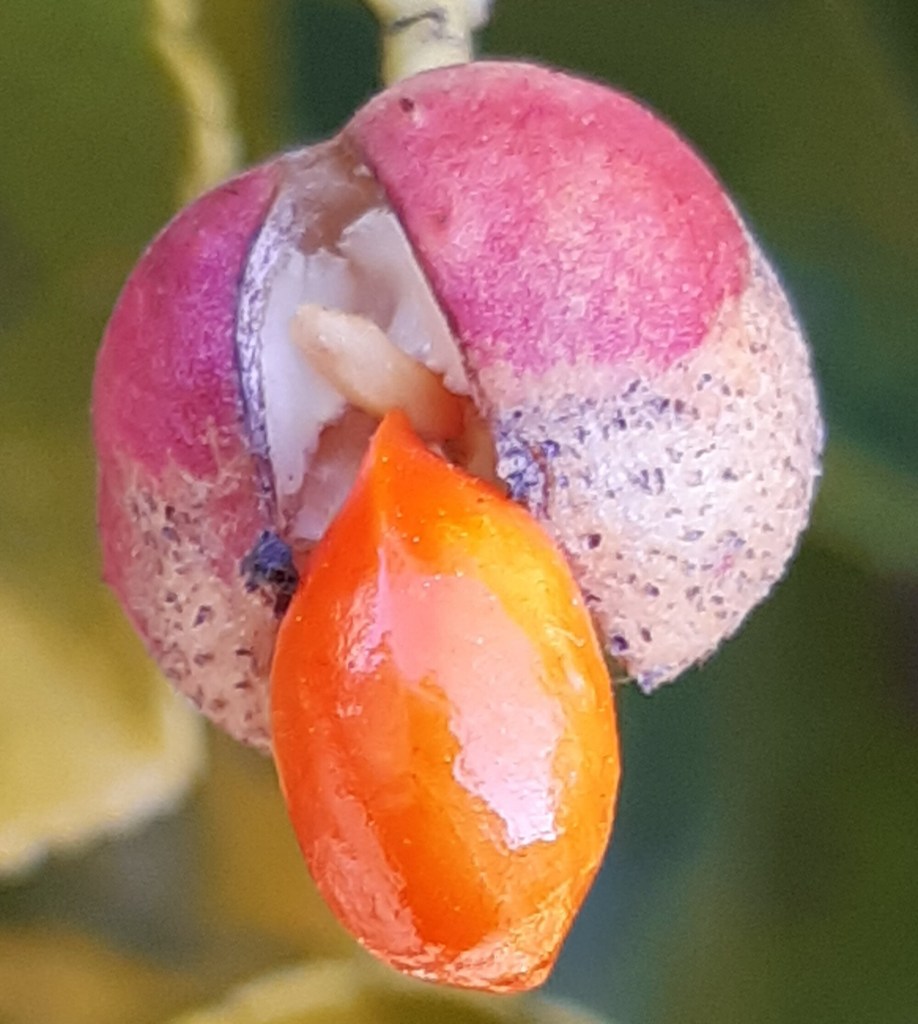
(Vimercati Edigio)
Habitat and Distribution
Native to the British isles Spindle thrives in a variety of habitats. It is most commonly found in woodlands, scrublands, hedges, and along forest edges, preferring calcareous (chalky or limestone-rich) soils but adaptable to others as long as they are well-drained.
In the wild, it often grows as an understory plant, tolerating partial shade but flourishing in full sun, and this resilience makes it a popular choice for gardens, where cultivars like ‘Red Cascade’ are prized for their enhanced fruiting and color.

Uses and Cultural Significance
Historically, the spindle tree earned its common name from the practical use of its dense, hard wood, which was ideal for crafting spindles used in wool spinning, as well as pegs, skewers, toothpicks, and even musical instruments.
In folklore, it was associated with creativity and inspiration, perhaps due to its connection to spinning and weaving, which have long been used as metaphors for fate and storytelling in many cultures. The wood was also used for charcoal production, favored by artists for sketching. Today, it’s primarily grown ornamentally for its alluring autumnal foliage and ecological benefits, though it’s not commonly used in modern crafts.
The plant, like almost all native species, holds a place in traditional medicine and folklore, but with caveats, because that bright colour warns us that all parts are toxic to humans and livestock, containing alkaloids that can cause severe gastrointestinal distress if ingested. Despite this, it has been used cautiously in herbal remedies in the past.

The Meaning of Its Scientific Name
The scientific name Euonymus europaeus derives from Greek roots: Euonymus combines ‘eu,’ meaning ‘good,’ and ‘onoma,’ meaning ‘name,’ traditionally interpreted as ‘of good name’ or ‘lucky,’ though ironically, this may allude to the plant’s poisonous nature, as if to euphemistically ward off its dangers. Some sources link it to Euonyme, the mother of the Furies in Greek mythology, maybe because of its potentially vengeful toxicity. The specific epithet europaeus simply indicates its European origin.

A Fantasy, by Dora Sigurson Shorter
I saw Winter ‘neath a spindle tree,
She plucked berries bright to crown her head.
She was singing little robin’s song
While wild beech-leaves round and round her spread.
I ran home into my little house,
Pulled to the shutters, barred up the door;
I knelt down to blow the fire to flame,
Great dark shadows danced upon the floor.
Long-legged shadows came from corners drear,
Leaped up white walls, fell, and climbed again.
I hear North Wind pushing at the gate,
I won’t open, not for wind or rain.
Oh, run home, wee ones, lest the whirling leaves
Take ye far away, fairy folk to see.
Crowning her dark hair with berries red
I saw Winter ’neath a spindle tree.
If you enjoyed this article please consider showing your appreciation by buying me a coffee, every contribution will go towards researching and writing future articles,
Thank-you for visiting,
Alex Burton-Hargreaves
 Northwest Nature and History
I have one in my front garden!
LikeLiked by 1 person
Funnily enough I sent this to my wife and she said “ooh they’re pretty, can we get one for the garden?”
We’re going to need a bigger garden for all the things we want to grow in it!
LikeLiked by 1 person
It’s a glowing red at present.
LikeLiked by 1 person
Thanks for your lovely article……there are indeed, ermine moth caterpillars every year on the spindles in my Burgundy garden. They swing about like tarzan on their silk threads! The moths are beautiful, streamlined , white with black specks. I have a photo if you like. Julie Anne.
Envoyé à partir de Outlook pour Androidhttps://aka.ms/AAb9ysg ________________________________
LikeLiked by 1 person
Ermine moths are fascinating, I remember finding a hedge covered in them as a kid and being confused because In thought they’d got caught by spiders! A photo would be lovely, if you want I can feature it in the article about ermine moths and credit/link it to you, as the current image of the moth is just a stock image.
LikeLike
Would love to…..will have a lookie see if I can find it on my computer. I have thousands of nature images ! JA
Envoyé à partir de Outlook pour Androidhttps://aka.ms/AAb9ysg ________________________________
LikeLiked by 1 person
Hello, apologies for my tardy response…..snuffles !! Here are 4 images of the Spindle Ermine in my Burgundy Garden, same species as the UK one. A credit would be perfect. Looking forward to catching up on reading more of your articles. I am on facebook , by the way. Happy writing, Julie Anne. ________________________________
LikeLiked by 1 person
Hi Julie, hope your snuffles have gone by now, I don’t think the link worked as I can’t view the images, thank-you for trying to send them though!
LikeLike