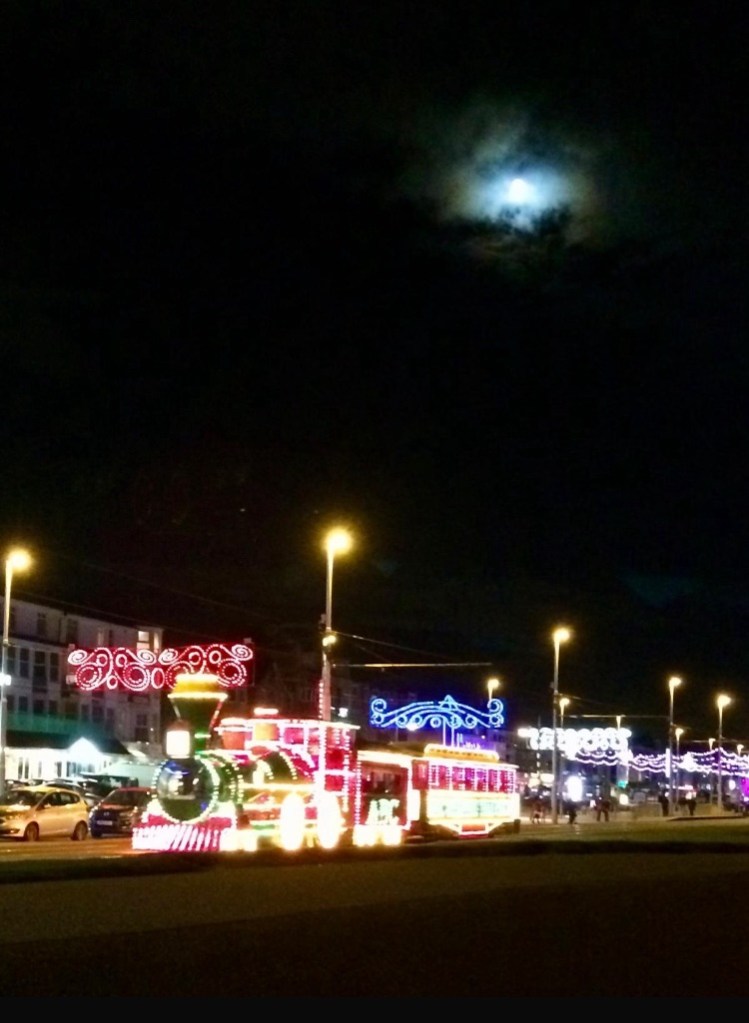
Like many people who grew up in Lancashire I have firm and fond memories of travelling to Blackpool each year with my parents to see “The Illuminations.”
We usually went around late September or early October, before going on our annual big family holiday to north Wales and, as well as me and my sister, one of our friends would often tag along, all crammed into my dad’s tired old Ford Orion.
Driving down the M55 from Preston was an adventure itself as we’d always be over-excited and, like every other kid, we’d compete with each other to be the first to see the tower, shining on the horizon like a beacon, promising fun, frolics and over-priced candyfloss.
Once at Blackpool we’d slowly crawl up the promenade with all the other cars, faces glued to the steamed-up windows, gawping at all the brightly flickering lights and displays and, if the traffic wasn’t too bad and my parents not too tired of us, we’d turn around where they ended at Bispham, and drive the 6 miles back down again to the other end, where they begin at Starr Gate.
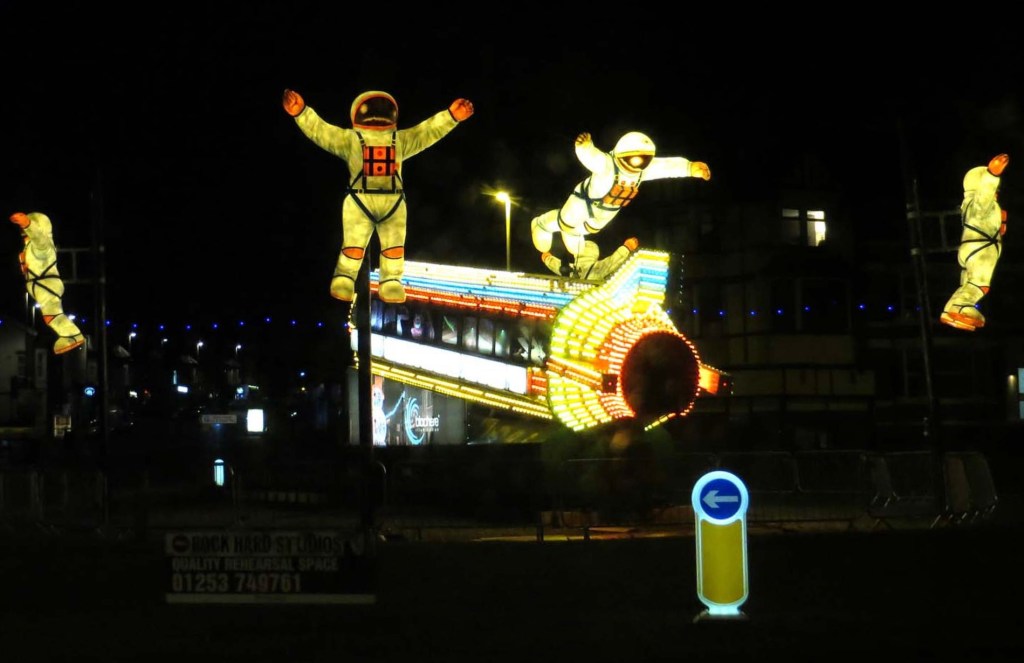
I remember that, as well as being the first to spot the tower, we had a few other games to play too, one being to guess this year’s themes, which are famous for being random and seemingly arbitrary (although I’m sure there’s some reasoning behind the way they are picked).
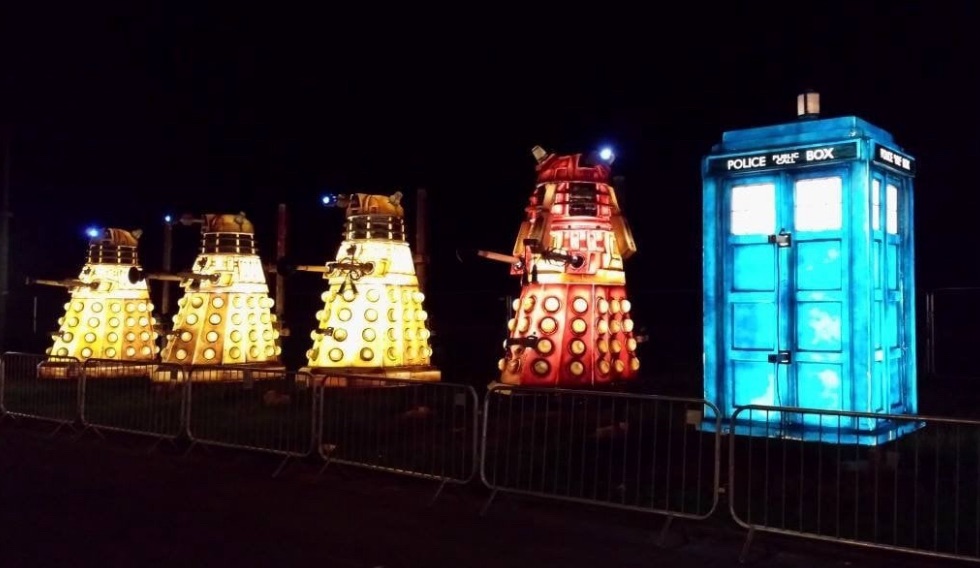
One memorable year it was Doctor Who and Under the Sea so the garish, but expertly crafted, lights suspended from the over-head gantries abruptly changed from threatening, glaring cybermen to smiling, waving mermaids.
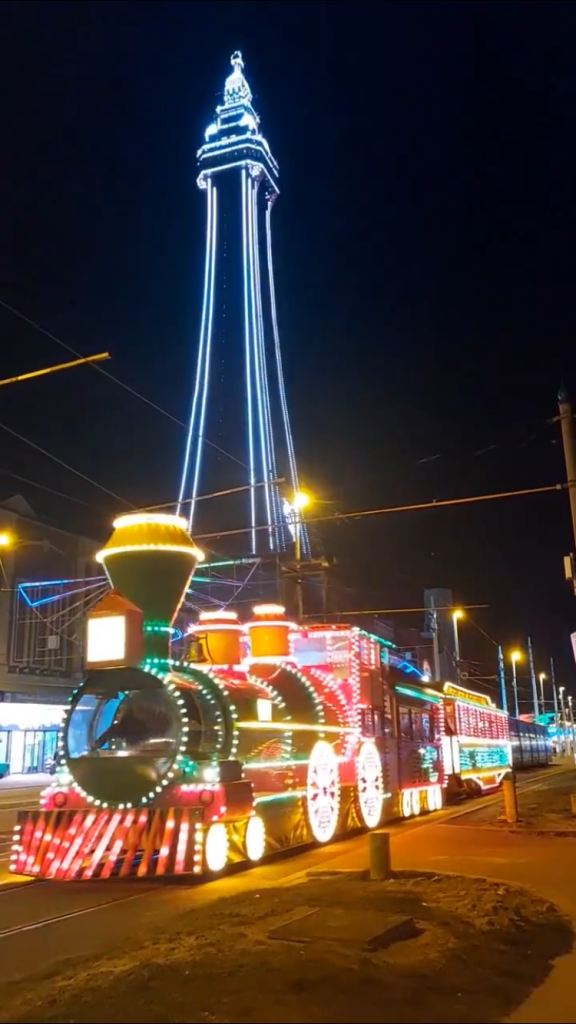
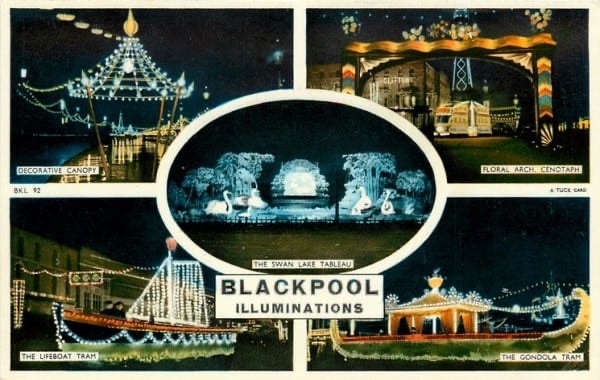
Another was spotting the illuminated trams, the “special trams” as we called them, which are brought out every year to parade up and down the promenade. If you were lucky you might see the one shaped like a boat, the steam-train, or even the rocket-ship!
I’m not ashamed to admit that I still find the Illuminations as exciting now as I did then, and I’m certainly not the only adult to feel this way. However, I am ashamed that I haven’t mentioned them at all in all the time I’ve been writing about the northwest of England. Especially as there are very few things as quintessentially British and as unique to this part of the world, as Blackpool Illuminations.
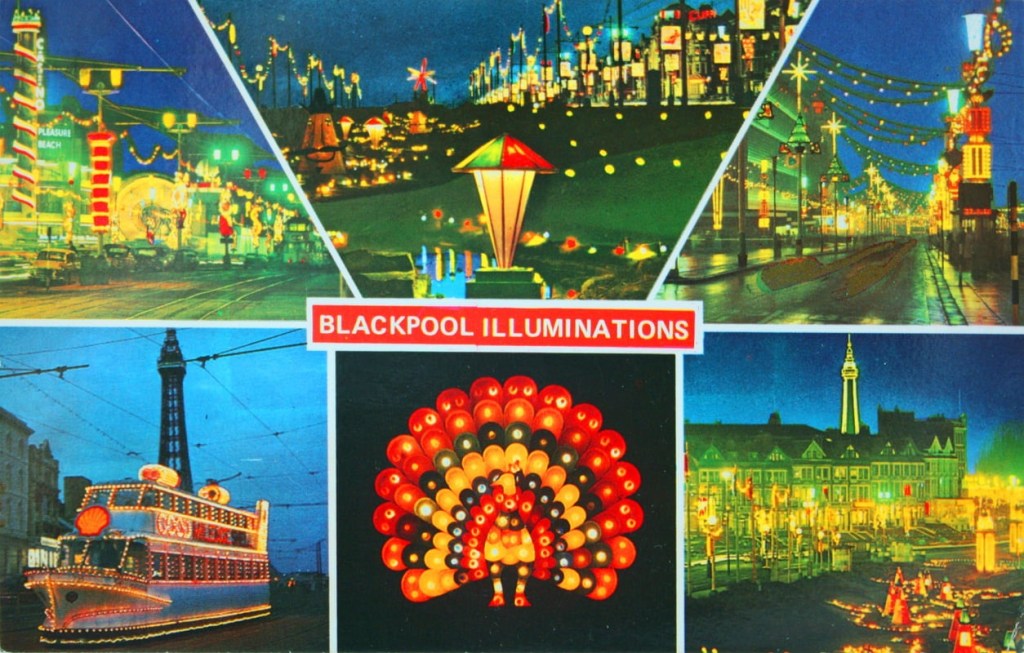
The Greatest Free Light Show on Earth
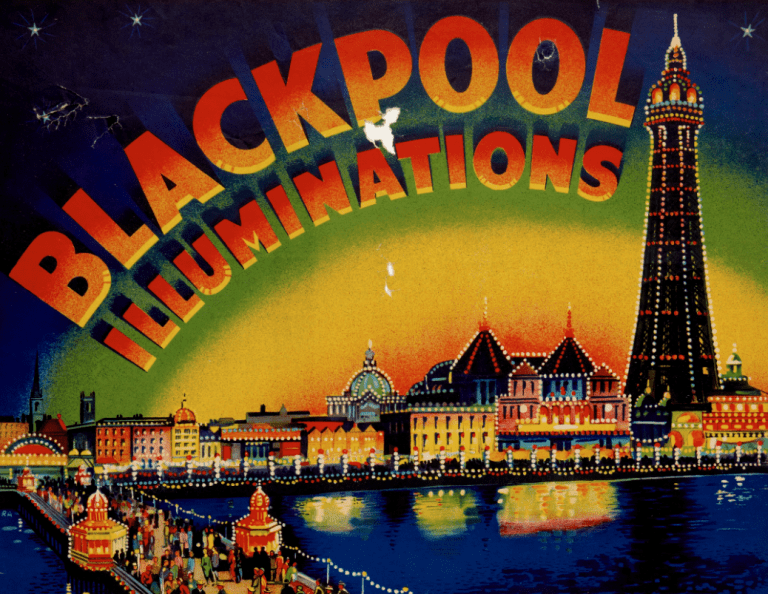
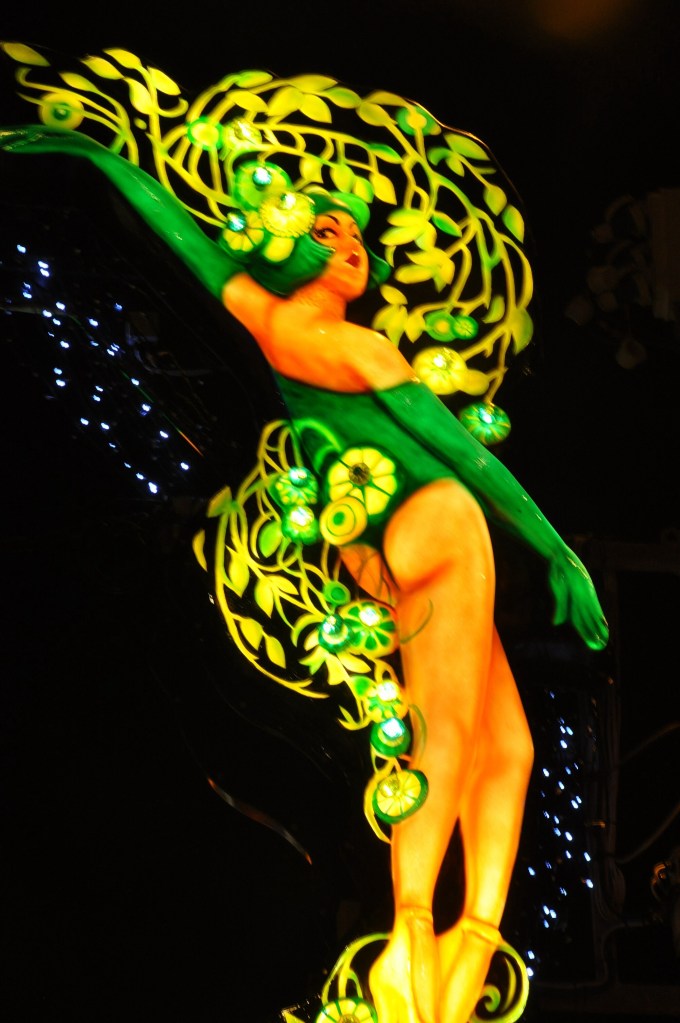
Often dubbed the “greatest free light show on Earth,” Blackpool Illuminations have been dazzling visitors to the Lancashire seaside resort for nearly 150 years. The annual spectacle transforms the town’s promenade into an extravagant display of light, colour, and creativity, drawing millions of tourists each winter.
Their story begins in the 1870’s, a time when electricity was still a novelty, when Blackpool Council allocated £5,000 to trial electric street lighting along the promenade, making the town one of the first in the world to adopt this technology on a public scale.
On September the 18th, 1879, the lights, consisting of just eight carbon arc lamps, were switched on for the first time, bathing the seafront in what was poetically called “artificial sunshine” by the newspapers.
These early illuminations were a sensation, attracting curious visitors from all over the country who marvelled at the glowing display against the dark Lancashire sky.
This initial setup was modest compared to today’s extravaganza, but it marked a turning point for Blackpool. The town, already popular as a Victorian seaside resort thanks to its beaches and piers, cannily used the lights to extend the tourist season into the cooler months.
The success of this experiment laid the foundation for what would become an annual tradition both for the town and for generations of families.
From Streetlights to Artworks
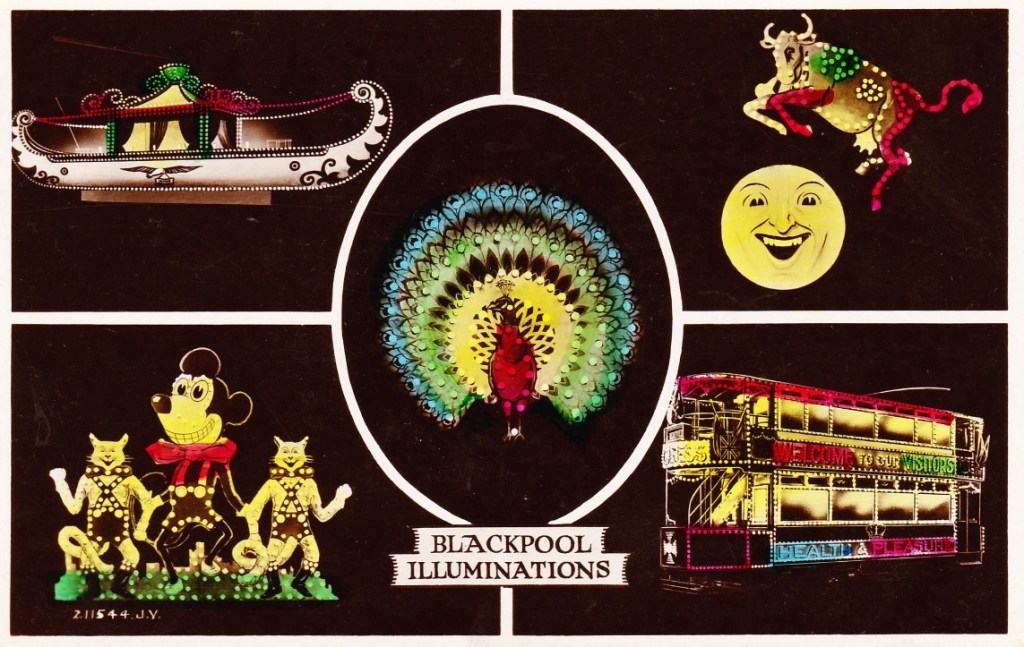
As the 20th century dawned, the Illuminations evolved from simple street lights into elaborate artistic installations. By 1912, the displays had become more sophisticated to coincide with the opening of the new Princess Parade, featuring themed tableaux and animated figures.
The interwar period saw rapid expansion, with the promenade adorned in fairy lights, garlands, and innovative designs that incorporated moving parts and colour.
The 1920s and 1930s were their golden era, as the Illuminations incorporated new technologies like neon and incandescent bulbs, celebrities began participating in the switch-on ceremony, adding glamour to the event, and the “special trams” decorated with lights became a highlight, ferrying passengers through the glowing spectacle.
By the 1930s, the display spanned several miles and attracted over three million visitors annually, giving Blackpool a reputation as the “Las Vegas of the North.”
Wartime Interruptions
The outbreak of World War I in 1914 halted the Illuminations, as resources were diverted to the war effort and blackout regulations made public lighting impossible.
They resumed briefly in the 1920s but were again suspended during World War II from 1939 to 1948 due to similar constraints and post-war austerity.
These interruptions demonstrated to everyone how important the Illuminations are as a symbol of peacetime joy and normalcy, and when they finally returned in 1949, it was a momentous occasion, signalling recovery and renewal for the nation, so widely celebrated.
Post-war Revival
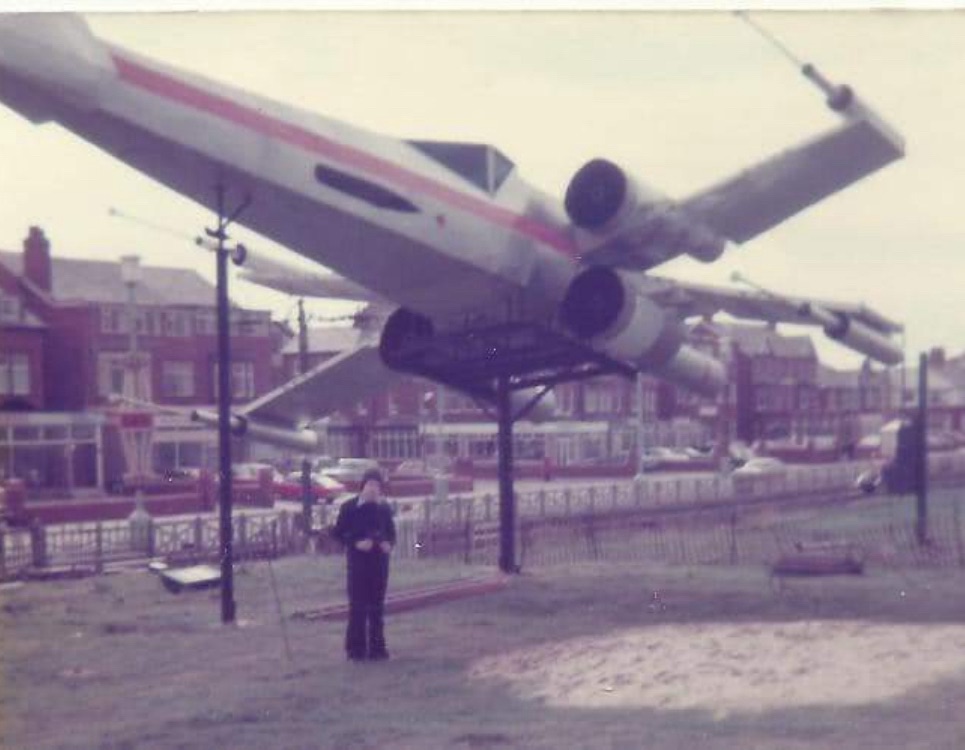
The post-war years brought a resurgence, with the 50s and 60s introducing larger-than-life tableaux inspired by fairy tales, space exploration, and pop culture. More recently innovations like fiber optics and LED technology has allowed for more energy-efficient and dynamic displays.
Today, the Illuminations run from late August to early January, featuring immersive art installations, laser shows, and collaborations with some of the world’s top artists and designers.
The event now costs millions to produce but generates substantial and much-needed revenue for the local area, which is one of the most deprived in Britain, attracting around six million visitors each year.
In an age of digital entertainment, the analog spectacle of the Illuminations reminds us of the ancient and simple magic of casting out the darkness with light, and a beacon of joy that started with a mere eight lamps now illuminates the hearts of millions.
For more information about Blackpool Illuminations please see; Visit Blackpool or Visit Lancashire, it’s well worth going, just make sure to wrap up warm as it can be bitterly cold on the front, give yourself plenty of time to enjoy them (and for the inevitable traffic jams,) and take a camera, if you send any photos here I’ll even add to them to the article so we can make a sort of gallery!
Celebrity Switch On stars from 1934 to 2025:
2025 Olly Murs
2024 Mel B
2023 Sophie Ellis Bexter
2022 Lawrence Llewelyn-Bowen
2021 Shirley Ballas
2020 Corona Heroes
2019 Lucy Fallon
2018 Alfie Boe
2017 Star Trek – Discovery & Diversity
2016 Barbara Windsor
2015 Tim Burton
2014 Peter Kay
2013 Jonathan Ross
2012 Olympic medal winners – Beth Tweddle, Karina Bryant, Luke Campbell, Sophie Hosking, Max Whitlock, Steven Burke & Smooth/Real Radio
2011 Keith Lemon & Smooth/Real Radio
2010 Robbie Williams & Smooth/Real Radio
2009 Alan Carr & Radio Two
2008 BBC Top Gear Team & Radio Two
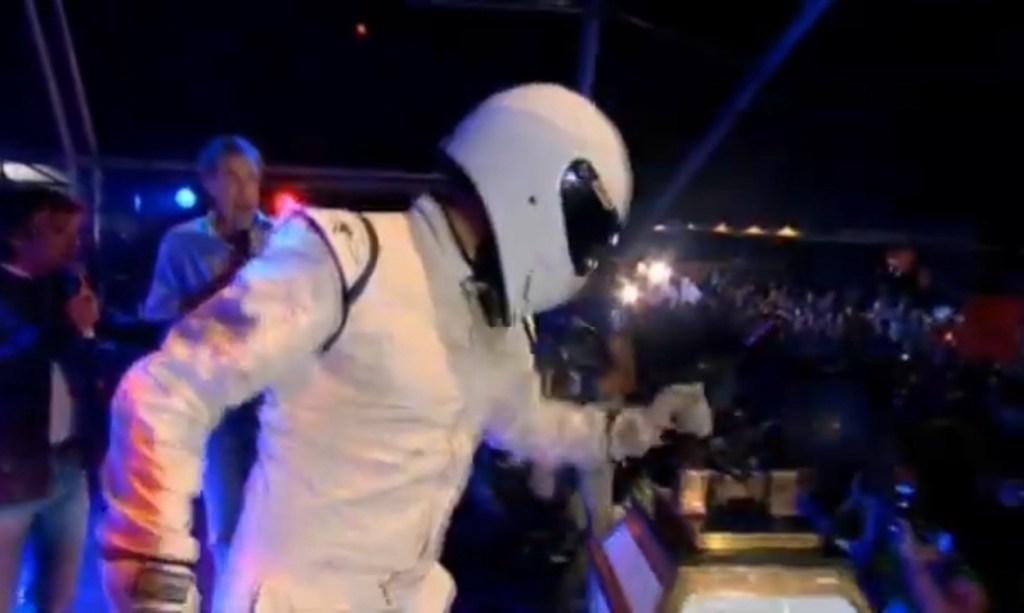
2007 BBC Dr Who – David Tennant & Radio Two
2006 Dale Winton & Radio Two
2005 Chris Evans & Radio Two
2004 Geri Halliwell & Radio Two
2003 Blue & Radio Two
2002 Ronan Keating & Radio Two
2001 Steps & Radio Two
2000 Westlife & Radio Two
1999 Gary Barlow & Radio Two
1998 Chris De Burgh & Radio Two
1997 Michael Ball & Radio Two
1996 Eternal & Radio One
1995 Bee Gees & Radio One
1994 Shirley Bassey
1993 Status Quo & Radio One
1992 Lisa Stansfield
1991 Derek Jameson and Judith Chalmers
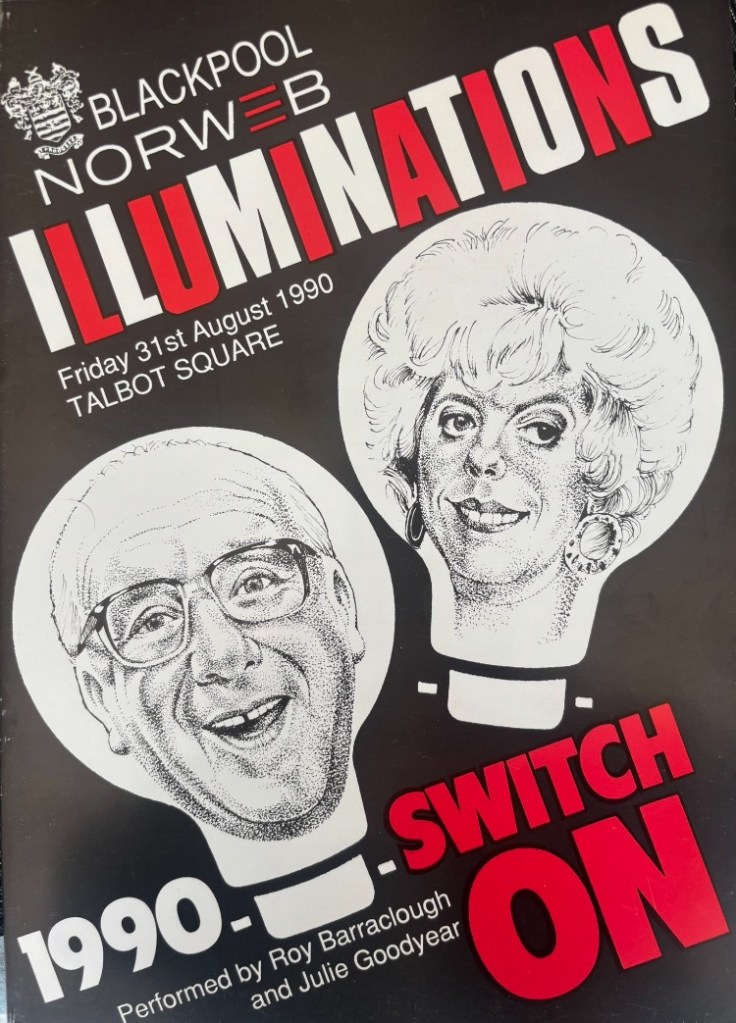
1990 Bet & Alec Gilroy “Coronation Street” (Julie Goodyear & Roy Barraclough)
1989 Frank Bruno
1988 Andrew Lloyd Webber and Sarah Brightman
1987 Frank Bough, Ann Gregg & Kathy Tayler, BBC “Holiday” programme
1986 Les Dawson
1985 Joanna Lumley, BBC “Children in Need”
1984 Johannes Rau (Minister-President, North Rhine Westphalia & David Waddington, QC, MP (Minister of State, Home Office)
1983 Cast of “Coronation Street” (Doris Speed aka Annie Walke)
1982 Rear Admiral “Sandy” Woodward
1981 Earl & Countess Spencer
1980 Cannon and Ball
1979 Kermit the Frog and the Muppets
1978 Terry Wogan
1977 Red Rum
1976 Carol Ann Grant (Miss United Kingdom)
1975 Tom Baker (Dr Who)
1974 Wendy Craig
1973 Gordon Banks
1972 Danny La Rue
1971 Cast of “Dad´s Army”
1970 Tony Blackburn
1969 Canberra Bomber
1968 Sir Matt Busby
1967 Dr. Horace King (Speaker)
1966 Ken Dodd
1965 David Tomlinson
1964 Gracie Fields
1963 Cliff Michelmore
1962 Shirley Ann Field
1961 Violet Carson
1960 Janet Munro
1959 Jayne Mansfield
1958 A E ´Matt´ Matthews
1957 John H Whitney (American Ambassador)
1956 Reginald Dixon
1955 Jacob Malik (Russian Ambassador)
1954 Gilbert Harding
1953 George Formby
1952 Valerie Hobson
1951 Stanley Mathews
1950 Wilfred Pickles
1949 Anna Neagle
1939 Cancelled when war broke out, no display during War years or indeed until 1949
1938 Councillor Mrs Quayle
1937 Alderman Ashton and the Duke of Kent
1936 Sir Josiah Stamp
1935 Audrey Mossom (Railway Queen)
1934 Lord Derby
If you enjoyed this article please consider showing your appreciation by buying me a coffee, every contribution will go towards researching and writing future articles,
Thank-you for visiting,
Alex Burton-Hargreaves
(Nov 2025)
 Northwest Nature and History
What an eclectic selection of stars.
We always had fish and chips to finish off with.
LikeLiked by 1 person
It’s very eclectic, Red Rum for example, and ‘Canberra Bomber’. I don’t know how either of those pressed the switch to turn the lights on!
As a kid I was always upset that my parents refused to spend a single penny, no chips or rock or anything, especially not those cheap light-up toys that the vendors on the road sell. Years later I had a flat down at Thornton-Cleveleys and my neighbour, Rob Grout, had a side-gig selling those when the Illuminations were on. He got boxes of these cheap chinese toys delivered to a lock-up, he’d go and stock up after work or on weekends and then drive straight down and hawk them, he made a fortune which he spent on collectible model cars, he told me that the waiting list for a vendor’s licence was huge.
My parents had a love-hate relationship with Blackpool, my mum like it because it was where she went on day trips from Clayton and Padiham, my dad was fond of it but didn’t like what had been done to it and because he’d grown up there. His parents had a big house in nearby Poulton-le-fylde, called Thornhill, that had originally been built on the proceeds of the Doric hotel, once one of Blackpool’s biggest, that’s still there but a lot smaller now, the hotel was built on the proceeds of my great grandads architectural designs for railway tunnels and bridges, both my grandparents ended up running it when they were younger.
The food waste from that hotel and others went in trucks to a farm at Great Eccleston that my uncle Peter Duerden grew up on, it’s where the tractor pulling competitions are held now, They had sheds full of pigs and the food waste was boiled up in a giant vat and fed to them, then the bacon and sausages went back to the hotels for their breakfasts, it’s the kind of sealed food supply loop that’s very frowned upon by the authorities now!
My uncle told me a story about a terrier they kept for controlling the rats in there, one day it fell in the vat and nearly got boiled to death, they got it out but it never had a single hair again!
Peter’s parents sold the farm for a tidy sum and emigrated to Australia where they bought a plot of land in Botany Bay at Sydney and built a house, now he’s an interesting man, he built a career out of mining exploration in the outback, gold, uranium etc, then he was Australia’s nuclear councillor for the IAEA, essentially he wouldn’t have got where he is without the tourism trade.
So thinking about it I’ve got a lot of connections to Blackpool, I should write about the town a bit more!
LikeLiked by 1 person
Excellent.
LikeLiked by 1 person