The Weakening of Environmental Protections Under the Labour Government and its Implications for our Countryside and its Biodiversity
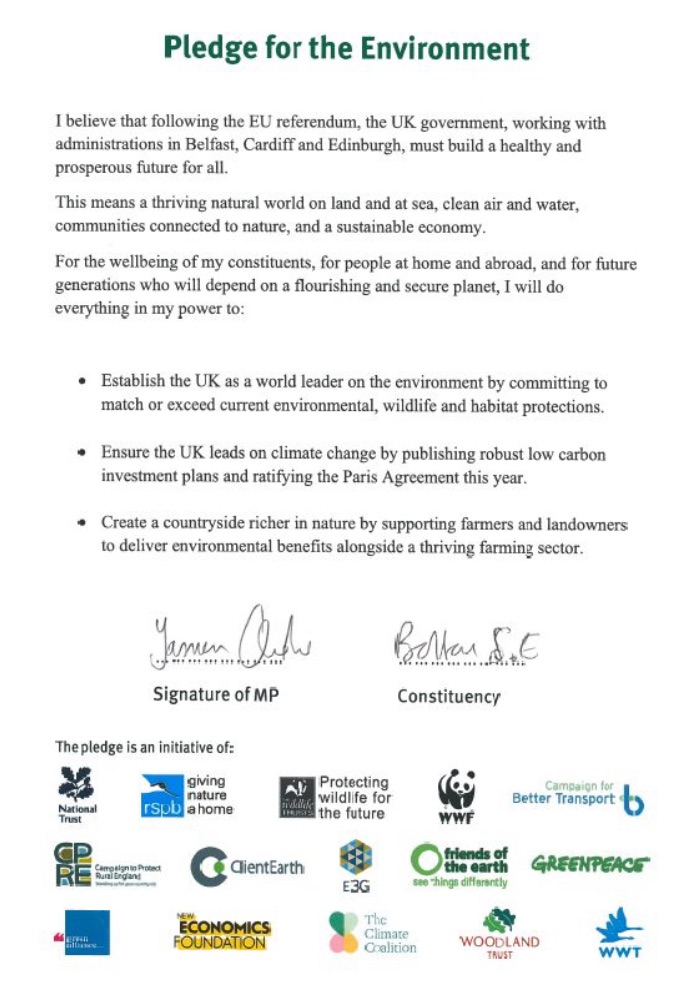
pledge / pledʒ / noun
1. a solemn promise or undertaking.
2. a thing that is given as security for the fulfilment of a contract or the payment of a debt and is liable to forfeiture in the event of failure.
(Oxford Dictionary of English)
In July 2024, the Labour Party, led by Prime Minister Keir Starmer, assumed power with ambitious pledges to restore nature, combat climate change, and position the UK as a global leader in environmental stewardship.
However, by November 2025, several policy decisions, particularly in planning and infrastructure, have drawn sharp criticism for diluting longstanding environmental protections, and it has become apparent that Labour have reneged on these pledges (ref.1).
Environmental watchdogs and advocacy groups argue that these changes prioritise economic growth and housing targets over ecological integrity, potentially accelerating biodiversity loss in what has often been called one of the world’s most nature-depleted nations (2).

The Planning and Infrastructure Bill: A Regression in Protections
Introduced in March 2025, the Planning and Infrastructure Bill aims to streamline development processes to meet Labour’s target of 1.5 million new homes and bolster infrastructure (3). However, the legislation has been lambasted for reducing safeguards that were previously embedded in environmental law.
Central to the controversy are the new Environmental Delivery Plans (EDPs) and the Nature Restoration Levy, which allows developers to pay into a fund for broader nature restoration projects rather than implementing site-specific mitigation measures (3).
The Office for Environmental Protection (OEP), the UK’s post-Brexit environmental watchdog, has warned that the Bill provides “fewer protections for nature written than under existing law.” In a letter to Deputy Prime Minister Angela Rayner, the OEP stated: “Creating new flexibility without sufficient legal safeguards could see environmental outcomes lessened over time. And aiming to improve environmental outcomes overall, whilst laudable, is not the same as maintaining in law high levels of protection for specific habitats and species.”
This shift introduces an “overall improvement test” that critics say injects “considerably more subjectivity and uncertainty in decision-making than under existing environmental law,” potentially allowing negative impacts to be outweighed by distant conservation efforts.
Amendments during the Bill’s Committee Stage in 2025 strengthened some aspects, such as prioritising onsite mitigation where more effective, but the OEP still described the changes as a “regression” in April 2025 (2). The Wildlife Trusts’ head of land use planning, Becky Pullinger, echoed these concerns: “It is ever clearer that nature will lose out from the Planning and Infrastructure Bill. As currently drafted, the Bill stands to rip up the very foundations of our wildlife protection laws. The UK Government can no longer ignore the calls to make changes to the Bill and must work quickly to install the necessary safeguards to ensure nature is protected.” (3)
Data from the OEP’s July 2025 review highlights the risks: Proposals to exempt minor developments from biodiversity net gain (BNG) requirements, mandating a 10% net improvement in biodiversity post-development, could “significantly narrow the scope” and lead to habitat loss, affecting the emerging biodiversity unit market.
This is particularly alarming given that over 2,500 hectares of habitat have been created or enhanced under BNG as of May 2025, but smaller sites are already proving less effective without robust enforcement (2).

Diluting Safeguards in National Parks and Protected Landscapes
In a move that has sparked outrage among conservationists, the government is considering weakening protections for England’s national parks and national landscapes (formerly Areas of Outstanding Natural Beauty) through amendments to the Levelling-up and Regeneration Act 2023. The proposal would remove the duty on public bodies to “seek to further” the conservation and enhancement of natural beauty, wildlife, and cultural heritage in these areas, making it easier to approve developments like roads and housing (4).
Over 170 organizations, including the RSPB, Wildlife Trusts, and National Trust, signed an open letter to Starmer in October 2025, warning of “disastrous consequences” for nature. The letter stated: “Skewing this balance will have devastating consequences, and future generations will inherit the mess. Clement Attlee’s postwar government understood this: it is why they created national parks and national landscapes … protecting landscapes alongside rapid housebuilding.”
Rose O’Neill, chief executive of the Campaign for National Parks, added: “Keir Starmer has talked so much about his love of national parks, and the Lake District, so we are appealing to him to stop this. We don’t think removing this duty will do anything to boost growth; in fact, it will slow down development.”
These parks, visited by 245 million people annually and generating £36 billion for the economy, are critical havens for biodiversity. Weakening protections could lead to irreversible damage, exacerbating the UK’s status as one of Europe’s worst for green space loss to development (4).For instance, relaxed post-Brexit rules have already left huge tracts of riverside habitats unprotected, threatening species like Water Voles.

(Charlie Marshall)
Broader Policy Shortcomings and Their Environmental Toll
Labour’s first year has shown “glimmers of hope,” such as banning bee-harming pesticides and reforming the water sector, but concerns persist over an “obsession with growth above nature protection.” Little progress has been made on laws to curb UK companies’ role in global deforestation or ratifying a UN treaty to protect 30% of oceans by 2030. Support for airport expansion and nuclear power without adequate decarbonisation funding further strains environmental commitments (1).
The OEP’s January 2025 report on the Environmental Improvement Plan (EIP) highlighted insufficient progress up to March 2024, prompting the government to promise revisions (5). Delays in Local Nature Recovery Strategies (only four published by May 2025) hinder the goal of restoring 500,000 hectares of wildlife-rich habitat by 2042 (2).
Damages to Biodiversity and Species: Data and Projections
The UK is experiencing biodiversity decline “faster than at any time in human history.” According to the 2023 State of Nature report, 13% of 8,840 assessed species in England are threatened with extinction, with the abundance of 682 terrestrial and freshwater species falling by 32% since 1970 (2). In Great Britain, 1,500 species are at risk of complete loss, including farmland birds like the Grey partridge and Skylark, whose numbers have plummeted. Invertebrate distributions have decreased by 18% since 1970, with pollinators down 22% and pest-control species by 40%.
Policy changes exacerbate these trends. The Nature Restoration Levy lacks “scientific evidence” for effectiveness on less mobile species like Bats and Great crested newts, which featured in just 3% of planning appeals but require specific protections. Without rigorous safeguards, habitat depletion in developed areas could push more species toward extinction, as offsets in distant locations fail to compensate. Broader impacts include a projected 12% loss to UK GDP from nature degradation (7), emphasising the economic folly of environmental shortcuts.
The Joint Nature Conservation Committee (JNCC) 2024 indicators reveal 36% of measures deteriorating long-term, with only 40% improving (8) (9). If unchecked, these policies could undermine the government’s 2030 target to halt species abundance decline, leaving future generations with an impoverished natural heritage.

Conclusion
The weakening of environmental protections through planning reforms risks irreversible damage to our ecosystems and species. As 32 environmental organisations urged in an April 2025 open letter (2), amendments are essential to align growth with nature recovery. Without swift action, the government’s legacy will be one of accelerated extinction rather than restoration.
References and Sources
1. Labour’s nature policy false start (The Ecologist)
2. Impact of government policies on biodiversity and the countryside (House of Lords Library)
3. Planning & Infrastructure Bill ‘weakens environmental protections’, watchdog warns (edie)
6. No let-up – the devastating decline of our wildlife continues (RSPB)
7. Nature degradation could cause a 12% loss to UK GDP (University of Oxford)
8. Five reasons for UK Government to restore nature in 2025 (The Wildlife Trusts)
9. Planning Bill breaks Labour’s nature promises (The Wildlife Trusts and RSPB)

Going, Going, by Phillip Larkin
I thought it would last my time –
the sense that, beyond the town,
there would always be fields and farms,
where the village louts could climb
such trees as were not cut down;
I knew there’d be false alarms
In the papers about old streets
and split level shopping, but some
have always been left so far;
and when the old part retreats
as the bleak high-risers come
we can always escape in the car.
Things are tougher than we are, just
as earth will always respond
however we mess it about;
chuck filth in the sea, if you must:
the tides will be clean beyond.
– But what do I feel now? Doubt?
Or age, simply? The crowd
is young in the M1 cafe;
their kids are screaming for more –
more houses, more parking allowed,
more caravan sites, more pay.
On the Business Page, a score
of spectacled grins approve
some takeover bid that entails
five per cent profit (and ten
per cent more in the estuaries): move
your works to the unspoilt dales
(grey area grants)! And when
you try to get near the sea
in summer . . .
It seems, just now,
to be happening so very fast;
despite all the land left free
for the first time I feel somehow
that it isn’t going to last,
that before I snuff it, the whole
boiling will be bricked in
except for the tourist parts –
first slum of Europe: a role
it won’t be hard to win,
with a cast of crooks and tarts.
And that will be England gone,
the shadows, the meadows, the lanes,
the guildhalls, the carved choirs.
There’ll be books; it will linger on
in galleries; but all that remains
for us will be concrete and tyres.
Most things are never meant.
This won’t be, most likely; but greeds
and garbage are too thick-strewn
to be swept up now, or invent
excuses that make them all needs.
I just think it will happen, soon.
Written by Phillip Larkin in 1972
If you enjoyed this article please consider showing your appreciation by buying me a coffee, every contribution will go towards researching and writing future articles,
Thank-you for visiting,
Alex Burton-Hargreaves
(Nov 2025)
 Northwest Nature and History
One thought on “Broken Pledges”