
IN the dark-clouded sky no star shews a gleam; the drift-laden gale whistles wild in the tree;
The ice-mantle creeps o’er the murmuring stream, that glittering runs through the snow-covered lea;
But, hark! the old bells fling the news to the wind!— Good Christians awake to their genial call;
The gale may blow on, we’ll be merry and kind; blithe yule, and a happy new year to us all!
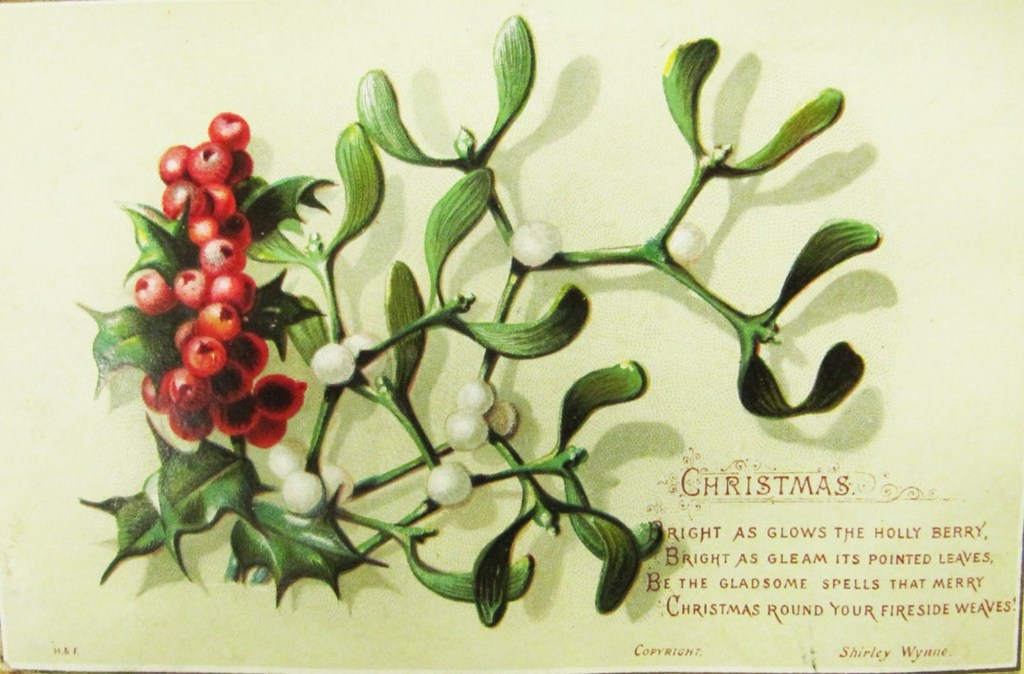
Bring in the green holly, the box, and the yew, the fir, and the laurel, all sparkling with rime;
Hang up to the ceiling the mistletoe-bough, and let us be jolly another yule-time!
II.
While, garnished with plenty, together we meet in carolling joy, as the glad moments flee,
Thus sheltered away from the frost and the sleet, with friends all around us, in festival glee,
We’ll still keep the heavenly lesson in mind, – the gentle Redeemer was born at this tide ;
The wind may blow keenly, but we will be kind, and think of the poor folk that shiver outside.
Bring in the green holly, the box, and the yew, the fir, and the laurel, all sparkling with rime;
Hang up to the ceiling the mistletoe-bough, and let us be jolly another yule-time
III.
He’s a cur who can bask in the fire’s cheery light, And hearken, unheeded, the winter wind blow,
And care not a straw for the comfortless wight, who wanders about in the frost and the snow;
But we’ll think of the mournful the while we are glad;
Our hearts shall be kind as the winter is keen;
And we’ll share our good cheer with the poor and the sad, who sorrow and struggle in corners unseen.
Bring in the green holly, the box, and the yew, the fir, and the laurel, all sparkling with rime;
Hang up to the ceiling the mistletoe-bough, and let us be jolly another yule-time !
Lancashire’s Burns
The Victorian Poet Edwin Waugh, known as “Lancashire’s Burns,” was born 1817 in Rochdale, Lancashire, to a shoemaker’s family.
After his father’s death at the age of nine, Waugh faced poverty but was taught to read by his devout Methodist mother. Apprenticed to a printer when twelve, he developed a love for literature, particularly Lancashire’s history and poetry, influenced by Robert Burns and John Collier.
Waugh gained fame for his Lancashire dialect poems, notably “Come Whoam to Thi Childer an’ Me” (1856), and prose works like Sketches of Lancashire Life (1855). By 1860 he had become a full-time writer, known for vivid depictions of working-class life. Despite personal struggles, including a turbulent marriage, Waugh was celebrated for his humor, pathos, and dialect recitations.
He died in New Brighton, Cheshire, in 1890 and is commemorated with Waugh’s Well on Scout Moor above his hometown of Rochdale.

(Michael Ely)
If you enjoyed this you can show your appreciation by buying me a coffee, every contribution will go towards researching and writing future articles,
Thank-you for visiting,
Alex Burton-Hargreaves
(Dec 2025)
 Northwest Nature and History