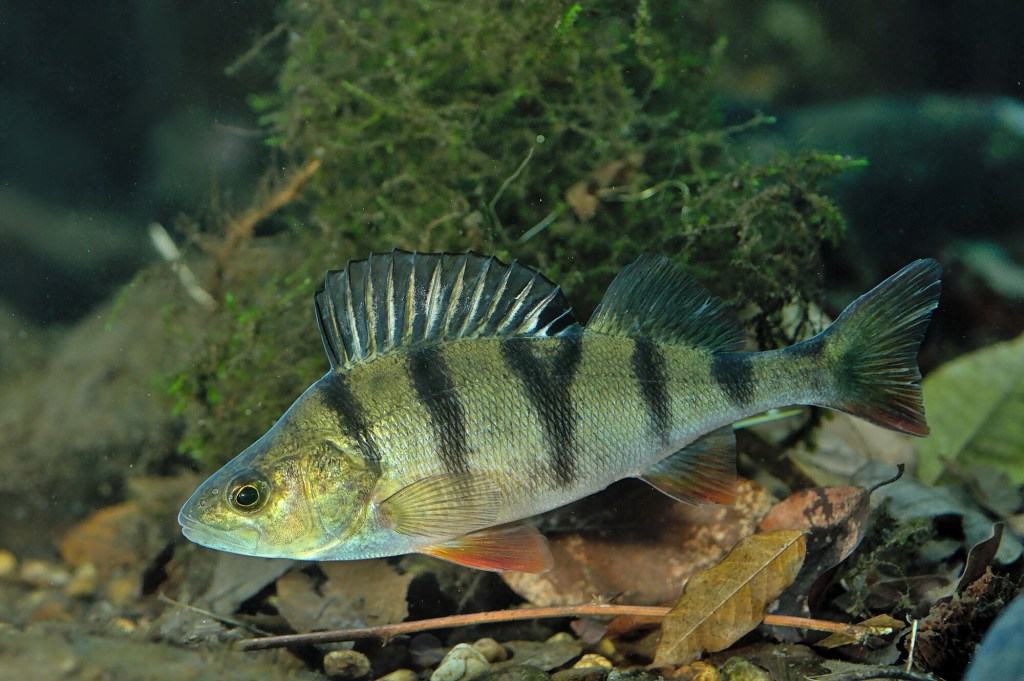
The European perch, Perca fluviatilis, is a highly adaptable predatory freshwater fish native to the British isles. It is found in a wide variety of habitats from ponds and lakes to brooks and rivers but has found a particularly thriving niche in our man-made canals.
Here these striped swimmers not only delight anglers but also play a key role in maintaining the aquatic balance as efficient and opportunistic predators, lurking in the still waters amid submerged structures and vegetation to ambush passing prey.
(Mark Whittaker)
Perca fluviatilis
The Perch’s scientific name; Perca fluviatilis, assigned by Carl Linnaeus in 1758 (but in use before his time) describes the species succinctly, with the genus name ‘Perca’ originating from the ancient Greek name for this fish Πέρκη ‘perke,’ and the epithet fluviatilis coming from the Latin fluvius, meaning ‘river,’ combined with the suffix atilis indicating ‘belonging to’ or ‘of the’.
While this name is apt canals did exist in Linnaeus’ time so he could equally have chosen canalis, as these manmade waterways offer ideal conditions for Perch: sheltered, calm waters with no strong currents and ample cover from locks, bridges, and overgrown banks providing them with spots to lurk and strike at smaller fish, insects, and crustaceans.
They prefer stretches with depths of 1 to 3 meters, schooling in groups during younger stages for protection before becoming more solitary and independent as adults. Water quality plays a crucial role too; Perch tolerate a range of conditions but flourish best in slightly alkaline, well-oxygenated waters.
Climate change may have influenced the distribution and demographics of Perch in our canal system as evidenced by a 70+ year study of the Perch population in Windermere summarised below.

Biology and Behaviour
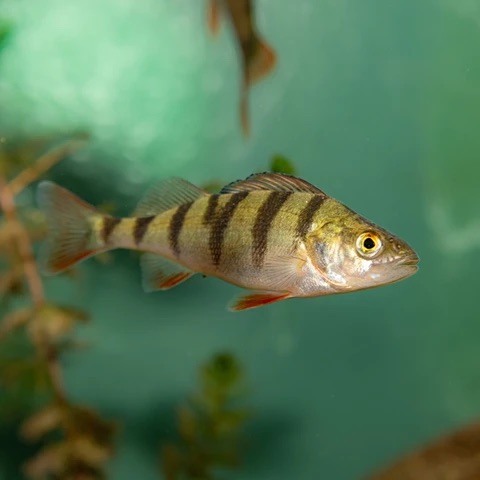
Physically, European perch are unmistakable with their greenish bodies, bold black vertical stripes (usually 6 to 9), and reddish-orange fins, hence another common name ‘Redfin Perch’.
Adults typically grow 25 to 35cm long, though specimens over 50 cm and weighing up to 3 kg have been recorded where conditions have been perfect.
As predators, they employ ambush tactics, using their spiny dorsal fins for defense while darting out to capture fry, minnows, or even Crayfish.
Reproduction occurs in spring, with females laying sticky egg ribbons on submerged vegetation or structures in shallow margins.
The juveniles feed on zooplankton before transitioning to a carnivorous diet. In canals, perch often form the top of the food chain in smaller systems, controlling populations of smaller species and contributing to biodiversity.

The Windermere Perch Study
Every year since the 1940s ichthyologists (scientists who study fish) have closely studied perch in Cumbria’s Lake Windermere, and what they have discovered has proven invaluable for the wider world of ecology:
Warmer weather affects reproduction
As the lake’s water has warmed over the decades, perch now spawn about 2 weeks earlier in spring. The microscopic plankton that young Perch eat also appear earlier, but they shift even faster than the perch.
For perch fry to survive and grow into fingerlings (literally finger-sized,) their hatching needs to line up nicely with the plankton bloom, if they hatch too early or too late, there’s less food and fewer fry survive.
The 1976 Disease Outbreak
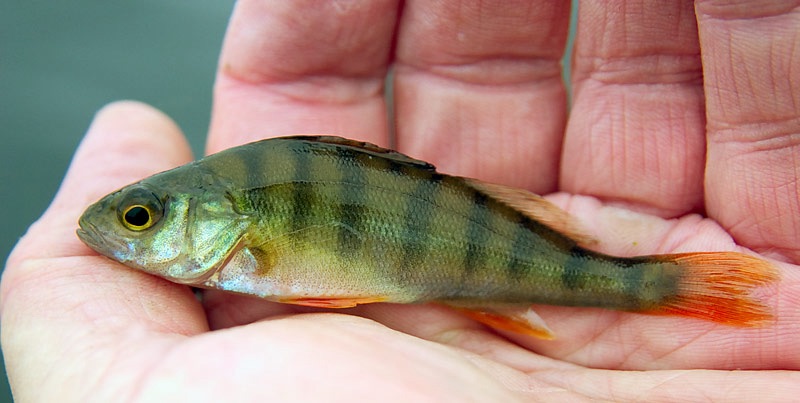
In 1976 Windermere’s perch population experienced a major outbreak of a still-unknown perch-specific disease that caused a severe population collapse, killing an estimated 98% of adults. After this outbreak, the population recovered but consisted mainly of younger, smaller fish.
This posed problems as when there are lots of big, old perch around, they help keep the population steady, partly by cannibalising the fry and reducing overcrowding. Without those older fish, the population swings up and down much more dramatically depending on whether the timing of hatching and plankton bloom coincides.
Warming makes things worse
Because warmer waters shift these timings and creating more mismatches between the perch hatch and plankton bloom, a population with mostly young fish is much more likely to boom one year and crash the next. This makes it harder for perch numbers to stay stable, and increases the risk of large population collapses.
In short; warmer waters, whether they be in lake, river or canal, mess with the spring ‘calendar’ for fish and their food. Losing older specimens (from disease or overfishing) removes a natural buffer, so overall the population becomes more vulnerable.

Fishing for Perch in Canals
Canals are prime spots for perch fishing, attracting enthusiasts with simple tackle like float rods, worms, or small lures.
Techniques such as drop-shotting or jigging near features like moored narrow-boats yield good results, especially in autumn when perch feed aggressively to build reserves for winter. They’re prized for their fighting spirit on light lines and make for tasty table fare, though catch-and-release is encouraged in managed waters to sustain populations.
In competitive angling, canal perch have starred in matches and records demonstrate their potential size in these environments. However, anglers should be mindful of local bye-laws and regulations.

CHAP. XII. Observations of the Pearch, and directions how to fish for him, from The Compleat Angler by Isaak Walton, first published in 1653
Pisc. The Pearch is a very good, and a very bold biting Fish: he is one of the fishes of prey, that like the Pike and Trout, carries his teeth in his mouth, which is very large, and he dare venture to kill and devour several other fishes of a greater bigness then himself: he hath a hooked or hog-back, which is armed with sharp and stiff bristles, and all his skin armed, or covered over with thick dry scales: and hath two fins on his back; he is a great devourer of the spawn of other fishes, and is very good meat.
He spawns but once a year, and that in April: he is a delicate fish, and in season from May to the end of August; but is not so good in the winter, for then he is abstemious, and feeds little.
And as he is a bold biter, so he is very gamesome when he is upon the hook, and will often leap out of the water, and make a great bustle before he be taken.
Directions how to fish for him.
The best way to angle for a Pearch is with a minnow, or a small frog; the minnow is the better bait, and the Pearch will bite at it very freely: you must hook your minnow through both his lips, or through the back fin, and let him swim up and down in the middle of the water, with a cork to keep him from sinking too low.
Or with a good brandling worm, or a red worm, scoured in moss or fennel; and fish with a float, and give him time to pouch it, for he bites slowly.
Note that the Pearch travels in troops, and is bold and fearless; often, when one is caught, others will continue biting nearby.

If you enjoyed this you can show your appreciation by buying me a coffee, every contribution will go towards researching and writing future articles,
Thank-you for visiting,
Alex Burton-Hargreaves
(Jan 2026)
 Northwest Nature and History