Appearance, Behaviour, Habitat and Recent Sightings of the Long-eared Owl Asio otus in the Northwest of England
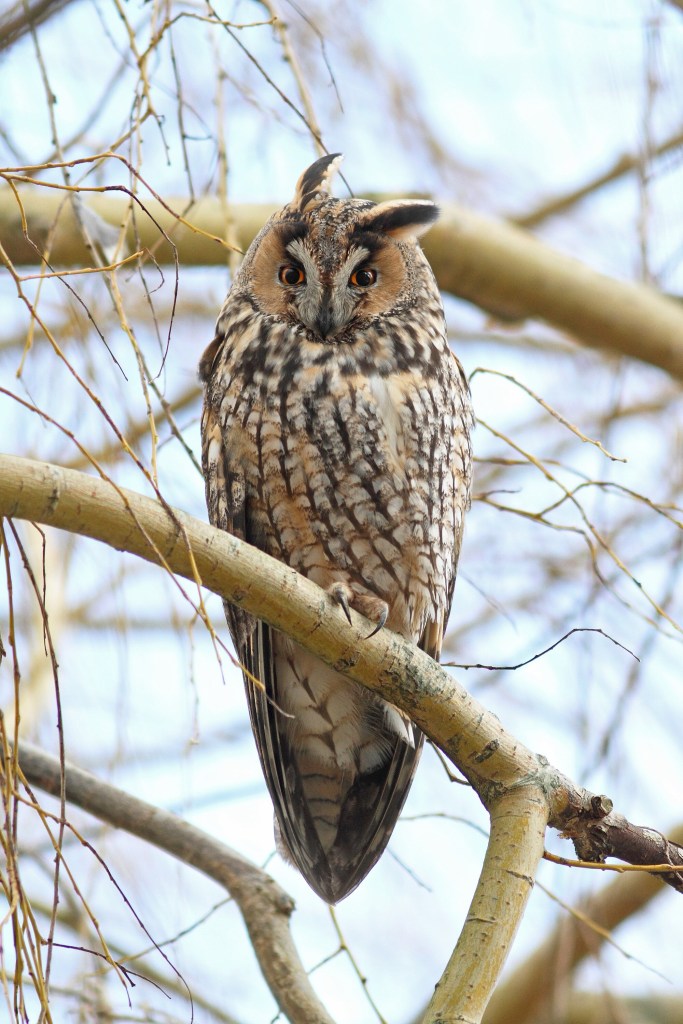
Asiō was used by Pliny the Younger in his Natural History to describe a species of owl with feather tufts on its head, and otus derives from the Greek otos (ὦτος) which simply means ‘ear’
(Image by Bouke Ten Cate)
Long-eared owls, Asio otus, are one of our most secretive and elusive birds of prey. With their distinctive ‘ear’ tufts (which are actually feather extensions for camouflage and expression), striking orange eyes, and mottled brown plumage, these medium-sized owls are unmistakable, yet they are rarely seen, as they blend so well into the landscape and prefer to secrete themselves in dense foliage during the day.
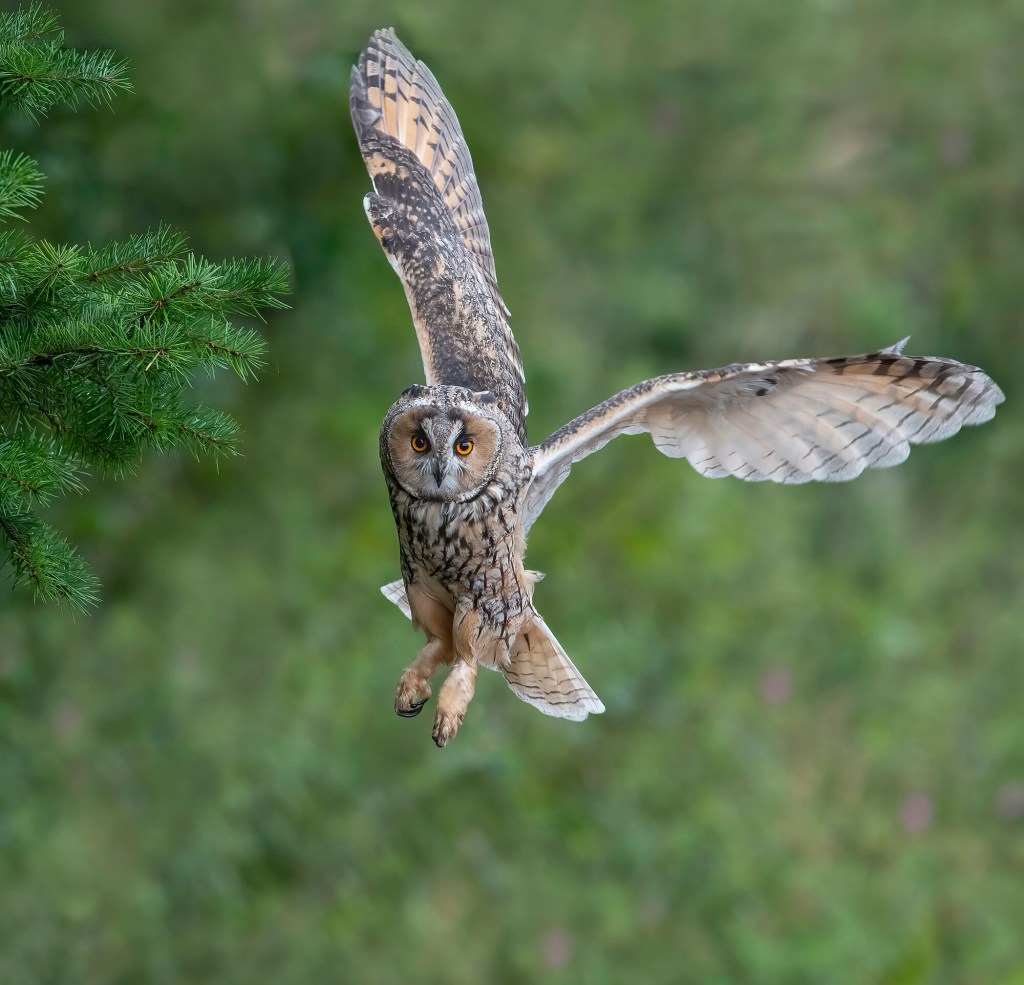
(Caroline Legg)
Appearance and Behaviour
Measuring about 35 to 37cm in length with a wingspan of around 95cm they are fairly large but still manage to remain unseen by the casual human observer. Their plumage provides excellent camouflage against tree bark, and they perch upright, still as a tree-branch with their ear tufts raised, when disturbed by intruders into their sylvanian realm.
They are chiefly nocturnal, emerging at dusk to hunt, and their flight is buoyant and silent, allowing them to glide over open ground in search of prey. In many instances they have been confused with the Short-eared Owl or Hen Harrier, which also fly in a low, deliberate manner over similar vole-ridden terrain, although the latter bird will be heading home to roost at this time of day.
Their diet consists mainly of small mammals, especially voles and mice, supplemented occasionally by small birds or insects and, like others of their kind, they specialise in hunting by ear, gliding low, slow and silently over the ground, listening for the slightest sound to swoop upon.
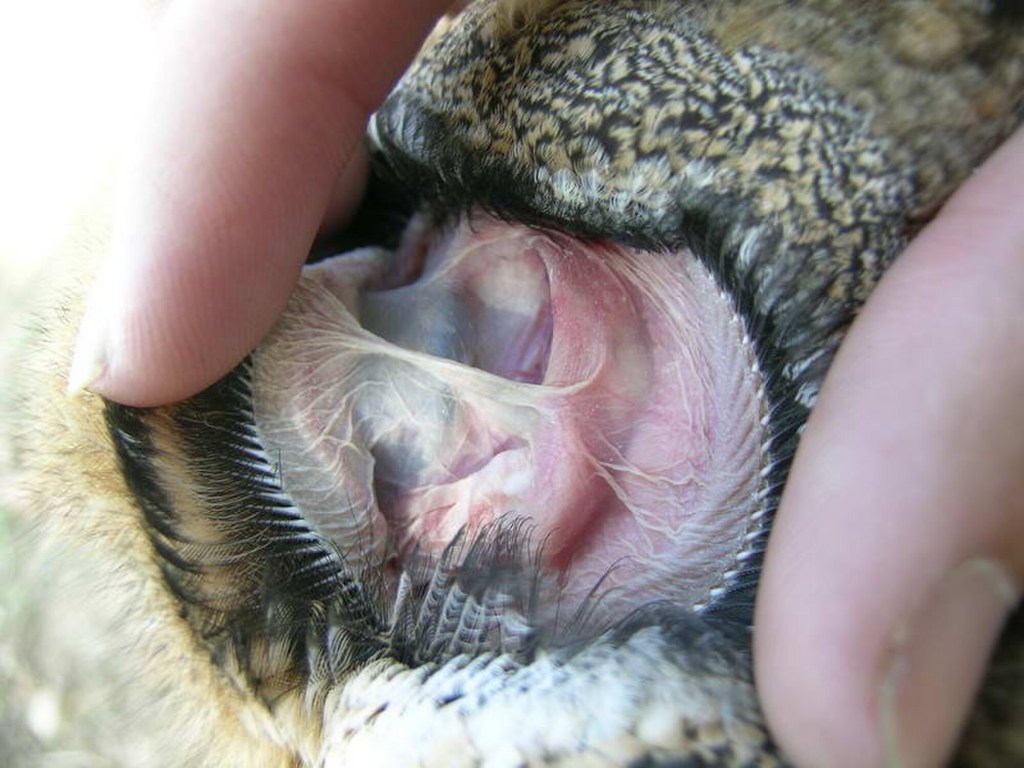
(Lee Kirk)
Nesting and Roosting
During the breeding season (typically February to July), males perform aerial displays, occasionally clapping their wings and emitting a low, repetitive “hoo-oo” call that echoes through woodlands. Females lay 3 to 5 eggs in old nests built by other birds, such as crows or magpies, rather than constructing their own.
The incubation period is typically 25 to 30 days with the female doing all the incubating, starting with the first egg, while the male provides food. Eggs are usually laid asynchronously (resulting in chicks of different sizes) between March and May.
This staggered laying means that in years where prey is hard to come by the bigger chicks are able to push the younger out of the nest, thus ensuring survival of at least one of the brood.
One of the most fascinating behaviours is their tendency to form communal winter roosts, where dozens of birds may gather in dense conifers or thickets to conserve energy during cold weather.
These roosts offer one of the best chances to observe the species, as the owls may be visible during daylight hours if approached quietly.
Habitat
Long-eared owls favour a mix of dense cover for roosting and nesting, typically coniferous plantations, mixed woodlands, tall hedgerows, or scrub adjacent to open rough grassland, pastures, or moorland for hunting.
The northwest is abundant in these habitat types and holds a modest but stable population which is closely observed by birdwatchers and ornithological organisations.
Recent Sightings and Winter Activity (2025 / 26 Season)
The winter of 2025 / 26 has been reasonably typical for Long-eared Owls (abbreviated as LEO by observers) in the region, with no major irruption or unusual influx reported, but scattered records continue to pop up, especially in suitable woodland and scrub habitats. Publicly shared sightings remain limited (as birders protect roost sites), but here’s what’s emerging:
Lancashire
Lancashire consistently produces the most reliable LEO reports in the northwest. There have been mentions of LEO in east Lancashire’s woodlands during 2025, with some photographers and observers noting individuals or small groups in familiar spots. Winter roosts (often 3 to 10 birds) are still being quietly monitored in dense plantations and coastal scrub areas. No huge counts have been reported this January, but the species is present and active at dusk /dawn.
Cumbria
Fewer public updates, but the mix of young coniferous plantations and moorland edges in the south and east remains promising. Short-eared Owls get more attention on open ground, but Long-eareds are tucked away in wooded cover.
Cheshire and Merseyside
Records are patchier, with occasional singles or pairs noted along the Mersey Valley or in scrubby derelict land.
North Yorkshire
North Yorkshire doesn’t seem to have the LEO hotspots that Lancashire does but there have been scattered sightings of single birds passing through, no irruptions or large roosts have been reported publicly, this doesn’t mean they’re absent though, many records stay off the public radar or go into private logs.
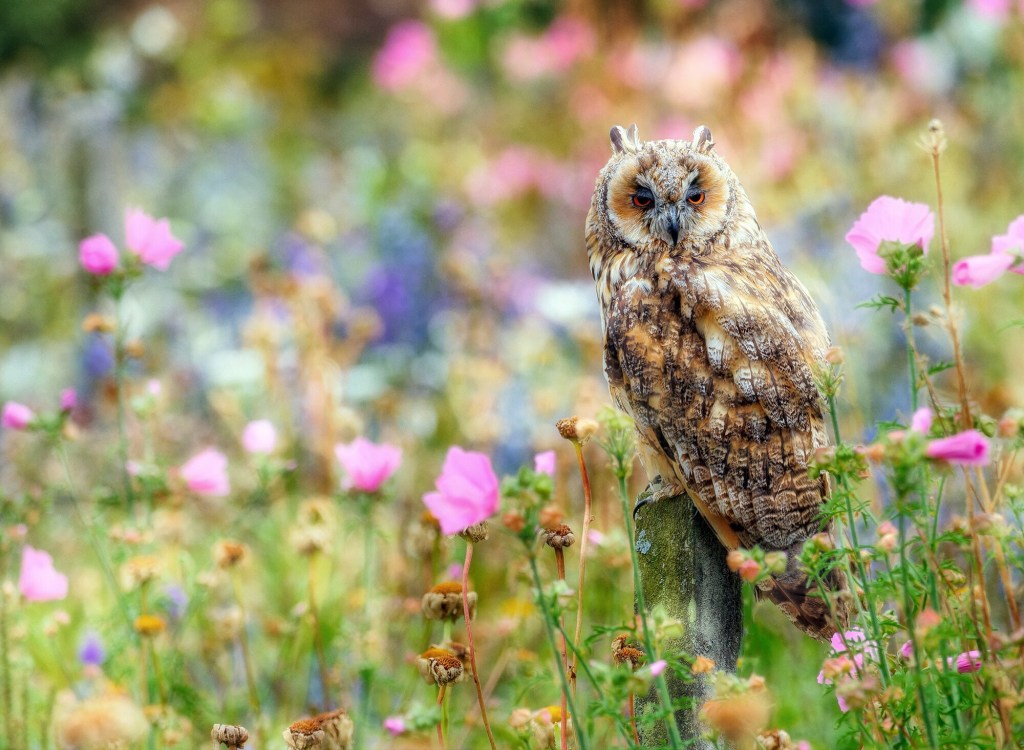
Nationally, the Hawk and Owl Trust’s on-going Long-eared Owl Winter Roost Survey (launched in recent years) is actively seeking records through 2026. They’re particularly interested in roost locations, counts, and spring follow-ups for breeding signs. If you’ve spotted any groups (even just 1 to 2 birds), submitting via their site (longearedowl.org or hawkandowltrust.org) helps build a better picture.
No dramatic population spikes or crashes have been noted specifically for the northwest this winter. Britain’s overall breeding estimate remains around 1,800 to 3,600 pairs but there is a high level of uncertainty due to the species’ secretive habits, the northwest holds a decent proportion though thanks to its conifer plantations and rough grassland mosaic.
The northwest benefits from an influx of winter visitors from northern Europe (Scandinavia and eastern Europe), boosting numbers during colder months. These migrants join resident birds, sometimes forming larger roosts.
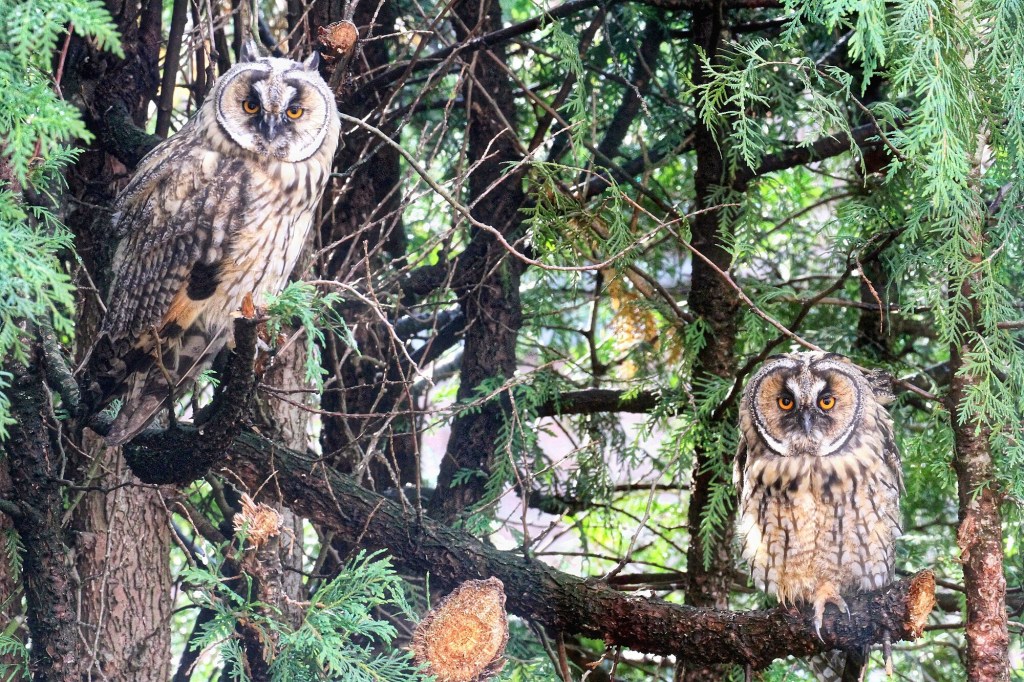
(Thomas Lendt)
Challenges and Conservation
Long-eared owls are classified as Green under the UK’s Birds of Conservation Concern list (BoCC5), indicating no immediate threat nationally. However declines have been noted in some areas due to habitat loss, reduced prey availability from agricultural intensification, and competition with Tawny Owls in deciduous woodlands.
In the northwest, habitat fragmentation from development and changes in forestry practices pose the greatest risks. The species’ elusive nature makes accurate monitoring difficult, but winter roost surveys help track populations and public sightings are hugely valuable.
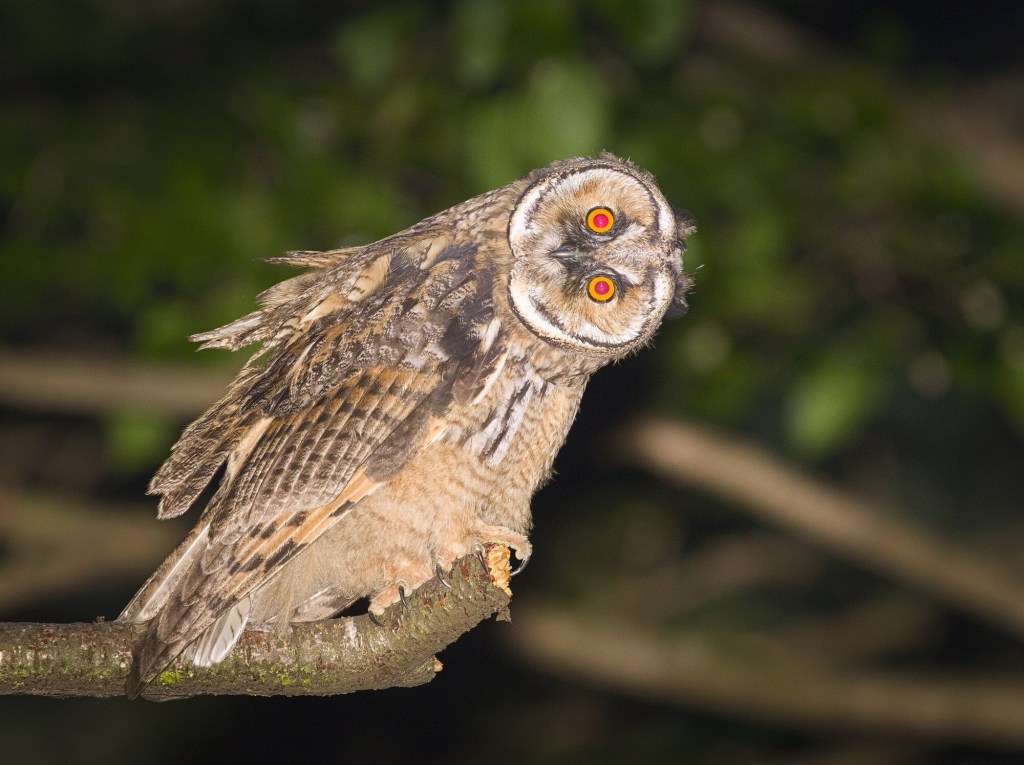
(Hedera Baltica)
How to See Long-eared Owls
Spotting Long-eared owls requires patience and respect for their shy nature, please avoid disturbing roosts though as this can cause birds to abandon sites.
The best opportunities arise in winter (November to February), when roosts are active and birds may be visible moving in or out of them at dusk or dawn.
As spring approaches listen for the male’s low hooting in the evening, or scan dense conifers for camouflaged birds during the day.
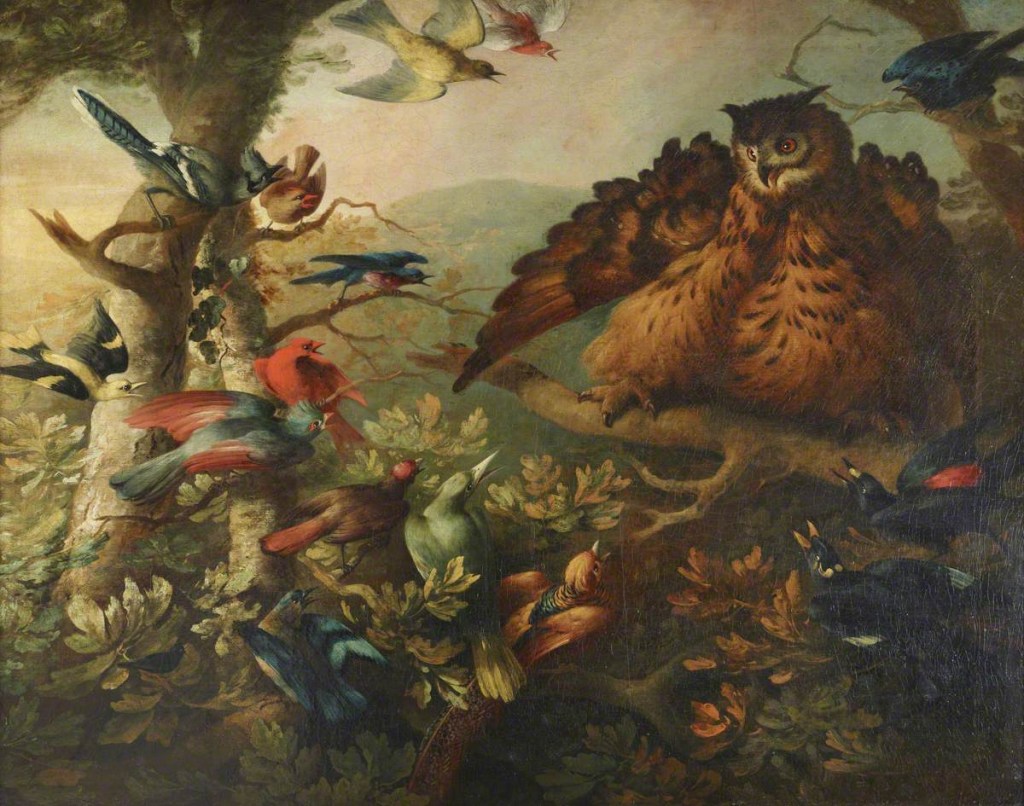
As with other owls LEO’s will be mobbed by smaller birds, especially corvids, if spotted out and abroad during the day, as depicted in Tobias’ painting below, currently on display by the National Trust in Anglesey Abbey, Cambridgeshire, I’ve used this method to spot many birds of prey over the years.
The Owls
by Charles Baudelaire
Under the overhanging yews,
the dark owls sit in solemn state,
like stranger gods; by twos and twos
their red eyes gleam.
They meditate.
Motionless thus they sit and dream
until that melancholy hour
when, with the sun’s last fading gleam,
the nightly shades assume their power.
From their still attitude the wise
will learn with terror to despise
all tumult, movement, and unrest;
for he who follows every shade,
carries the memory in his breast,
of each unhappy journey made.
If you enjoyed this you can show your appreciation by buying me a coffee, every contribution will go towards researching and writing future articles,
Thank-you for visiting,
Alex Burton-Hargreaves
(Feb 2026)


I only got to see my first one, on my own patch last year, I’d seen what i thought was a Shortie a few times and then …. there it was, staring at me from a fence post. Moved on now, I think, there’s been landwork in the area but I hope it will return.
LikeLiked by 1 person