Notes on the Biology, Ecology, Uses etc of Armeria maritima, commonly known as Thrift or Sea Pink
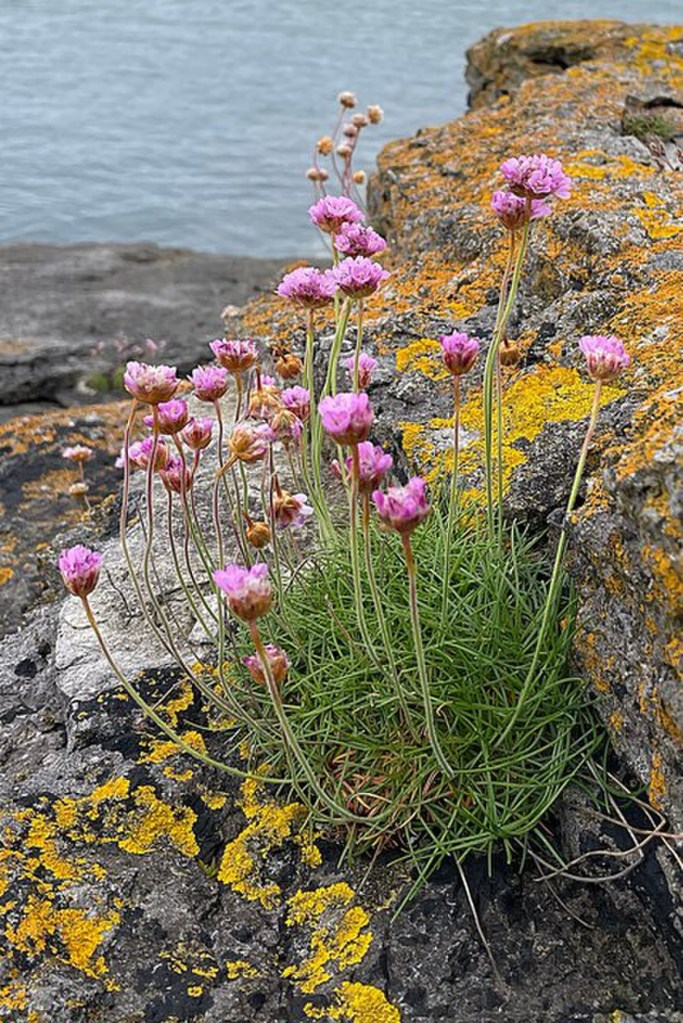
Armeria maritima, better known as Thrift or Sea Pink, grows all around the shores of the British Isles and is one of our most charismatic maritime wildflowers.
It is a member of the Plumbaginaceae (aka Leadwort) tribe, a small and tough family that specialises in harsh habitats, having evolved ‘chalk glands’ that excrete salts, allowing it to flourish in places where weaker plants fear to venture, like our storm-lashed, salt-sprayed coastlines.
A Tough Little Plant Built for the Coast
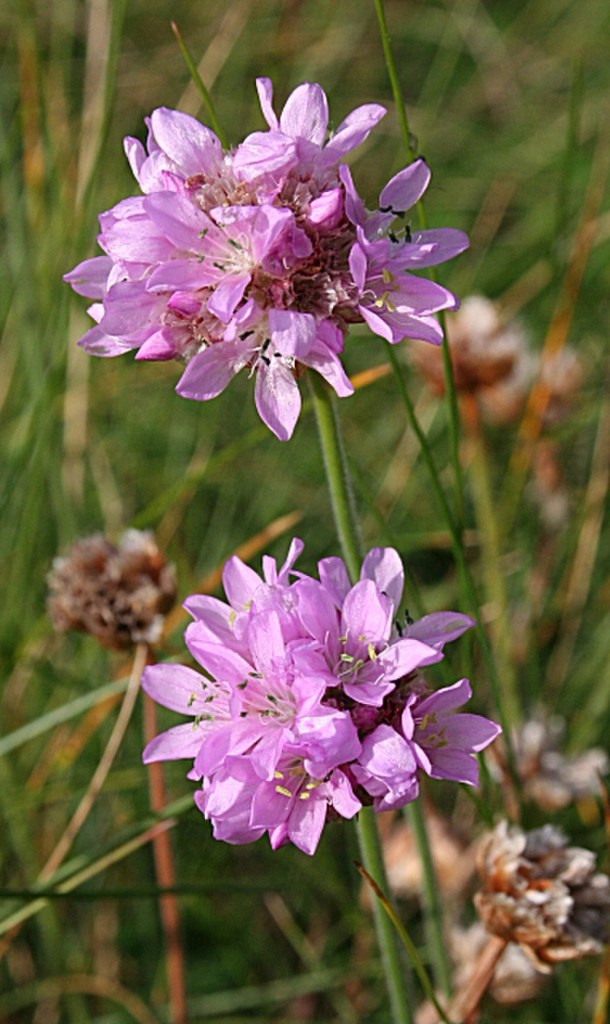
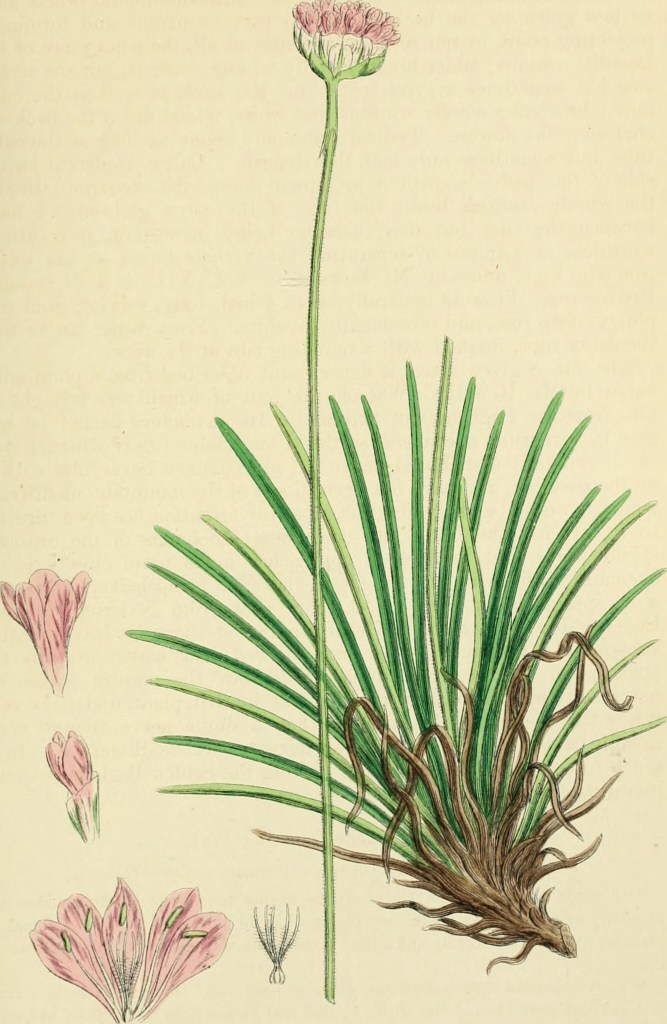
An evergreen perennial Thrift hugs the ground for shelter, forming neat, rounded cushions of narrow, grey-green leaves, these leaves are somewhat fleshy, helping the plant hold on to moisture in the face of salt spray and drying winds. From the centre of each cushion rise stiff, leafless stalks, each topped with a tight, rounded head of small five-petalled flowers, the colour of these is usually a soft pink, though deeper magenta or occasional white forms can turn up.
As well as having a remarkable tolerance of salt, wind, and poor, well-drained soils, that allows it to thrive where many other plants would wither; on shingle, rocky outcrops, stabilised dunes, and the upper reaches of saltmarshes, it also has a deep root system that helps anchor it against coastal erosion.
For this reason it is classed as a pioneer species as it is often, along with species like Sea Campion, the first to colonise new grounds where cliffs have tumbled, mud banks have been left behind by changing water channels or shingle banks have built up after a storm, stabilising the soil for successive plants to take root.
Thrifty by Name Thrifty by Nature?
As well as playing a useful role in stabilising fragile coastal soils Thrift provides early-season nectar for bees, butterflies like the Small Copper and Common Blue, and other insects, being, in spite of its thrifty reputation, highly prodigious in pollen. Indeed it is recognised by the Royal Horticultural Society (RHS) as a ‘Plants for Pollinators’ plant and recommended in gardens for this reason as well as for ornamentation.
Although long planted for its looks and to cater for bees (especially back when almost every sizeable homestead kept beehives), it was not widely planted in herb gardens for medicinal use. When John Gerard included it in his famous 1597 Herball, he noted its value as an ornamental garden plant for edging beds and banks, but stated plainly that it had “no medicinal value”.
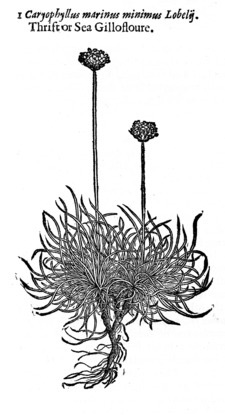
‘Their use in physic as yet is not known, neither doth any seek into the nature thereof, but esteem them only for their beauty and pleasure’
Despite this early dismissal as being of no medicinal use, scattered folk records show that people in remote coastal areas did find uses for the plant:
• Tuberculosis (consumption): In the Orkney Islands, the roots were traditionally sliced and boiled in milk as a remedy for tuberculosis. This use dates back several centuries and is an often-used example of how isolated communities have to rely upon readily available herbal remedies in areas short on natural resources.
• Hangovers and nervous disorders: Remote communities also used Thrift to treat hangovers, the same dried flowers were also taken for certain nervous disorders.
• Urinary infections and obesity: In some areas Thrift was considered to have mild antibiotic properties and was used in traditional remedies for urinary infections and, in some accounts, as an aid for obesity or slimming.
Modern phytochemical interest has confirmed that extracts (particularly from the seeds) can show antibacterial activity in laboratory tests, including against certain Staphylococcus species, however, the plant is rarely used today in herbal practice.
There is also an ancient but almost certainly unfounded folk belief that extracts of Thrift could cure lead poisoning. This idea likely arose because the plant belongs to the family Plumbaginaceae (the leadwort family, plumbus being latin for lead) and can tolerate heavy-metal-rich soils, such as old mine waste or calamine heaps. It does not, however, appear to have any genuine therapeutic effect against lead toxicity.
The origins of the common name ‘Thrift’ are as uncertain as the origins of its family name but are thought to refer to the plant’s ability to thrive in poor, salty soils while using resources economically; a sort of living lesson in frugality.
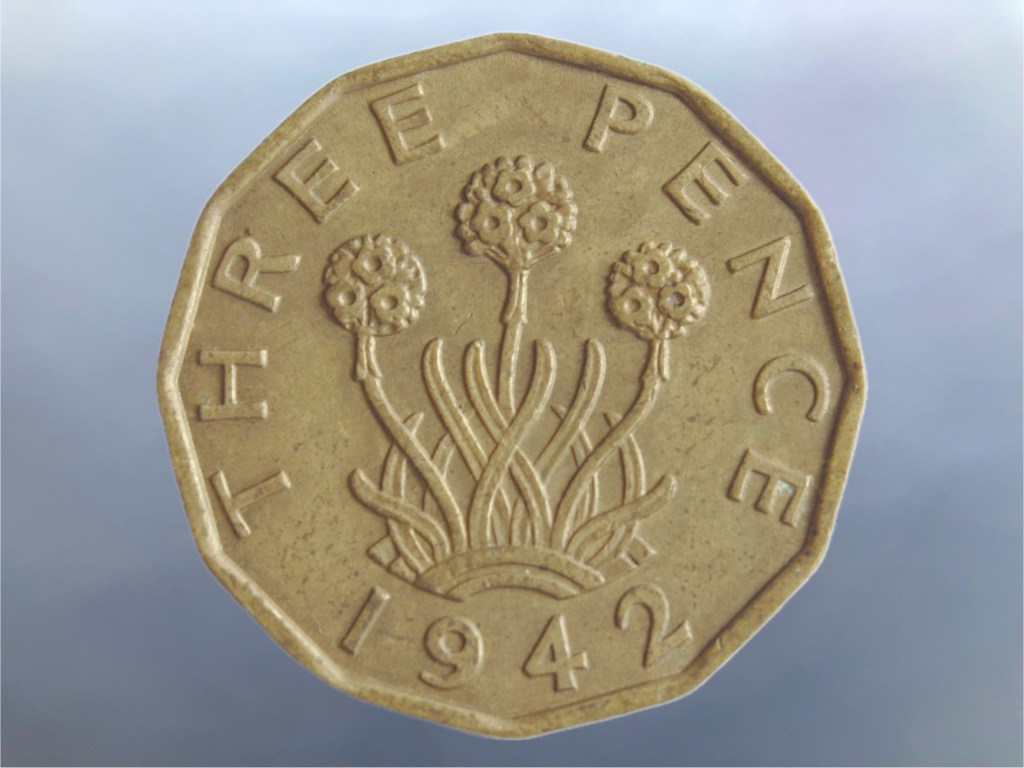
This symbolism was cleverly employed in the 20th century when Thrift appeared on the reverse of the British threepenny bit (the “thruppenny bit”) from 1937 to 1952. During a time of wartime and post-war austerity, the coin taught a subtle lesson: “be thrifty”.
The design, by artist Madge Kitchener, showed the neat cushion of Thrift flowers and is still fondly remembered by many older people.
Where to See Thrift in the Northwest
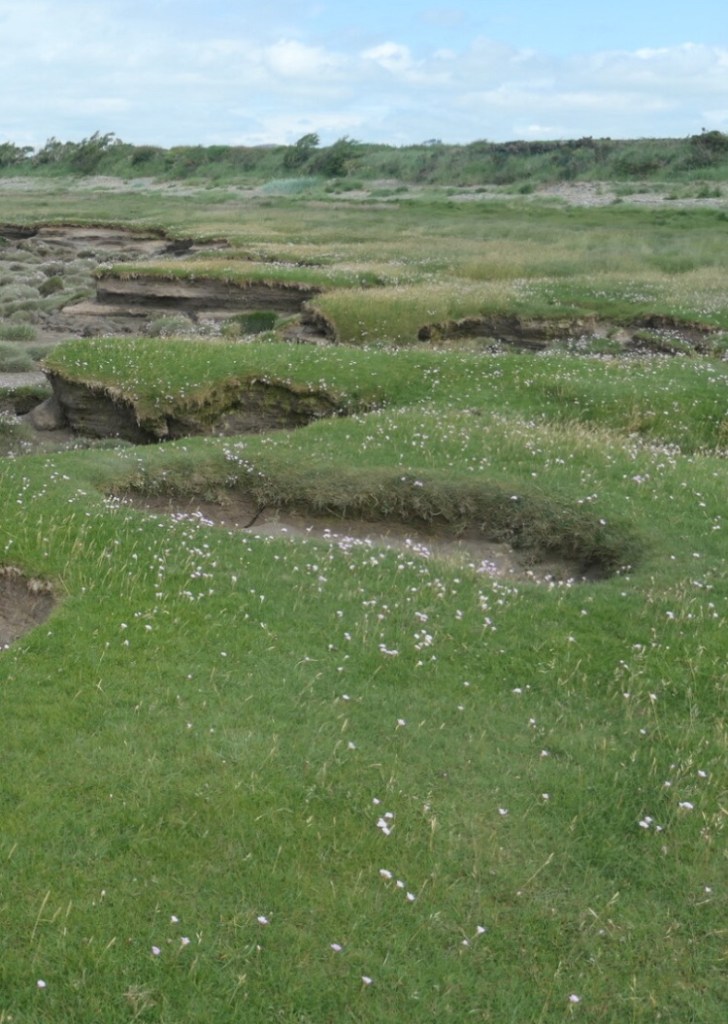
Here in the Northwest Thrift usually begins flowering in April and can carry on right through to July or even October in more sheltered spots. Early displays often appear on the higher, drier parts of saltmarshes or in dune slacks and add to the maritime palette alongside Gorse and the last of the spring bulbs.
Good places to look include coastal nature reserves such as:
- Barnaby’s Sands and Burrow’s Marsh Nature Reserves on the eastern side of the Wyre estuary, where it forms attractive pink cushions among the saltmarsh vegetation.
- The Sefton Coast dunes around Formby and Ainsdale.
- Half moon bay at Heysham and Humphrey’s Head near Grange-over-sands.
- South Walney Island and Eskmeal Dunes nature reserves in Cumbria both bear healthy populations of Thrift.
In a good season the pink heads can create quite a show, contrasting nicely with the blue of the sea, the golden sand, and the waving Marram Grass.
Sea Pink
On a Northern shore where west winds bite,
low cushions cling to the cliff-top tight.
Grey-green leaves in tight-close spheres,
defying the gale that whips the tears.
Hearing spring’s call, pink flowers rise,
bright as sunrise against dark skies.
Thank-you for reading. If you enjoyed this piece and would like to support further articles on the wildlife and history of the Northwest, you can buy me a coffee here.
Alex Burton-Hargreaves
(April 2026)
 Northwest Nature and History