
The Hark to Bounty Inn stands at the centre of the village of Slaidburn in the Hodder valley and is a building of an immense and hugely interesting history.
The building itself is Grade 2 listed and is comprised of a row of 17th and late 18th century buildings situated on a much older site dating back to the 12th century.
The Dog
Up until 1875 the Inn was known simply as ‘The Dog’ and the story behind the name change to its current name ‘The Hark to Bounty’ is unique in Britain and quite humorous.
Slaidburn is and always has been an estate, owned by one family, with the current owners being the Hodgsons, and in the early 1870s the squire and parson of the estate was a Reverend Henry Wigglesworth, who lived at Town head just outside of the village and who, along with being the squire and parson, was also the Master of the local hunt.

The story has it that one day Reverend Wigglesworth and his entourage were enjoying some après hunt drinks in the pub and the pack of hounds were of course left outside. One particular hound, which was the reverend’s favourite and named ‘Bounty’, could be heard baying and otherwise making a racket over the noise of the rest of the pack.
Reverend Wigglesworth reportedly proclaimed “hark to bounty!”. There is an old nursery rhyme, ‘hark, hark the dogs do bark’, (I do apologise for the Wiggles link but it is this exact nursery rhyme, it’s kind of appropriate really!) which dates as far back as the 11th century, which was very popular at the time this story is based so this possibly has something to do with the Inn’s renaming too.
The Inn’s sign illustrates this story quite clearly, but if you walk up the stairs and through the ancient studded oak door that leads into the courtroom you will find a black and white print of the sign which preceded it, which tells a different aspect of the Inns history.

Full Moon Lodge
The print of the old sign on display in the old courtroom upstairs portrays the silhouette of a baying dog in front of a full moon, the full moon signified, to those who understood its meaning, that the inn was a ‘full moon lodge’, a Masonic lodge which met only on the full moon.
This was for practical reasons though, rather than anything eldritch, as it simply meant that members of the lodge could find their way to the lodge by the light of the full moon, and it existed before the advent of street lighting. Slaidburn was only fully electrified in the 60s and was still illuminated by oil lights up to then, the post of one these still stands just up the road from the inn and another two can be found elsewhere in the village.
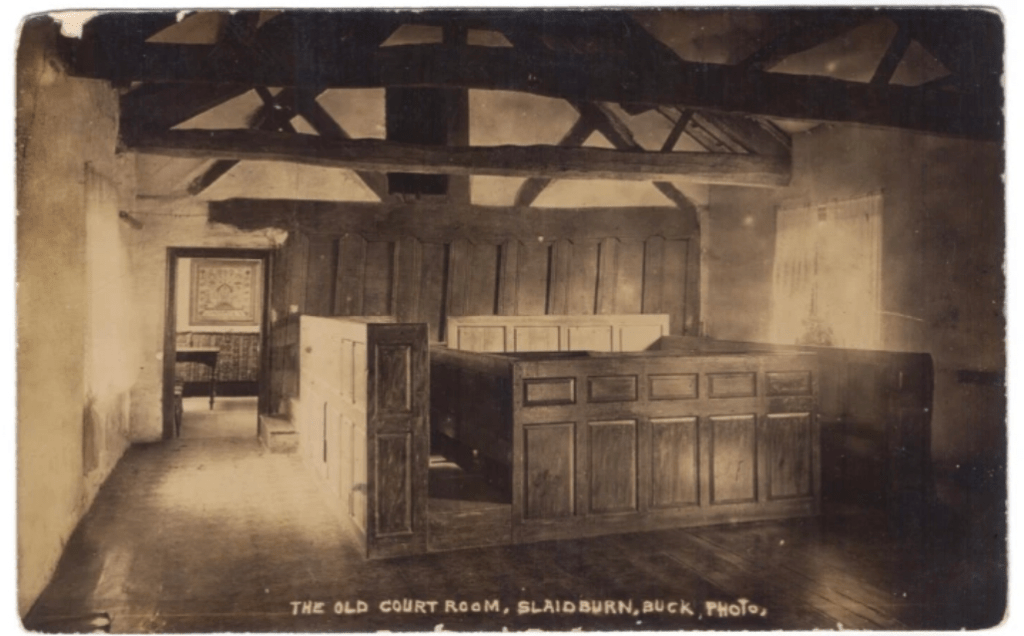
The courtroom
At the right of the main entrance to the Inn are a flight of stone steps, these have a mounting block strapped to the outside, on the other side of the earlier railings. A similar mounting block can be seen on the front of the youth hostel across the road, which used to be an Inn called the Black Bull, these were installed at the request of a previous squire of Slaidburn who found it increasingly hard as he aged to get back onto his horse after leaving either Inn.
These stone steps lead up to was is now known as ‘the courtroom’ but this used to be known as a ‘halmote’, coming from the Norse word ‘moot’ used to denote a meeting hall and from which derives the modern word ‘meet’.
From as early as 1250 this was the ‘court of Bowland’, and was used to administer county court level justice for the Forest of Bowland area. It was visited by travelling justices on their way to-and-fro the administrative centres of York and Lancaster as it was the only court lying between them and trials would have been carried out there for such crimes as poaching deer and game; ‘venisson’, and for other offences peculiar to the royal forest’s bye-laws.

The hall, with its huge oak beams and exterior stairs for conveying suspects in and out without going through the premises was used as a court for nearly 700 years up until 1927 and the oak benches for the jury at the back of the courtroom still survive, although the jury would have been picked from outside the area, as up until 1820 all persons residing in the Forest of Bowland were exempt from jury duty as it was their duty to preserve the king’s deer and land.
It is possible, with the permission of the current landlords; Nicholas and Victoria Hey, to visit the courtroom and look around at the Oak beams, benches and the ancient, warped, panels behind them.
Although some guides may state that the square wooden structure to the left of the room is a witness box or dock this is in fact a bar that was installed in the 60s to cater for dances that were held on the wooden dance floor in the room as most of the original furniture was removed some time ago.
The hall is very occasionally still used to cater for functions such as the Christmas fairs that are held there and when Slaidburn Silver band hold their concerts in the room if the weather in the beer garden is too inclement. Documents recording the court proceedings are held in the archives of Clitheroe Castle Museum and at Lancashire County Council’s HQ in Preston.
Below the courtroom there are 3 arched doorways dating from the Tudor period, these originally led to shops, one was a leather shop, and another sold farm equipment, at the very end is a room used as offices for Slaidburn estate.
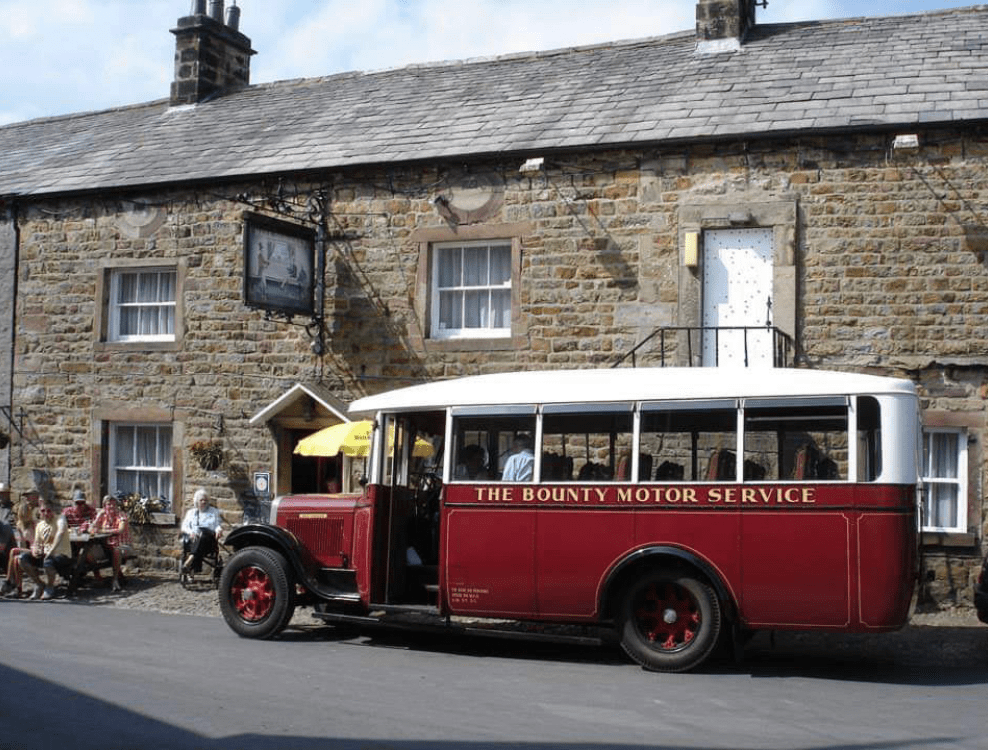
The Bounty bus
The Inn even had a bus named after it, the ‘Bounty Bus’, this is a 1931 REO Speedwagon single-decker that used to operate on the route between Clitheroe, Whitewell and Slaidburn and was run by a company called Hodder Travel until it was retired. It is since been refurbished and can be seen at the Slaidburn Steam Rally every year.
Details for visitors
The Hark to Bounty, at the time of writing, is open on;
Thursday 12 – 2.30pm and 5.30 – 11pm
Friday 12 – 2.30pm and 5.30 – 11pm
Saturday 12 noon – 11pm
Sunday 12 noon – 11pm
The Bounty serves excellent food and drink, (I really recommend the Friday Fish Night but book early for this as it’s very popular!) has open fires, accommodation and you are guaranteed to meet some very interesting local characters there if you hang around til late!
Contact the Bounty at https://www.harktobounty.co.uk/ (they also do the best value Sunday Roast you’ll find anywhere around here!)
Update: The Bounty is now closed and currently up for lease at 35.000 pa with Savills.
A B-H


I have spent many a happy time in the Hark.. I discovered it in a television programme about a wedding in the court room. No-one seems to remember when that was if anyone remembers please let me know on this website
thanks
LikeLiked by 1 person
I think that was in 2010 or 2011? I remember because i’d just started working there and they’d just had a wedding where they’d filled the court room with dead leaves and they were everywhere for ages afterwards! It’s a shame they didn’t use that space more, of course it’s all empty now until someone new takes it on, only £35,000 a year rent!
LikeLike