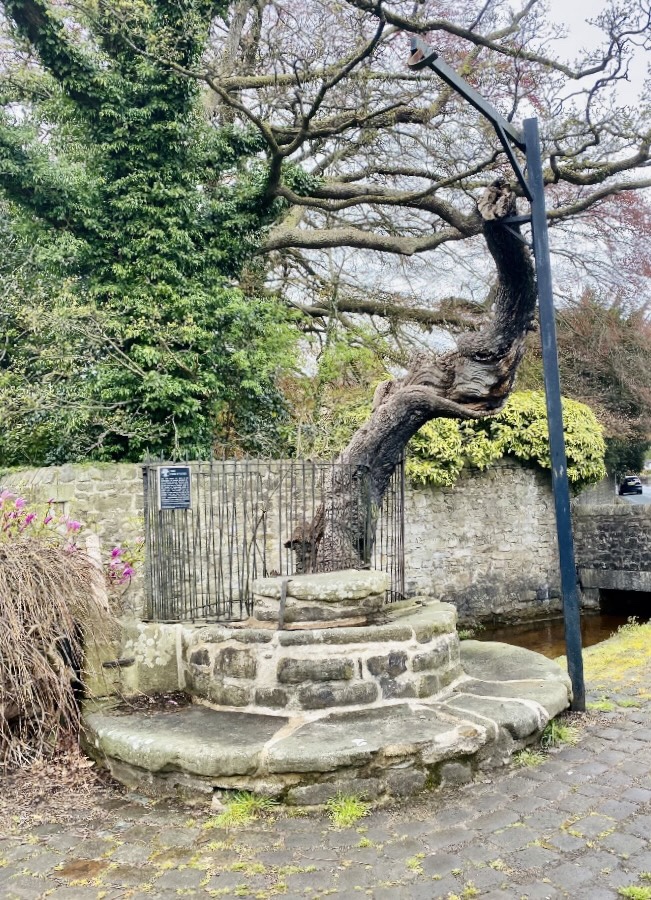
In the Lancashire village of Caton in the Lune valley, on top of a medieval monument consisting of a set of stone steps, known as the ‘Fish Stones’ due to the fact that medieval monks from nearby Cockersand Abbey would display Salmon for sale upon them, stands a young Oak tree with an ancient history.

Venerable Old Oak
This Oak was planted in 2007 to replace its parent, a very venerable old Oak, which met its end on June the 20th in 2016 after its last surviving branch was unfortunately struck by a passing HGV. An acorn, one of many saved from the tree in order to keep its legacy alive, was planted in the hollow that was left behind by the High Sheriff of Lancashire at the time Ruth Winterbottom.
Previously to this the increasingly unstable tree had been propped up with steel posts in 1998 by concerned parish councillors but it was eventually decided that the remains of the tree had become too rotten and dangerous to be left standing.

Emblem of the village
The Caton Oak, also known as the Druid’s Oak due to Druidic rituals which were supposedly carried out below its canopy, is regarded as very important to Caton, indeed the tree has become the emblem for the village, which originally grew up around it, although nowadays must of the village now stands on the other side of Artle Beck, a tributary to the Lune.
The local football club, Caton United FC, have the Oak as their emblem, as does the Parish council and due to the tree’s importance to the local community it and the monument it stands upon are now protected by law.

Kati’s place
Caton derives it’s name from the Norse ‘Kati-ton’, with ‘ton’ meaning village, hamlet or farm, and ‘Kati’ being a popular Norse name, so essentially ‘Kati’s place’, and there has been a settlement recorded here from at least the Roman era, this is known from archaeological findings including a mill-stone. The village has always been a hub for the local farming community, in the 40’s a local blacksmith used to set up shop underneath the tree to shoe horses for nearby farms and the fish stones are still a local landmark where people meet to conduct business or while away the time of day.
A B-H
 Northwest Nature and History
2 thoughts on “The Caton Oak”