
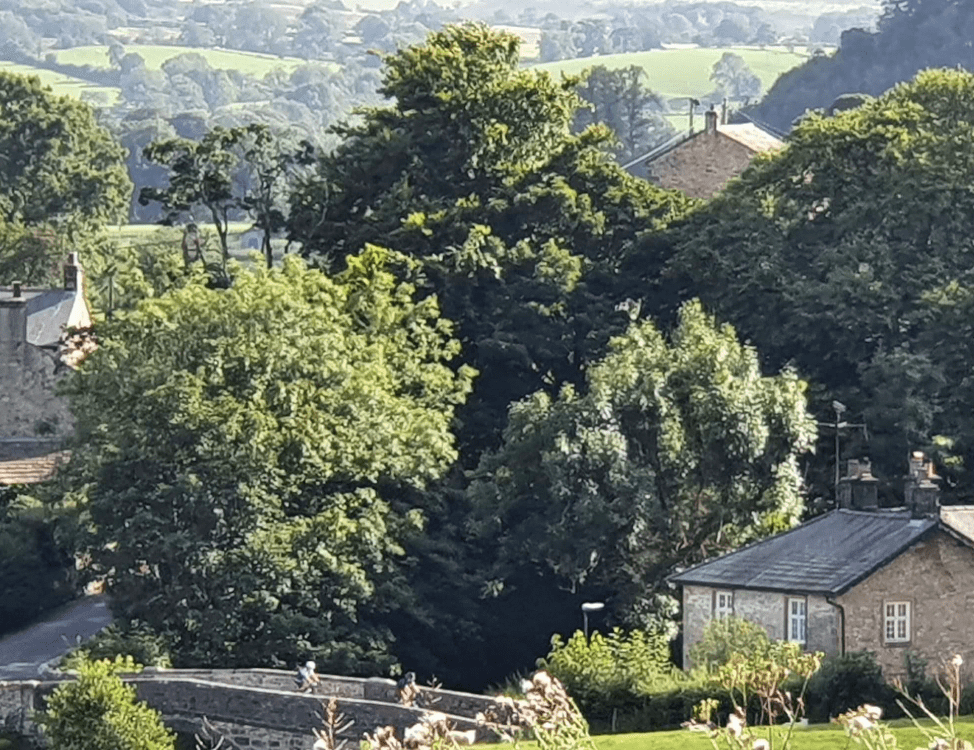
Hamerton hall is a grade 2 listed, 16th century hall near to the village of Slaidburn in the Forest of Bowland, it was once the ancestral home of the Hamertons who were a very wealthy medieval family who were said to have been able to ride all the way from Slaidburn to York without leaving their land.
Pele tower
It is built on the foundations of an earlier house which dates from the 12th century and which was thought to have been a ‘pele’ tower. Pele towers were small tower houses, built in the North of England from the 14th century up to the 1600s and characterised by being heavily fortified against border reivers and raiders from Scotland.
It incorporates some of this original building and has had many extra additions over the centuries to its basic, original 3 wing footprint, with various extensions, kitchen buildings and sheds added to it. From the rear it is hard to figure out which bits date from which century and as it is a functioning house and farm now as it always has been it is far removed from the National trust style properties that many criticise as feeling ‘sterilised’ and is all the more characterful for it.
The de Hamertons
The de Hamertons have an interesting and unfortunate history, they lost most of their land and power when Sir Stephen de Hamerton took part in the Pilgrimage of Grace of 1536 with the Abbott of Whalley Abbey John Paslew. The pilgrimage, which was a protest against Henry the 8ths rule, failed and Sir Stephen was executed at Smithfield in central London in 1537.

As he was a knight the price Sir Stephen paid for High Treason was beheading and forfeiture of his families land, he avoided the worse punishment his neighbour Nicholas Tempest of Catlow estate and Waddington received though, as Nicholas was a commoner he was hung, drawn and quartered.
Nicholas and Sir Stephen were both initially reluctant to take part in the pilgrimage but were coerced into taking part due to the violent nature of its local supporters. They set off to Halton West, near Gisburn, where they met with a band of 400 men ready to join the protests, things fell apart however when they failed to gain the further support they were hoping to gain from the people of Colne and Burnley and the movement lost its steam.
Sir Stephen’s widowed wife, Elizabeth de Hamerton, (nee Bigod) managed to reinstate some of the original estate to the family after his execution but it wasn’t any where near the original expanse, which included Wigglesworth Hall, the family’s main home, and Hellifield Peel, they did however manage to re-attain a farm called Stephen park which is now in the middle of Gisburn forest and surrounded by forestry. One feature of the hall which dates from Elizabeth’s time there are the bee boles she had built in the hall’s gardens. (I’ll write about bee boles in a future article)

A pleasant walk
The main footpath from Slaidburn to Gisburn forest passes by Hamerton Hall and follows the river Hodder which the hall overlooks, it’s a very pleasant walk across some of the best agricultural pastures in the valley which is why the hall was built there in the first place, these are used for lambing now and probably have been for thousands of years.
To reach the start of the footpath start from the Cenotaph in the centre of Slaidburn and head north to the bridge over Croasdale brook, past a little walled public garden on the left, when immediately over the bridge head right through a cast iron kissing gate and then follow the path by the river and across the fields. This leads to the circular Stocks reservoir walk which also takes you past Dalehead Chapel (the history of which I’ll also write about at some point) or you can walk to the road and head back to Slaidburn for a smaller walk or if the weather turns bad, either way it’s very picturesque!
Interesting notes
An interesting note; in front of the hall is a concrete bridge over Barn Gill, just on the left of it are the remains of a hump back bridge which was the original bridge to Hamerton hall, this was washed away by a flash flood in the 60s, upstream to the right of this is a small waterfall which falls over a limestone shelf.
This is part of the same limestone reef which crops up again at whitewell and which Clitheroe castle is built on, it’s also a fault line, some interesting fossils have been found here. If it hadn’t been for this fault line the dam at Stocks reservoir would have been constructed further down the valley and Hamerton hall would have to been demolished or moved like Dalehead chapel was!
A B-H
 Northwest Nature and History
Enjoyed that; thank you very much. Wonderful photos too.
LikeLiked by 1 person
Thank you 🙂
LikeLike
thanks Alexander – I came across Hamerton Hall on a Census – off to Slaidburn on Sunday to have a nosey round the graveyard – looking forward to doing the walk you suggested later in the year
LikeLiked by 1 person
Slaidburn has a fascinating history so you’ll have a lot to look at, make sure you pop into St Andrew’s and the archives up the road too if you get a chance, i hope the weather’s fine, please let us know what you find!
LikeLike