Part Two of The Bluebell
In Part 1 of this 2 part series about the Bluebell we looked at where and when you might see this beautiful spring flower bloom, in this part I’ll write more about the lifecycle of this plant and one of the main threats to its existence, the Spanish Bluebell.
Fragrant, bell shaped flowers
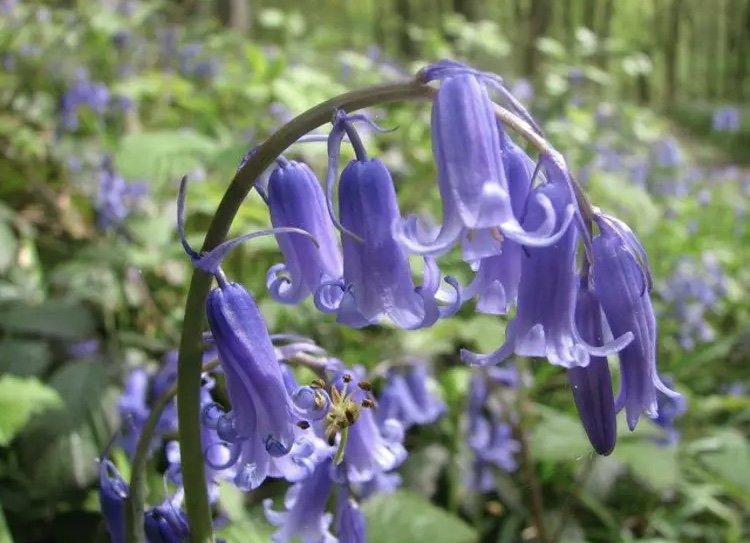
The fragrant, bell-shaped flowers that give the Bluebell its common name stand upright when it is in bud, but hang downwards when fully opened to sway gently in the spring breeze. The colour of the flowers can range quite widely from the familiar violet-blue through to white, and can even be pink on rare occasions, they are arranged in clusters on flower spikes (called racemas) that grow to about 40cm high and with drooping tips.
It has narrow, deep green leaves which can reach a length of about 45cm and these grow quickly earlier on in the year to make the most of the longer daylight hours, and to gather enough energy to feed the bulbs which have been dormant under the soil and leaf litter all winter.
The flowers themselves appear from early April to June, with the plant making the most of the fact that the trees above have yet to develop their full complement of leaves. Plenty of light still reaches the forest floor now, and the bluebells are quick to exploit it . The flowers also attract a host of insect pollinators as they too emerge from hibernation, which makes them particularly valuable to a wide range of wildlife such as Bumblebees, Butterflies, Hoverflies and moths.

Perennial displays
Bluebells are perennial flowers, meaning that they re-occur every year and grow from underground bulbs in the same location. It is this predictable pattern of growth has led to woodlands around the country, like Spring Wood above Whalley, the woods at Gawthorpe hall, Padiham and Nicky Nook near Scorton becoming locally noted for their fine spring display of bluebells.

Once bluebells have finished flowering the flower spikes die back, but the foliage persists afterwards for some time, these leaves convert energy from the limited amount of sunlight that will still penetrate the now fully developed woodland canopy. This energy is converted into food and transported to the bulb where it’s stored to fuel next springs early growth, eventually the leaves will die back too.

The Spanish Bluebell
Edit: although I believed the information below to be correct at the time of writing recent research by Markus Ruhsam et al into hybridisation of H. non-scripta and H. hispanica has thrown doubt on the severity, or even existence, of the threat to our native Bluebells which has been widely feared and shared by many including myself.
I thought it more helpful and prudent to provide a link to the research here instead of updating or deleting the below text, also thank you to Peter Llewellyn for sharing this, which I must say has come as a bit of a relief!
Original text;
Ironically the Bluebell’s huge popularity in the British isles has become the source of one of its biggest threats. Bluebells will hybridise very readily with a subspecies called the Spanish Bluebell (Hyacinthoides Hispanicus), which was introduced to the horticultural market many years ago and there is growing concern that hybridisation is threatening the genetic integrity of our native species
The Spanish Bluebell is a much heftier and hardier subspecies than our indigenous Bluebell and the two will cross very readily, which gives rise to a mongrel hybrid. These mongrels and their Spanish parents are much more robust than our native species which has led to our native plant becoming overwhelmed and even extinct in some areas.
It would be real loss to Britain’s countryside if our native Bluebell were to be replaced by this Spanish invader as it has none of the grace of our wispy, native species with its richer, bluer flowers, romantically arching stem and delicate fragrance.
Instead the Spanish counterpart is stockier in proportion, paler in colour, and has straight, inelegant stems from which sprout flowers in all directions and whose fragrance is more reminiscent of onions rather than the sweeter smell of the Sapphire carpet which spreads across our woods in spring.
A B-H


A timely post.
LikeLiked by 1 person
Thankyou, I try to get all my posts to reflect what’s going on at the time
LikeLiked by 1 person