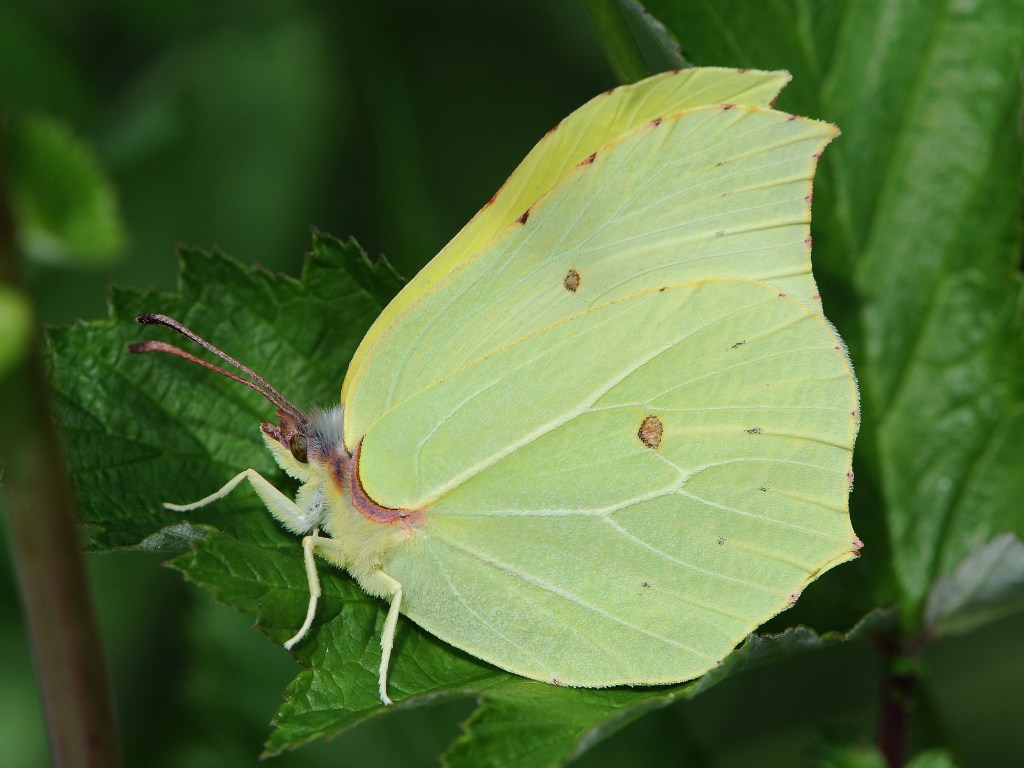
The Brimstone Butterfly Gonepteryx rhamni, is one of our largest butterflies and quite often the first to be seen as it languidly flaps across the landscape after emerging from its winter hibernation.
It is thought to be the original butterfly after which the common name for this type of insect came from, as its wings are a strikingly bright butter-colour, almost sulphurous yellow, hence the name ‘Brimstone’ which is the old name for Sulphur. This obviousness coupled with the fact that it is seen before other species and even on winters days, if they are unusually warm enough to fool it into temporarily leaving hibernation, means that it is almost the archetypal butterfly and the one that a child will draw when trying to picture one.
Habitat and diet
The Brimstone is found wherever its larval food plants are found, these being Buckthorn Rhamnus catharticus and Alder Buckthorn Frangula alnus, but will fly quite a long distance to find fresh plants, it is found throughout the British Isles except Scotland and is rare in Ireland and Wales.

Life Cycle of the Brimstone
This species only has one brood a year, laying it’s bottle shaped eggs singly on the underside of leaves up to a height of 4 metres above the ground. It lays these between April and July and they are around 1mm in height and initially white in colour but becoming a deep yellow after a few days, finally turning grey before hatching.

(Douglas Goddard)
After around 2 weeks the caterpillars hatch and start to feed, growing to between 30 to 35mm in length with a green body which changes to a blue-green on the upper surfaces with a white line down their sides. Their body is finely speckled with black bristles, called ‘urticating’ hairs as is their green head and they rest on the upper side of the leaf holding on with their claspers. They feed by chewing down through the layers of the leaf leaving characteristic holes, later the caterpillar will rest on the leaf edge and eat the entire leaf, this larval stage lasts for around a month.
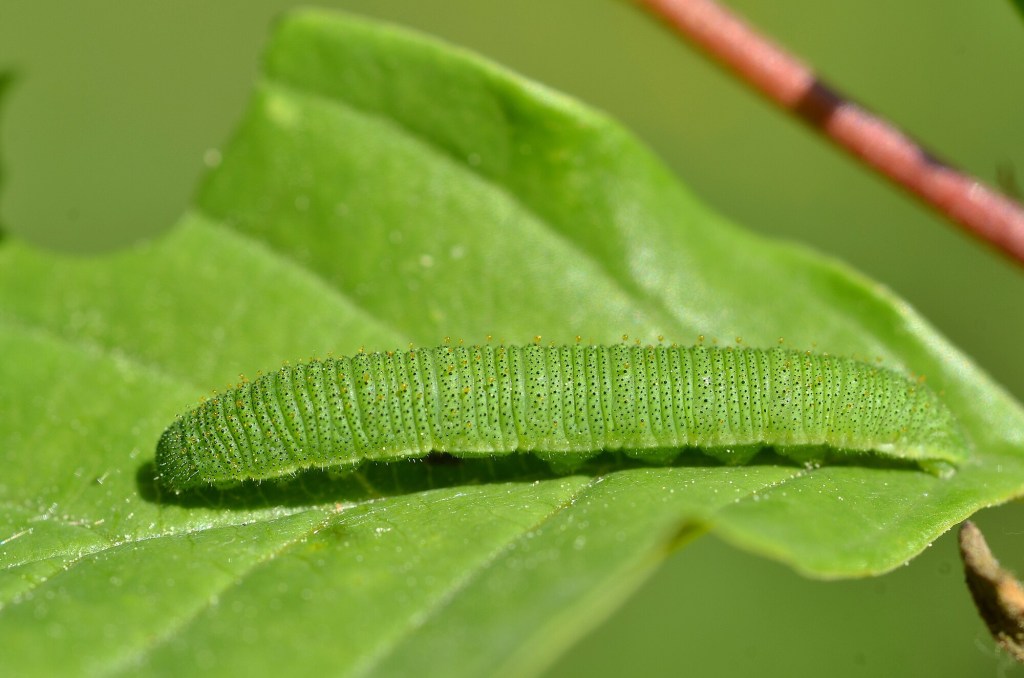
(Gilles San Martin)
When fully fed the caterpillar will leave the food plant to pupate in a suitable place, such as the underneath of a leaf in the undergrowth, the pupa will be supported by a cradle made out of a silk like material the caterpillar secretes and attached to the leaf by a hook shaped structure at the end of the chrysalis called a ‘cresmater’.
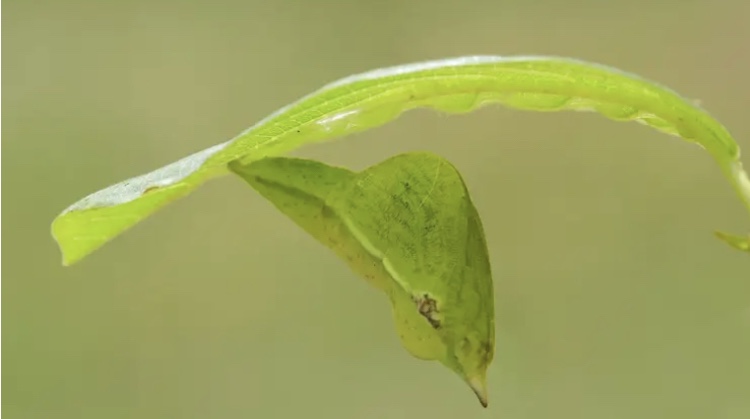
(John Philpott)
Pupation usually takes place around July and lasts for 2 weeks after which the adult butterfly emerges, it will be active until the end of September but doesn’t mate in the first year, waiting instead until the next spring. Instead the butterfly will concentrate on feeding to prepare itself for hibernation. The Brimstone has a preference for purple flowers such as Buddleia, Purple Loosestrife, Teasels and Thistles.
Hibernation
The sharply angled wings of the Brimstone are shaped like leaves and have a prominent vein structure which resembles that of a leaf, their yellow colouration, with brown spots along the wing edge, also matches that of dead foliage which helps to camouflage them when they hibernate. They will choose foliage that is likely to remain through the winter, such as Bramble, Holly or Ivy, which makes it a good idea to leave the removal of pruning of these plants until after winter when any hibernating Brimstone will have woken up to brighten the spring countryside.
A B-H
Edit; just found this additional fact out when I was reading up on this fascinating species but to be honest I don’t fully understand the process, apparently they rarely freeze due to the fact that when they enter hibernation they start to convert sugars to glycerin (nature’s antifreeze) which they circulate in their bodily fluids.
When it gets very cold they will discharge as much water as they can get away with without doing themselves harm so can survive sub zero temperatures, conversely this means a winter without any freezing spells can mean that the next generations of Brimstone may be less able to survive freezing temperatures, very often the more you try to understand something the harder it is to comprehend it, (that’s how it feels to me very often anyway!)


Fascinating information about their life cycle and survival during winter hibernation! I’m currently in central France and outside our hotel there are so many fresh Brimstone feeding in the hedgerows. I only associate them with Spring but now know thanks to your blog that these are products of Spring egg laying. Thank you!
LikeLiked by 1 person
Thank-you, yes they’re fascinating creatures, I haven’t seen any this year, lots of other species though, I was talking to someone from France the other week and it seems like they have a lot more butterflies over there
LikeLike