
The Longridge Line
If you visit the stone quarries just to the north of the Lancashire town of Longridge you may find the remnants of a short-lived railway that used to run from there to the village of Grimsargh and then on to Preston, a failed enterprise which had great ambitions. This article looks at the history of this railway, and in doing so cuts a line through time as well as geography.
Quarries
The line was built to take Longridge sandstone, which was quarried from Lords and Tootle quarries, to locations such as Preston and Liverpool.
The stone had already been used to build such grand constructions as the Harris Museum in Preston, St Walburgh’s, (the tallest church spire in Preston) the West coast line’s Preston station and Liverpool Docks and to increase production and ease of transport the idea of the Longridge railway line was conceived.
The Preston and Longridge Railway Company was formed for this purpose in 1835 and the board that the Chairman, Peter Hesketh Fleetwood, the MP for Preston, created for the company expected to make profits of at least 15%.
The go ahead for the grand scheme was given in 1836 for a track running from St Paul’s Square in Preston to the quarries with a station at Grimsargh and one at Longridge. The contractor hired for the job, Mr Wilkie, took three years to construct the line and it was finished in March 1839.

Cheapest service in England
Initially the line ran on Horse, rather than Steam power as two justices of the peace both had to give consent for steam engines to be used, so train carriages were hauled up the incline to the quarries by teams of horses instead, which were then sent back down in wagons.
On Wednesdays and Saturdays two passenger services a day were scheduled to coincide with market days and the tickets for these services were known as being the cheapest of any passenger service in England, as an article in the Preston Chronicle reported;
‘We are glad to find that the traffic on this line, which, by the way, is worked the cheapest of any in England of the same length, is fast increasing. We understand that the sightseers and holiday folks will have an opportunity of witnessing the wonders of our Whit Monday. Several extra trains offer the convenience of passengers to and from the scene of attraction, being intended to be run on that day.’
Originally the Preston and Longridge railway was not joined at all to the network or the main line at Preston, but in 1848 when Horse powered carriages were finally replaced with Steam, the line was joined to the Preston and Wyre railway by a 1 Mile long link which ran from the Deepdale passenger terminus through a tunnel called Miley tunnel, which is still in place now and will be used for the new Preston Tram when it comes into operation.

Grand ideas
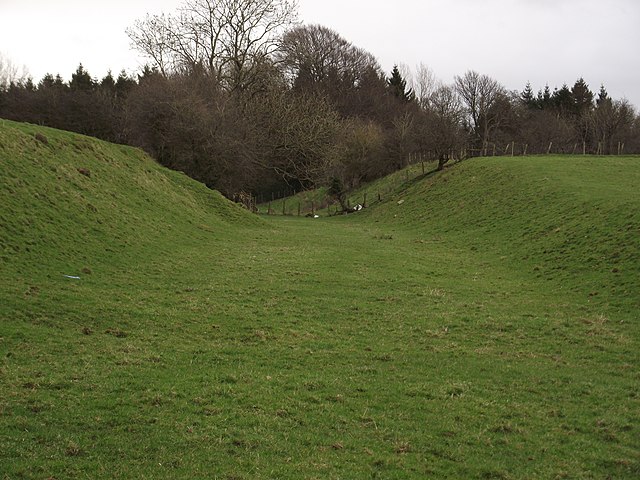
This link to the Preston and Wyre railway was part of a greater scheme to extend the line beyond Longridge through to West Yorkshire via Clitheroe, this idea never saw the light of day however, with only the beginnings of cuttings at Hurst Green being made before it was abandoned.
The plan was to branch out into the new and lucrative tourism market by providing a route for Lancastrians to the Spa towns of Knaresborough and Harrogate and, vice-versa, to give Yorkshire tourists the option of travelling to the seaside resort of Blackpool .
Instead the line remained just a minor branch line serving the towns of Grimsargh and Longridge for the next 15 years until 1866, when the company was incorporated into LNWR (Lancashire North West Railways) and became more of a freight route, serving the brick works at Holme Slack and the clay works at Red Scar as well.
Another development came in 1889 when a 2 mile long branch line was added to the Longridge branch which ran to Whittingham mental hospital from Grimsargh. This service conveyed supplies and passengers and became very busy, by the 1930s this was the only passenger service scheduled on the whole line but it ended in 1957 with the closure of the hospital.
The end of the line?
Cargo trains continued to run on the railway, servicing Courtauld’s factory at Grimsargh which produced Rayon through to 1967, this factory was demolished in the 80s and the site is now an industrial estate. This marked the end of the line which then only ran to Deepdale to service a coal depot before being closed entirely in the 90s.
Although all that remains of the line is a mile or so of track in Preston, this may see new life again with the opening of a tram route which may, if it goes ahead as funding is currently very limited, be the start of a renaissance of trams as a form of public transport in towns and cities throughout the U.K.
It’s not quite the ambition that the railways founders had in mind but still something they would be proud of if they could see it.
A B-H
 Northwest Nature and History
Thanks for highlighting Longridge.
A few points though.
The rail link went up to the quarries in the upper part of Longridge, mainly Lord’s Quarry, end of the line, and Tootle Heights, the latter linked through a tunnel to the line. This is where all the stone for Preston and Liverpool came from.
The line never went near Kemple End, the quarry up there only producing stone for Hurst Green and Stonyhurst via a sled track, still visible.
The Whittingham branch line was used from Grimsargh to a station platform in the hospital. I have a friend who in her childhood used to ride that link in what were virtually cattle trucks, but importantly there was no charge. This line can still be followed on the ground, as can the continuation line from Grimsargh to Longridge.
The Courtauld’s site you mentioned was at Red Scar above the Ribble. It had its own link to the Longridge Preston line. I remember the day in 1984 when they blew up the cooling towers of the power station,
The site is now part of a large industrial estate. The nature reserve you mention, Grimsargh Wetlands, is actually on the site of three decommissioned Preston Water Board reservoirs.
I doubt if the proposed Deepdale tramway will ever get the go ahead in these cash strapped days. Shame.
Keep up the good work, I really appreciate your posts.
LikeLiked by 1 person
Thank you for the information and corrections, I’m always wary writing the history articles as it’s so easy to get something wrong, I’ll try to correct it as soon as I get a moment. I’ve looked at the walk you’ve written about, it looks very interesting, I’ll have to try it one day, thanks for enjoying my posts! 🙂
LikeLiked by 1 person
I think my facts are correct. I’ve lived in Longridge for 50 long years and taken a keen interest in the local history.thanks for acknowledging them.
I was up at Kemple End today climbing in the sunshine. Lots of bilberries and blackberries to be had.
LikeLiked by 1 person