
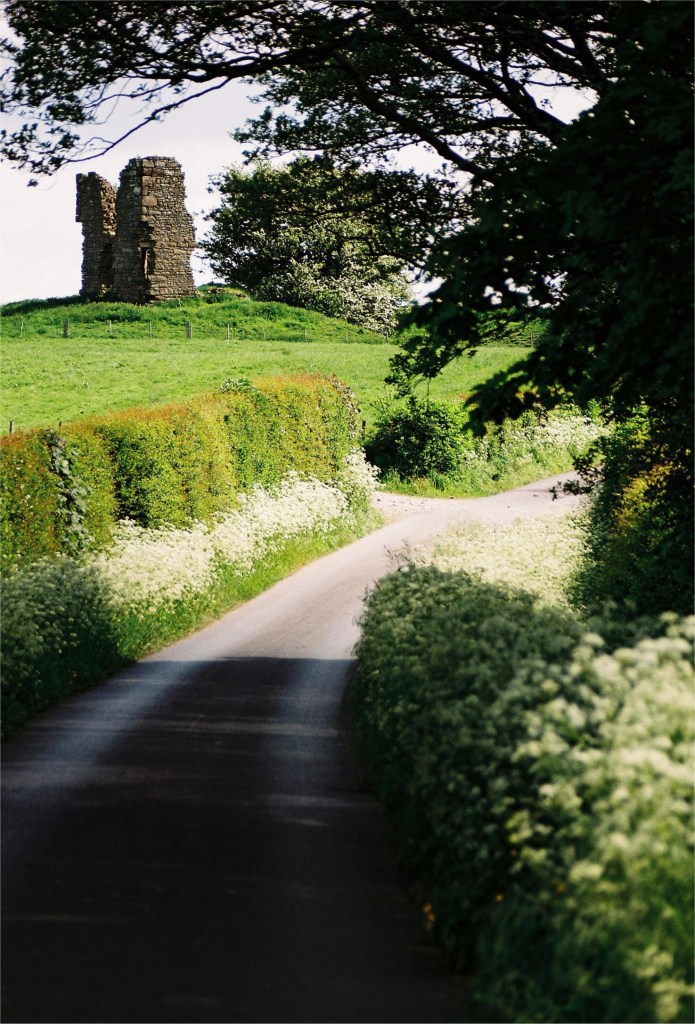
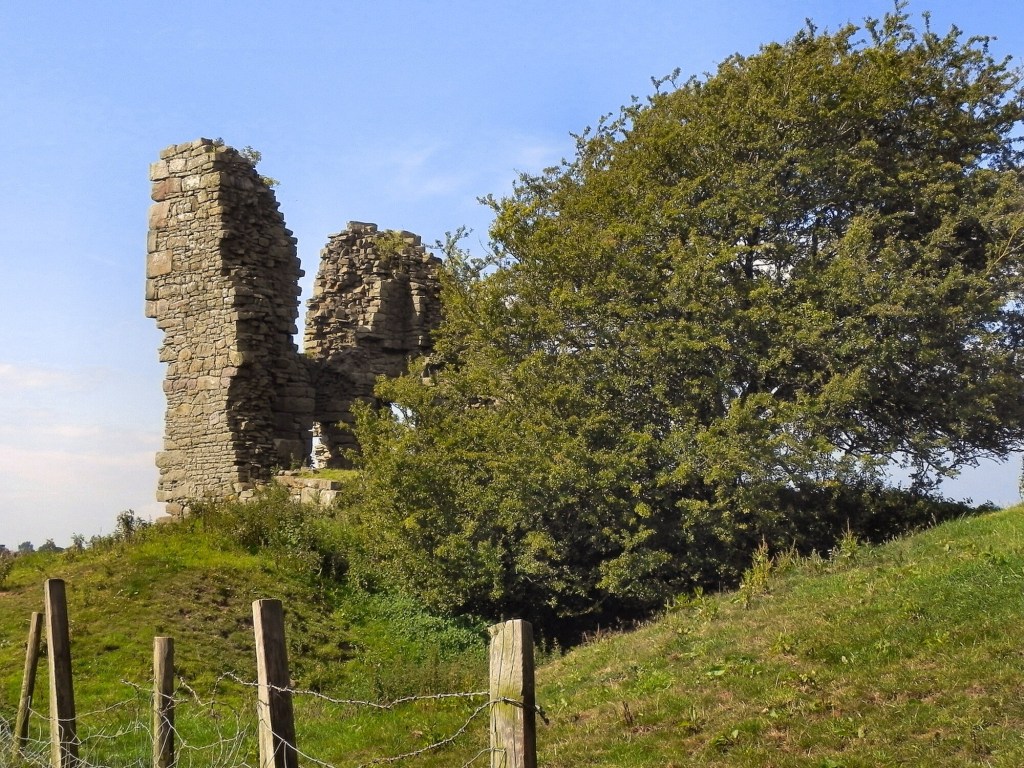
Greenhalgh castle consists of the ruins of the base of one tower of a castle built in 1490 on the outskirts of the small town of Garstang.
The ruins of the castle are on private land but can be seen from Millenium green park by the side of the river Wyre where there is an information board and from Hazlehead lane to the west of the town, here there is lay-by where a public footpath begins which passes the ruins. They can also just be seen as you pass Garstang on the M6 or the West coast main line.
There’s not much left of the original castle now as it was largely demolished after the Royalist garrison which held the castle in the civil war eventually gave in to a siege by Cromwell’s forces. The siege lasted two years and the papists, amongst the last in Lancashire, only surrendered in May 1645 after Oliver Cromwell personally guaranteed their safety.

Siege and Surrender
During the siege the fortification, owned by the staunchly royalist 7th Earl of Derby James Stanley and nearly impregnable with its well-constructed 5ft thick walls, was pummelled by cannon fire from the Parliamentarian forces, garrisoned at Garstang under the command of Colonel Dodding, yet withstood the barrage.
Sappers had even been brought in at one point to undermine the walls and blow them up with gunpowder, however these attempts failed as the underlying ground proved too sandy to shore up.
The Papist forces only surrendered after the death of their leader Captain Nicholas Anderton, of nearby Claughton, and only agreed to lay down arms after being guaranteed their lives and allowed to make their way home.
Embattled, Turrelated and Machicolated
The castle was ordered to be ‘slighted’, demolished and made uninhabitable, with all the supporting timbers removed, what was left was taken by local farmers, the farmhouse of nearby Castle Farm, built in the 17th century, was almost entirely built with stone taken from the ruins.
Originally the castle was built by sir Thomas Stanley, the First Earl of Derby, ancestor to James Stanley, to protect his estates around Garstang after king Henry the 7th gave him ‘licence to crenelate’ or permission to build a castle; “empowered to all with stone, lime and other material in his manor called Greenall in the parish of Garstang, to embattle, turrelate, machicolate or otherwise fortify them and hold forever without impediment or instruction”.
‘Machicolate’ means to build projecting stonework for dropping things like boiling oil or rocks onto invaders, ‘embattle’ means to fortify against attack and ‘turrelate’ is to build an observation turret.
Strategically Located
The castle’s position meant that only a keep was needed as the position, on a hill surrounded by marshes, meant it had a natural moat as defence and was only accessible via a narrow isthmus of land to the east. It was constructed from four square, sandstone towers about 30 yards apart on a levelled foundation and what you see now is just the base of one of the towers.
The location of the castle was also strategic as it guarded a well-used ford over the river Wyre through which the main north-south route passed, the M6 motorway and the Westcoast mainline are not too far away and also follow this same north-south route.
The ruins are now a scheduled monument and protected from further demolition, it is hard to imagine what the original castle would have looked like but the surviving ruins make for a very dramatic scene especially with the Bowland fells as a backdrop.
A B-H


I think it may be built on a drumlin from the Ice Age
LikeLiked by 1 person
I might be, there’s a band of moraine which goes across the Fylde plains so it could be the end of that too
LikeLike
The Cromwellian forces naively in my eyes made an unforgivable decision to demolish this castle.
If they had foresight they could have used the castle themselves in later years for further use.
We have a sense of history these days and it’s a tragedy that we do not have this castle to wander around and admire in this day and age.
LikeLiked by 1 person
I think ‘slighting’ which is the term for knocking a castle down after defeat, was mostly symbolic, a really visible way of saying “i’m the boss now so deal with it” Clitheroe and Skipton castles were also slighted
LikeLike