
‘Haytime by the Wharfe’
Herbert Royle (1870-1958)
In the cold depths of a northern winter farmers will go through a lot of hay, it’s good, nutritious winter fodder for store lambs, hill sheep overwintering in the valleys, dairy cows, beef cattle, and horses.
It’s also portable, there are 3 types of bale which can be easily transported in winter time when feeding to animals and which are very suitable for farms with scattered fields such as the hill farms around here.
The most commonly used bales are round, these can only be moved by a tractor with a front-loading bale spike or prongs, round balers are also ubiquitous, so cheap to buy second hand and quickly find spares for. Gathering up a field’s hay is quickest with a round baler, as long as it doesn’t jam!

Types of bales
Square bales are commonly used too, these are also too large to move without using a machine but have the advantage of being more stackable for cramming into a barn.
Little bales are the bales that spring to mind first when most people think of traditional hay making and the ones that came with your England’s model farm when you are a kid were these. They are a favourite of hill farmers as they are small enough for one to be put on the front and back of a quad bike, or for several to be jammed in the back of a pickup or landrover, perhaps most importantly they are man-portable, easy enough (although they are still heavy) to chuck over a fence or wall.
Little bales dropped out of fashion quite a few years ago due to the economies of scale, as larger bales mean faster gathering of hay and therefore less hours to pay the tractor driver you’ve hired, also they are quicker to pick up and put in a trailer as there are naturally less per field.
But in recent years there has been a bit of a resurgence in their use, enough for some manufacturers to take their schematics for little baling machines out of mothballs and start selling them again.
There are several reasons for this, the main one is the increase in horse ownership and hobby farmers who aren’t keeping livestock on an industrial scale, they can’t really manage large bales or afford them and storage is also hard if you’ve only got an allotment or paddock. They have never lost favour amongst hill farmers who use quad bikes and have small listed barns with small throw holes and little capacity (or structural integrity) for stacks of heavy bales.
One thing that was overlooked by farmers and manufacturers alike was the simple fact that if a little baler jams, as all balers do occasionally, it’s a lot easier to extract bits of a small bale from the machine to fix it!

The best time to make hay
Hay is best made in June or July when the grass has dried out a bit, the sugars in the grass are highest and the grass is starting to ‘head out’ or produce seed heads, this is when the ‘yield’, the optimum amount of good quality hay you can get, is greatest, lots of seed heads which are ripening and green provide protein which is very important for keeping animals going over the winter.
Of course altitude and the local season for hay making have a direct correlation so some of the highest pastures in the north of England may only be ready for gathering around August. This means the farmers are really cutting it fine and trying to beat the traditional bank holiday rain; damp hay rots, but upland livestock need more of those protein-rich seed-heads, which is all yet more pressure on the upland farmer!

A canny farmer will own meadows or buy hay from farmers that have meadows on the lowest, most fertile and sheltered pastures, here, on a good year, two cuts of grass might be made, so an extra load of feed for the winter.
As with everything in farming this is totally dependent on the weather but, for all the animosity that farmers can demonstrate towards each other most of the time, they will make sure that neighbours have bales in for winter and will help to gather them in as best as they can, even offering their own machinery, farmhands or barns to store them, though this is a favour that won’t ever be forgotten!
In traditional farming communities everyone was expected to step in when it was haytime before it became more of a commercial enterprise with contractors being hired. In places like Cumbria, the Yorkshire dales and Bowland fells, with smaller farms, and smaller budgets as well, its still the case that anyone fit enough to help will be called up.

Important time of year
Haytime is the second-most important time of year after lambing time and everyone from school kids to couples on their summer holidays will be out in the fields when it’s gathering up time, quite often just for the fun of it and the promise of a couple of pints paid on down the local.
Personally when I was growing up and still at school the fiver I got was hardly worth it cash-wise, but the chance to be working with some of the farmer’s daughters and being given a can of much needed lager at lunch by the farmer himself was worth it, also you got a tan and muscles after a few days of hard work in the sun which worked wonders when you went back to school!
I still help out occasionally although not as much as I used to as I now live in a town, but I used to be quite capable, and stupidly proud, of being able to heft little bales up to five high, being 6ft 2 helps but I probably shouldn’t try that now unless I want to knacker my back.
One job I had a few times when I was a kid was sitting on the top of the trailer of bales and banging on the roof of the cab if it looked they were going to fall off or if a low branch or telegraph wire loomed, it was risky but the whole thing was enormous fun, (we often shared a very stupidly advised but very enjoyable smoke up there too whilst no one could see!)

Baling day and night
Cut grass needs to be allowed to dry so that the bulk of the moisture is removed, but the grass is still robust enough to be picked up from the ground by balers and packed into bales, this means sunny dry weather is necessary, if it’s dry for long work may go on all night.
This is exhausting but has its own unique charms, one of my favourite sounds is that of farm machinery running off in the distance on a still summers night and a few times when it’s been too hot to sleep I’ve slunk off in the night to find out who’s working and maybe take them a couple of cans of beer out of the fridge so we can natter, the smell of cut grass permeates the air on these nights and nothing smells better to me.
The time of day to start cutting hay is as equally weather dependent as rowing it up or baling it, if the day dawns fair, it is best to mow as early as possible. If the grass is wet due to rain or heavy dew, it may be advantageous to wait an hour or two while it dries out, since standing grass will dry more quickly than a cut swathe. If cut early, the grass can often be turned and rowed up or ‘windrowed’ in a morning, before any afternoon rain, wind rowed refers to the practice, forgotten by a lot of farmers, of cutting a field perpendicular to the prevailing wind to facilitate drying.
When scythes were used however it was better to start when there was dew on the grass as it made it easier for the blade to cut, back then it took one experienced scythesman a day to cut half an acre so they needed to start early to get it all in. Having scythed a quarter acre meadow myself several times I can testify that it’s bloody hard work!

“If it’s fit to bale it’s fit to store”
An old farmers adage goes ‘if it’s fit to bale then it’s fit to store’, and it is important to get bales into dry storage as fast as possible, damp bales will rot and the whole lot can be lost if they get damp which not only means a huge loss in time and money but also a lack of winter food when it’s needed and the expensive purchase of a truck load of winter fodder like sheep nuts, so a double hit on the farmers wallet.
There are several things that can be done to avoid rotting, for a start the grass must be the right sort, thin-stemmed, thin-leaved species dry quickest and fields with broad leaved grasses dominating them will be cut for silage instead, a trick to find out if hay is dry enough to bale is to twist it in your hand and see if any moisture appears, if it does it needs longer to dry.
Bales left out overnight will get damp underneath and can soak up dew so it’s best to get them under cover as soon as possible, with big bales this means lots of racing about the fields in tractors with baling spikes and trailers to cart them off to the barns, with traditional small bales this is when lots of hands are needed.
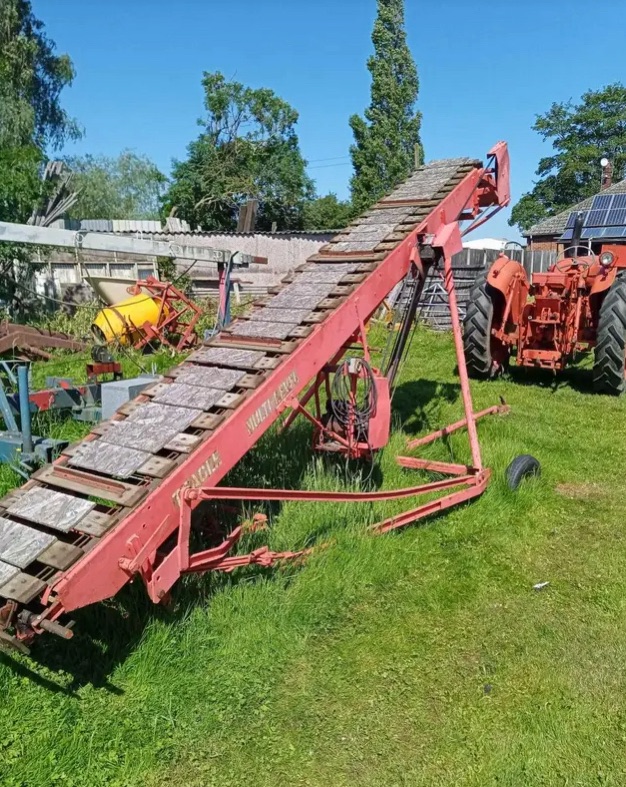
Two things that are quite often forgotten about in the rush of bringing in bales are the tyres on the trailer, usually it’s been sitting idle all year with the tyres going soft, and does the bale elevator work?.
In the north of England most upland farms will have old stone barns built in what is called a ‘vernacular’ style, these will have ‘pop’ holes or ‘throw’ holes for throwing the bales into the top of the barn, usually manpower is needed for this too as most small barns either don’t have an elevator, which is like a conveyor belt, or it’s broken down.
Bale storage
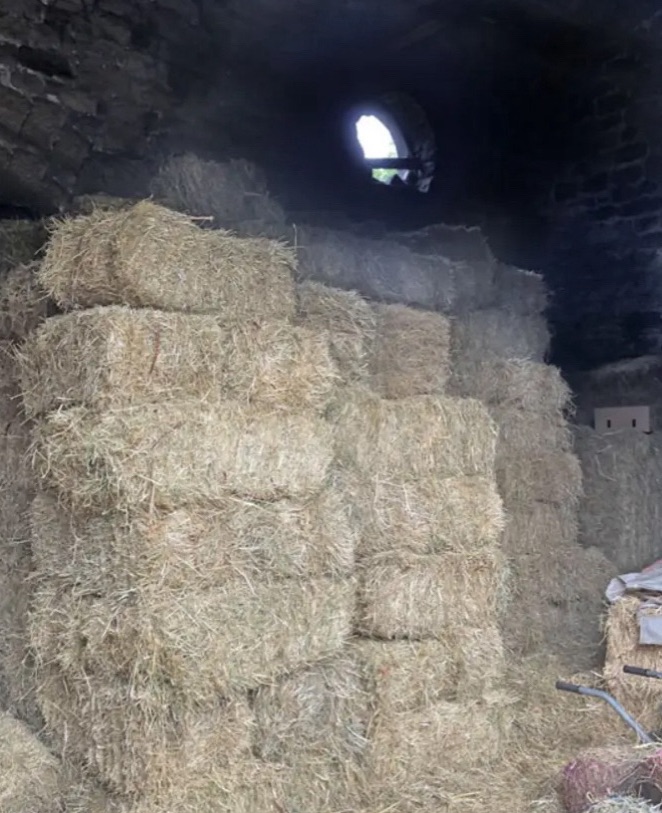
Stacks of bales must be placed carefully to avoid them falling on people but also to allow ventilation, the small holes you will see in the gable ends of a barn wall allow air to flow through and the roof must be intact too as the northwest is infamous for rain and a leaky roof can wreck a winter’s worth of bales.
Damp bales or those made of grass with too high a moisture content also hold risks for the farmer, as mould spores can be toxic, causing a respiratory disease known as ‘farmers lung’ and a lot of rotting bales can generate enough heat to spontaneously combust.
Dry bales have their own risks of course, they are highly inflammable, a few years ago there was a spate of fires caused by Chinese Lanterns landing in barns and setting the whole lot on fire including machinery left in them, the NFU; National Farmers Union, set up a campaign to petition councils to ban their sale.

A family I know had a whole barn go up which was full of bales I’d actually helped to gather (they were good Timothy grass bales too), they had a brand new Fendt tractor in there which was a birthday present from the farmers wife which was lost. The 17th century barn was heavily damaged and it almost spread to their house but luckily fire engines arrived in time. Chinese lanterns have also caused the injury of livestock which means yet more distress for them and more vet bills for farmers.
Where farms border urban areas or are in parts of the country which get massive influxes of tourists in the summer there are the problems of contamination of grass with litter which gets broken up and can cause internal injuries to livestock, dog waste, which can cause diseases that poison livestock, and fires, either accidentally caused by barbecues or cigarette butts or intentionally caused by bored kids.

Hay making time can be a very hectic and stressful time for farmers when it seems like everything is against them, including time, weather and other uncontrollable outside forces, but it’s also one of the highlights of the year. Many village halls will put on social events like dances at this time and some country barns traditionally leave their back doors unlocked for parched workers to sneak in for a much needed pint after a night’s haymaking.
Those nights are the most memorable and for a lot of farming communities the whole season can be the most important in the calendar, and it probably always has been for the thousands of years since scythes were first swung and horses were first harnessed.

Hay time, by Kathryn Whittaker
The rhythm of the scythe,
bringing together the cycle of life.
The farmer in tune with nature,
cutting the crop, storing for later.
Sweet lingering fragrance
of the sun kissed grass.
Steady hand, skilful eye
meadowsweet, buttercup, clover.
The meadow a land of gold,
treasure to behold.
Awash with life
in time with the rhythm.
A time to join together
hard work, laughter, tears
man at one with nature.
Once a horse, cart and many
now a tractor and few.
Still Mother Nature is master,
in the gathering of her bounty.
The making of the hay.
By Kathryn Whittaker, from the Wildflower Way with Words
A B-H
(July 2024)
 Northwest Nature and History
A really enjoyable post, thank you. I’m making a documentary film at the moment, based on a cine film made by my granny in 1959/60 about everyday life in the small Pennine village of Stanbury. That point in time is fascinating to observe: hay making is still going on using horses and carts, but there’s also great excitement at the arrival of the new ‘International’ tractor – a state of the art piece of kit which is now settling into gentle decay in a Stanbury barn.
LikeLiked by 1 person
Thank you I’m glad you enjoyed it, just typed this one out without planning any structure to it or anything so I’m happy it turned out ok, the documentary sounds interesting, so much must have changed in such a short time!
LikeLike
Really interesting read about something I take for granted and no very little about. I don’t think my back would last very long if was scything a field!
LikeLiked by 1 person
Thanks, yes there’s a lot of frantic activity as it can be make or break for some farms, very hard work though!
LikeLiked by 1 person
Fascinating to read, all the detail of it.
LikeLiked by 1 person
Thanks, it’s one of my favourite times of year 🙂
LikeLike
A good piece that. I loved haymaking as a child on our farm, especially the arrival at lunchtime of the farmer’s wife with a bite to eat and the tea in those metal containers (whose name I can’t remember).
LikeLiked by 1 person