
(Chris Kirk)
The Lancaster Canal currently stretches over 42 miles from the City of Preston to the village of Tewitfield near the county’s northern boundary, it is a very famous waterway for all sorts of reasons, for its scenic beauty, long history, wildlife, but not least because it is the longest lock-free stretch of inland waterway in the United kingdom.
Construction of the canal began in 1797 and it took a mere 7 years until completion, with the canal, designed by the Scottish Civil Engineer John Rennie (1761-1821), who is also famous for designing Waterloo bridge and London Bridge, originally running past Tewitfield north to the Cumbrian town of Kendal.
It was intended to connect with the Leeds to Liverpool Canal but the stretch south of Preston was never constructed, nowadays it does though via the Ribble Link, a system of 9 locks which allows narrowboats to reach the Ribble and then, via the River Douglas, access the Leeds to Liverpool Canal.
Only very experienced boaters use the Ribble Link as, being a tidal river and exposed to storms the Ribble can be quite treacherous for a tiny narrowboat to navigate.

chamber is a larger-than-lifesize wooden statue of a man, labelled: “Gauging the Ripple” 4. “Water” by Thompson Dagnall Commissioned by The Waterways Trust and British Waterways
The Black and White Canal
To begin with traffic on the canal was of an industrial nature, carrying Limestone south and Coal north from Lancashire’s coalfields, for this reason it had the nickname ‘the black and white canal’, the canal also brought Barley from the Fylde plains to the breweries of Preston and Lancaster, the last cargo shipment being conveyed in 1947.
The canal also became enormously popular with passengers, who could travel from Preston to Kendal on the daily Packet Boat services in what was, at the time, an extremely speedy 10 hours (although it sometimes seems to take that long driving between the two towns on the M6 nowadays!)
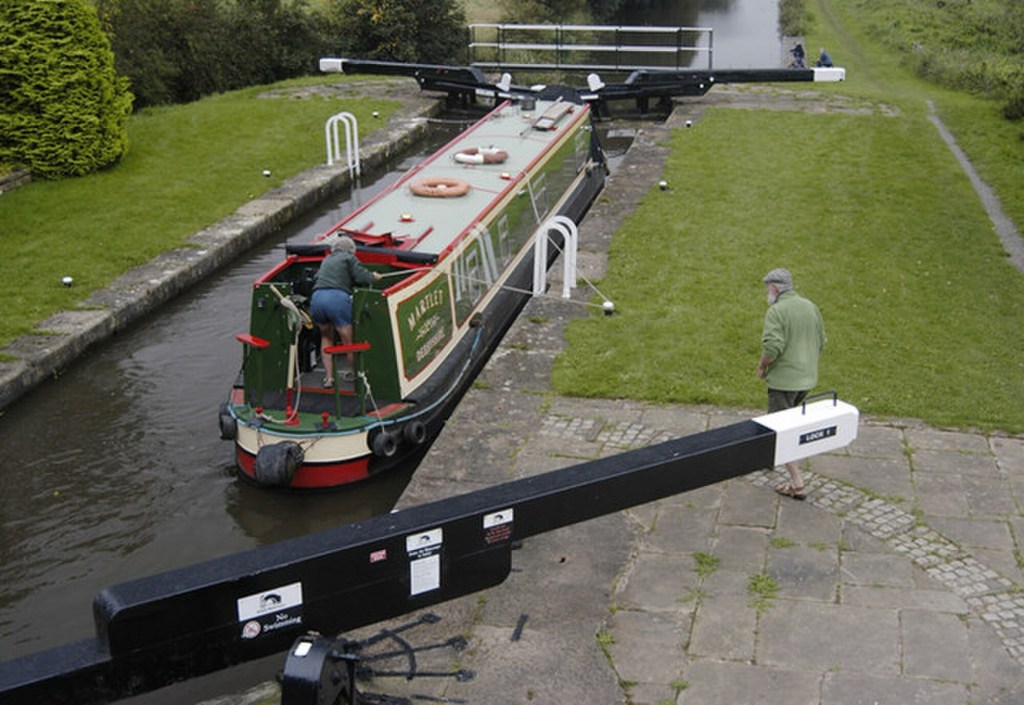
(Tom Richardson)
Rise, Fall and Rise again
The service earned such a reputation for fast and comfortable travel that it remained popular for a long time after the completion of the West Coast Mainline in the 1860’s. Sadly the construction of the M6 motorway literally cut short the canal, severing it in 3 places at Tewitfield and isolating the last 14 miles to the north.
Still well-liked today the remaining stretch of canal attracts people from all around the country including private narrowboat owners, who can moor at a multitude of marinas, such as Moon’s Bridge in Preston, Garstang, Galgate, Lancaster and Tewitfield.
Tourists, who often rent their own narrowboats, can cruise the canal in purpose built barges with fine-dining and entertainment provided, one such barge is often captained by retired sea captain David McNamee who likes to regale passengers with tales of his voyages around the seven seas.
Many also visit just to cycle or the miles of towpath which wind through some truly beautiful countryside, or to fish and paddle in its clear waters.
It could be said that the fortunes of the Black and White Canal and its sisters around the nation have risen, fallen and risen again in a manner much like that of the still waters within their locks.

Frozen In, by Jo Bell
You wake, and know.
The boat is still as bones and you, its red heart beating.
The canal was taken in its sleep and paved with cold; the chilled air gathers round your feet.
The ice, disgruntled, shifts itself and chews a little on the hull, sets itself to set again.
Beneath the glaze fish flicker like grey flames, silent, watchful.
Inside, you go on with the business of making tea, waiting for crocuses.
A B-H
(Nov 2024)
 Northwest Nature and History
Thanks for the link to the page on my website, Alexander
LikeLiked by 1 person
No problem, i only use the best links! i’ll try and write a bit more about the canals as they’ve been so important in our history and i think this is often overlooked
LikeLike