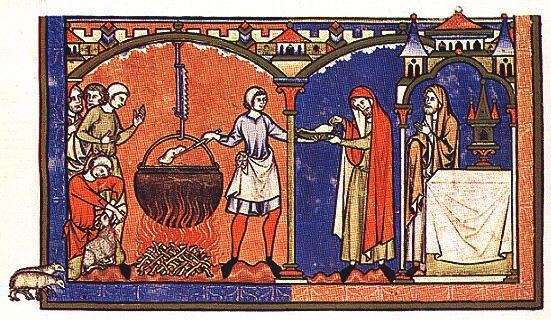
In one form or another the dish now known as Haggis has been around for hundreds, if not thousands, of years.
It is now synonymous with the nation of Scotland, but was once found served upon plates throughout the isles, being a versatile recipe with ingredients that were available in all seasons of the year.
Originally we lived a in a more communal style than we do now and food was prepared and cooked in a central part of the settlement and shared out amongst all, whether old or young, or of high or low status.
This has always been reflected in the nature of Burns’ night which, as well as being a celebration of Scotland’s cultural heritage, is a time of conviviality and community. So in this spirit the Haggis has always been shared with friends or strangers, be they baron or peasant, and at any time of the year, not solely the 25th of January.
There are a great many recipes for Haggis, all following the same theme, but the oldest known recipe, referred to as ‘hagese’ in the text, can be found in the medieval Lancashire manuscript ‘Liber Cure Cocorum’ dating from around 1430AD.
Here’s a summary of what this recipe entails:
- Ingredients: The recipe includes the heart, liver, and lungs (pluck) of a sheep, mixed with onions, oatmeal, various herbs, and spices.
- Preparation: The organs are minced together, combined with oatmeal and suet, seasoned, and then stuffed into the sheep’s stomach (paunch) for cooking.
- Cooking Method: The stuffed stomach is boiled until cooked, a process which historically could take several hours.
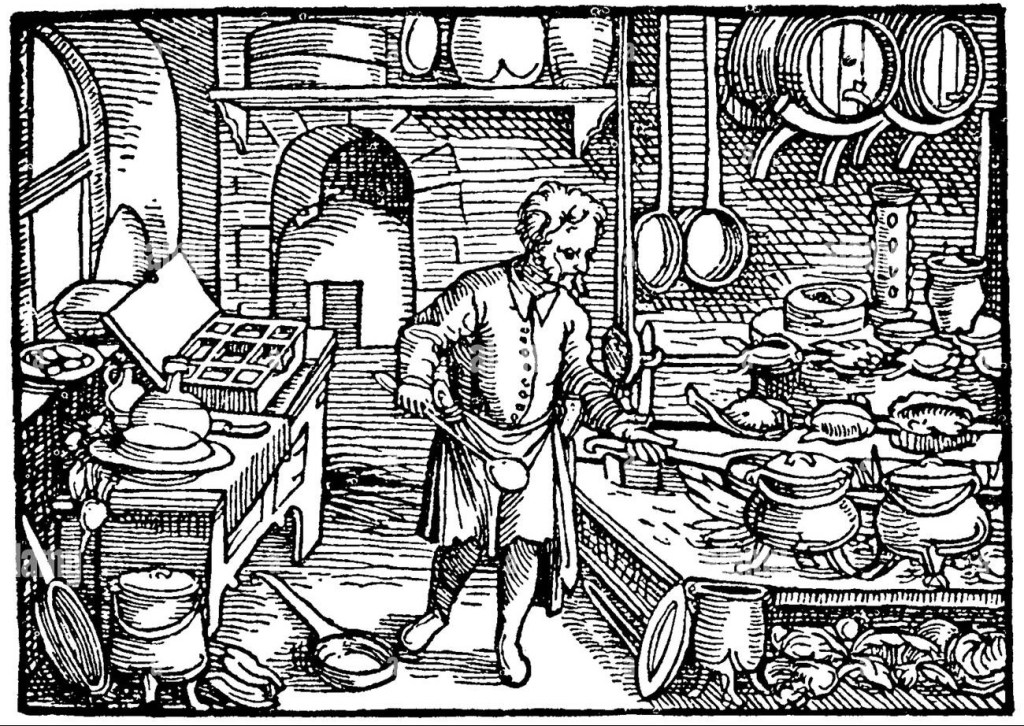
Rhyming Recipes
All of the recipes in the Liber cure cocorum were, rather uniquely, written in rhyming verse and included delicacies such as Blanke maunger of fysshe (Blancmange of boiled tench or lamprey with rice and almond milk) and Harus in albotretus (Hares in a broth), they were all written in ancient Lancashire dialect too, which is surprisingly easy to understand!
Þe hert of schepe, þe nere þou take,
Þo bowel nout þou shalle forsake,
On þe turbilen made, and boyled wele,
Hacke alle togeder with gode persole,
Isop, saveray, þou schalle take þen,
And suet of schepe take in, I ken,
With powder of peper and egges gode wonne,
And sethe hit wele and serve hit þenne,
Loke hit be saltyd for gode menne.
In wyntur tyme when erbs ben gode,
Take powder of hom I wot in dede,
As saveray, mynt and tyme, fulle gode,
Isope and sauge I wot by þe rode.
Which translates as:
The heart of sheep, the kidneys you take,
The bowel naught you shall forsake,
In the stirred broth made, and boiled well,
Hack all together with good parsley,
Hyssop, savory, you shall take then,
And suet of sheep take in, I teach,
With powder of pepper and eggs good quantity,
And seethe it well and serve it then,
Look it is salted for good men.
In winter time when dried herbs are good,
Take powder of them I know indeed,
As savory, mint and thyme, quite good,
Hyssop and sage I know by the Rood.

I’ll write a bit more about the ‘The Slyghtes of Cure, or, in modern English, ‘The Art of Cookery’ in the future but for now if you fancy a Haggis for supper it’s still made in Lancashire today by companies such as the Lancashire Haggis Company of Chorley.
A B-H
(Jan 2025)
 Northwest Nature and History
Nice post 🌅🌅
LikeLiked by 1 person
When I read those ingredients I’m gald I’m vegetarian.
LikeLiked by 1 person
When you realise they heavily seasoned all their meat dishes for a very good reason!
LikeLiked by 1 person
Hi there! Good luck on your project and have a good day 🙂
LikeLiked by 1 person
Thank you, I hope you’re having a good day too 🙂
LikeLike