(Red Rose Collections)
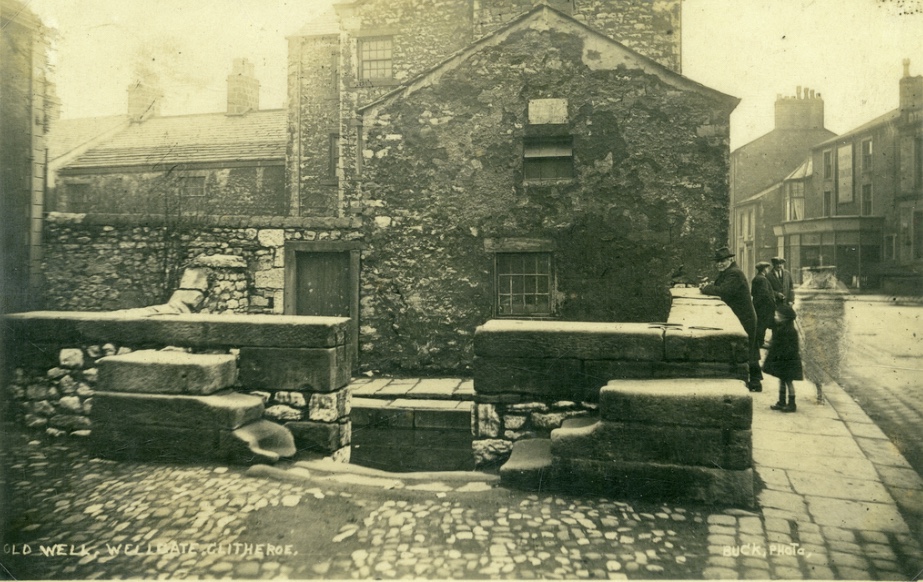
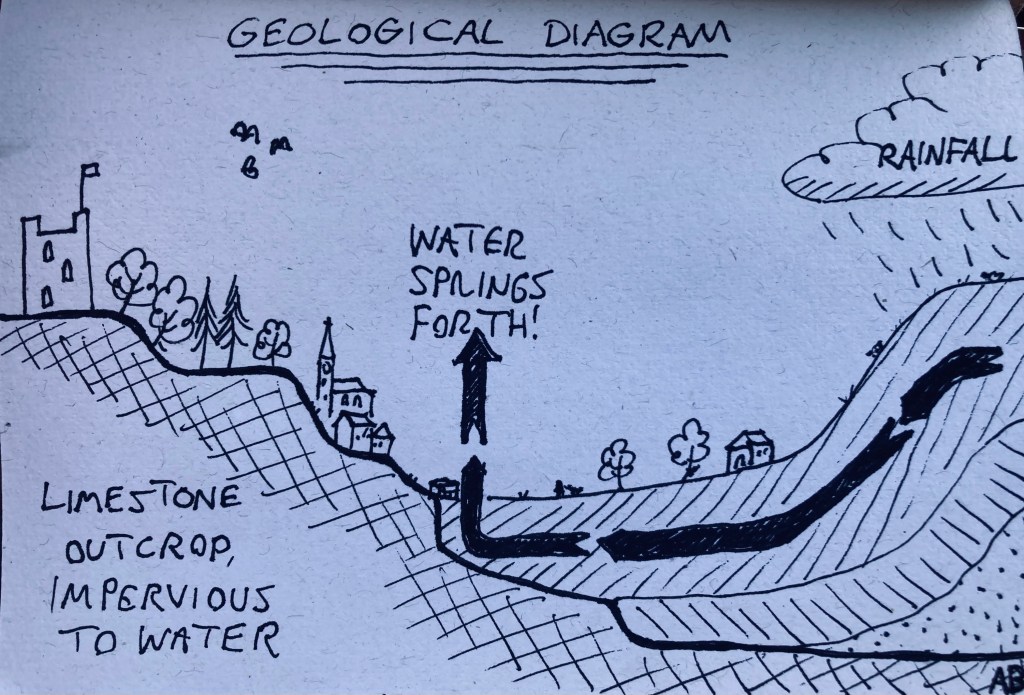
The market town of Clitheroe is unique in Lancashire for being the only one built predominantly of, and on Limestone and owes much of its existence to the waters which bubble up through its calciferous bedrock.
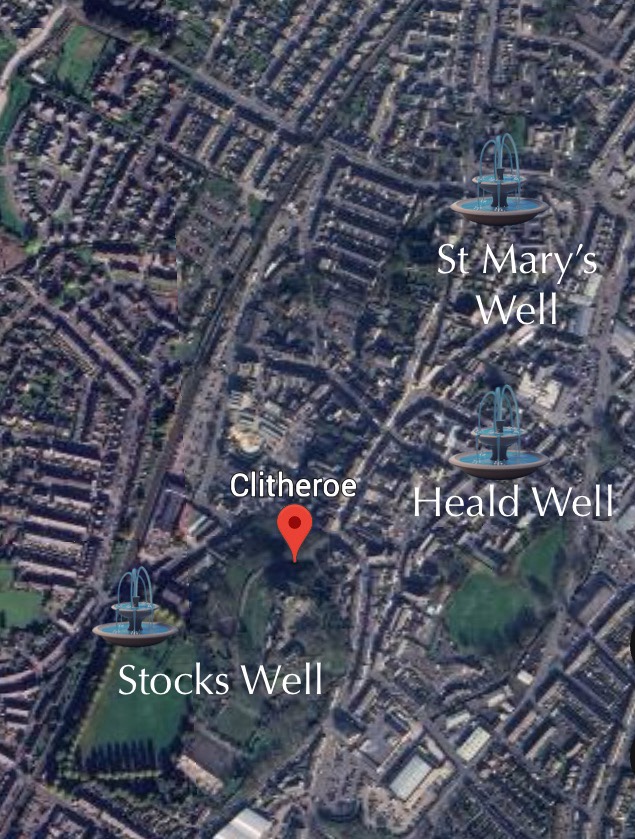
It was founded around three ancient wells, St Mary’s Well, Heald Well, and Stocks Well, which served not only as its primary water supplies but as social hubs too.
Their history stretches back centuries, to Anglo-Saxon times or older, and they have become enduring symbols of Clitheroe’s heritage.
Here we explore the origins, significance, and ongoing efforts to preserve these remarkable structures, drawing on historical records and local preservation campaigns.
(John S Turner)
Watering Holes
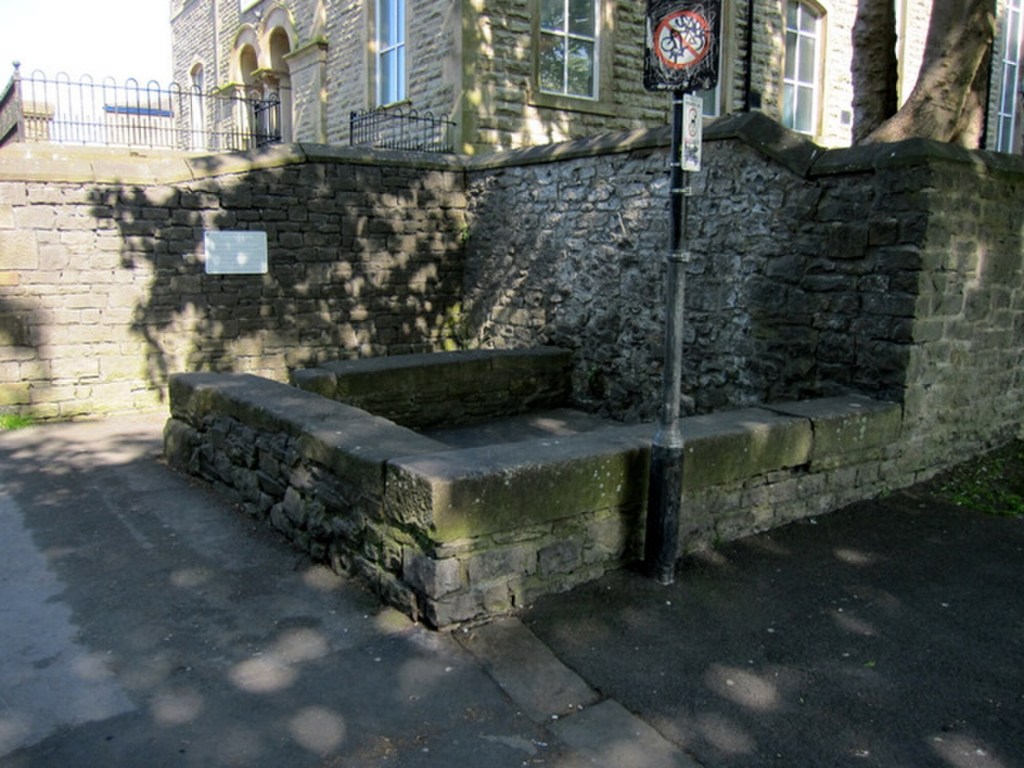
The three main wells of Clitheroe, St Mary’s, Heald (also spelt Heild), and Stocks, are believed to predate both Clitheroe Castle and St Mary Magdalene’s Church, potentially dating back to the Anglo-Saxon period or earlier.
Steve Ragnall, chair of the Clitheroe Town Wells Conservation Campaign (CTWCC), has argued that these wells, built atop ancient springs, were the primary reason for the town’s settlement. “It’s because of these springs that people were able to settle here,” he notes, emphasising their foundational role in Clitheroe’s development.
Each well has unique characteristics; St Mary’s Well, located on Well Terrace, is thought to be a holy well, possibly of medieval origin. Its structure features two stepped entrances and a stone gangway dividing the pool, with a worn cube-shaped stone likely used for washing clothes.
Heald Well, situated on Wellgate in front of the Dog Inn, and Stocks Well, accessible through Clitheroe Castle grounds, are both equally distinctive.


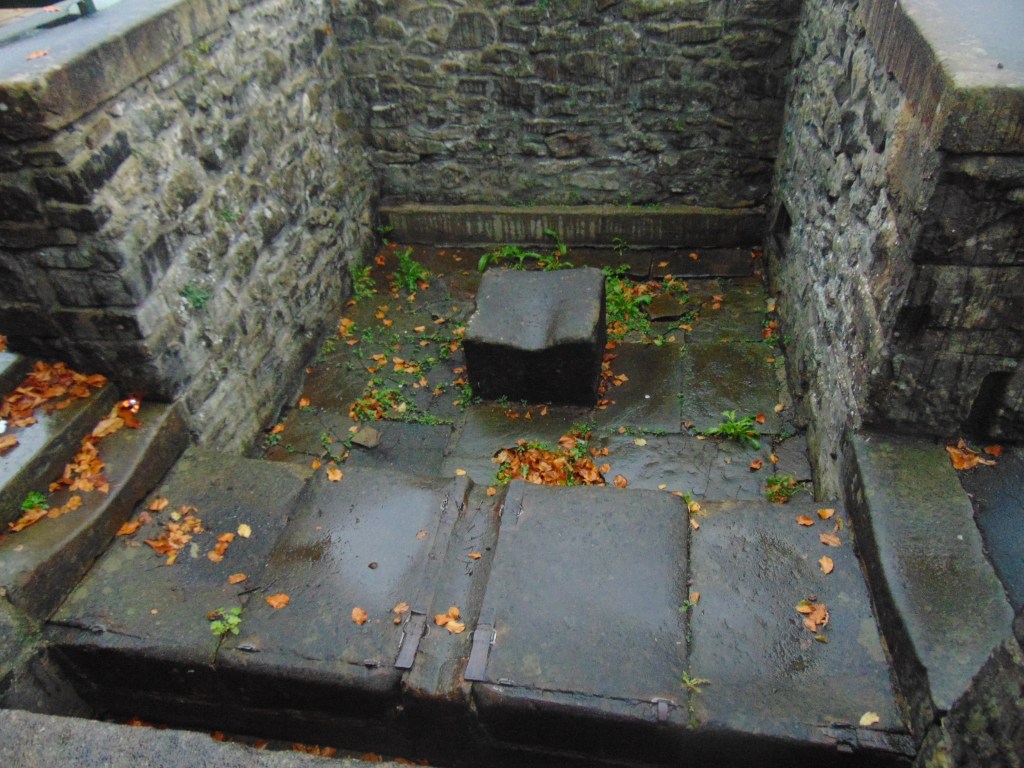
Stocks Well, named (according to several sources) for the town stocks once incorporated into its structure, is the smallest of the three and was first recorded in 1645.
Heald well, sometimes also known as Town well, was the largest, and possibly most important, situated at the oldest road junction in the town, the word ‘Heild’ or ‘Heald’, meaning roofed.
These wells were enclosed by walls with flagged floors, designed to hold pools of water, and they served as Clitheroe’s sole water supply until the mid-19th century, when piped water was introduced in 1856.
Beyond their practical function, the wells were social epicentres, Ragnall has likened them to “the Facebook of their day,” where townsfolk gathered to collect water, wash clothes, and exchange news and gossip.
(please remember to give it a like!)
When the Wells dried up
The wells’ prominence waned with the advent of modern water systems and by 1856, Clitheroe had transitioned to piped water, rendering the wells obsolete.
Stocks Well was sealed in 1880 after two children narrowly escaped drowning, and all three wells were capped, their springs no longer flowing. A cholera outbreak in 1849 had already heightened concerns about the wells’ water quality, prompting the Local Board of Health to prioritise cleaner water sources.
Despite their disuse, the wells were maintained by the Clitheroe Corporation, the predecessor to Ribble Valley Borough Council, into the 20th century, however, after the municipal reorganisation in 1974, responsibility for the wells became contentious.
While Stocks Well, located on council-owned land at Clitheroe Castle, was adopted by Ribble Valley Borough Council, the ownership of St Mary’s and Heald Wells remains unclear, with no registered title deeds.
This ambiguity has led to neglect, with the wells’ Grade II-listed structures deteriorating due to weathering and lack of maintenance.
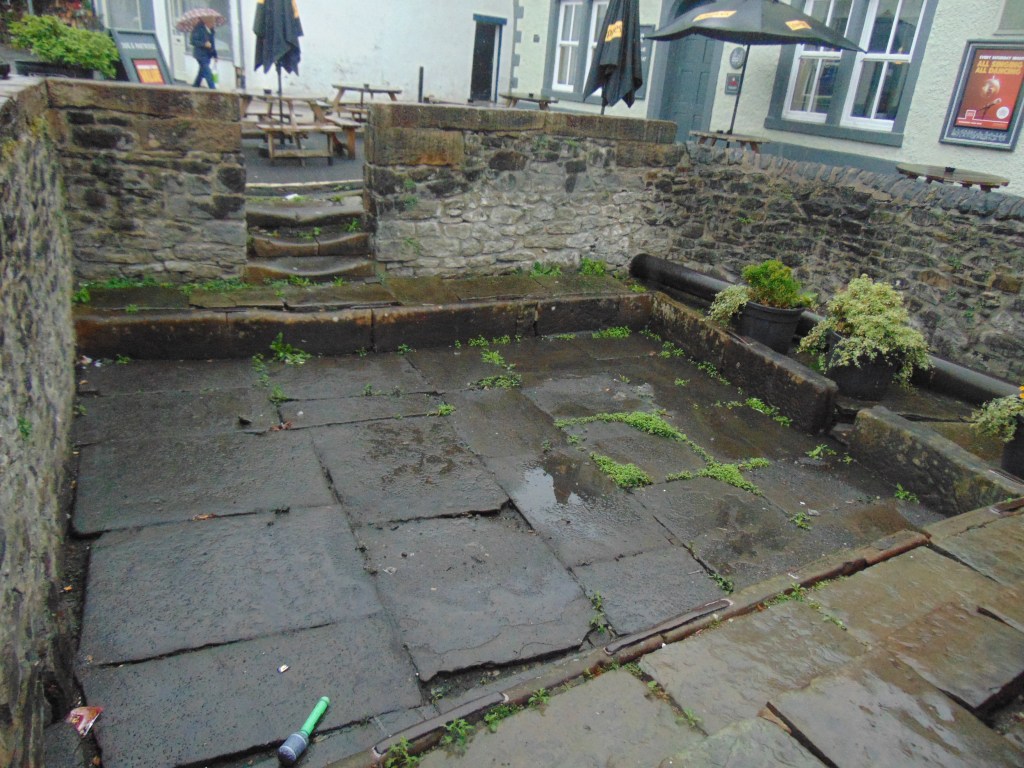
On occasions it still holds water.
Years ago Clitheronians would joke that you’d better off supping this water than a pint from the neighbouring Dog Inn! Thankfully the new landlords know what they’re doing and it’s an excellent pub now.
Vital waters
Clitheroe’s wells are more than mere relics; they are integral to the town’s identity. Listed as Grade II buildings, they are among its most significant heritage assets, alongside Clitheroe Castle and St Mary Magdalene’s Church.
This historical importance is underscored by their rarity, no other town in England is known to retain three such public wells within its conservation area.
Local historians and campaigners argue that the wells are as vital to Clitheroe’s story as its castle and that, unlike the castle, a symbol of martial power, or the church, a spiritual center, the wells represent the ‘temporal’ needs of the community; water, sustenance, and social connection.
Their locations, St Mary’s by a busy road, Heald in front of an Inn, and Stocks near the castle, reflect their integral roles in daily life.
The wells also hold archaeological potential, with some speculating they may date back to Saxon times or earlier, predating the Norman Conquest, something which deserves a deeper investigatory delve.
Their construction atop natural springs also reinforces Clitheroe’s deep connection to the area’s geology, a topic explored in Andy Bowes’ book reflections on the water.
Modern Conservation Efforts
In recent years, the Clitheroe Town Wells Conservation Campaign, supported by Clitheroe Civic Society, has spearheaded efforts to preserve the wells. The campaign seeks to secure their “lasting and meaningful future” by addressing two key challenges: establishing ownership and securing funding for repairs.
The ownership issue is a significant hurdle as, while Ribble Valley Borough Council adopted Stocks Well in 2019, it has resisted taking responsibility for St Mary’s and Heald Wells, citing a lack of evidence of ownership.
A 2022 council assessment found no record of title deeds for these wells, but campaigners argue that the council, as the successor to Clitheroe Corporation, has a “de facto” responsibility, having maintained them until recent decades.
The CTWCC has provided evidence to support this claim and is pressing the council to apply for possessory title through HM Land Registry, as it did successfully for Stocks Well.
To rally support, the CTWCC has engaged the community through public meetings, petitions, and exhibitions. A January 2025 meeting at Clitheroe’s Moot Hall drew over 50 attendees, who heard presentations on the wells’ history and the campaign’s goals. A petition launched in 2021 garnered nearly 1,800 signatures, urging the council to adopt all three wells to enable conservation work and boost tourism.
The campaign envisions the wells as tourist attractions, drawing inspiration from Tissington’s Well Dressing Festival in Derbyshire, which attracts 50,000 visitors annually.
By restoring the wells and integrating them into a town trail, the CTWCC believes Clitheroe could enhance its cultural and economic vitality further.

(Rosser1954)
Today and Tomorrow
Today, the wells are in varying states of disrepair. St Mary’s Well, positioned between bus stops on Well Terrace, shows signs of wear, with eroded stones from centuries of use.
Heald Well, on Wellgate, and Stock Well, near the castle, are similarly neglected, their mortar crumbling and structures vulnerable to further damage. Despite this, their historical integrity remains intact, and their Grade II status affords some protection within Clitheroe’s conservation area.
Ribble Valley Borough Council has expressed willingness to collaborate with the community, but progress hinges on resolving the ownership dispute. The CTWCC, backed by Clitheroe Town Council and local residents, is pushing for a Conservation Management Plan to outline repair costs and secure funding from sources like the National Heritage Lottery Fund.
Hopefully they will be seen as more than mere historical curiosities, but as testament to the town’s origins, resilience, and community spirit.
From their role as vital water sources to their modern status as neglected heritage assets, they encapsulate the enormous challenges of preserving the past in a rapidly changing world. The efforts of the Clitheroe Town Wells Conservation Campaign highlight a community determined to honor its history, not only for nostalgia but to enrich the town’s future.
As Steve Burke, a campaign leader, aptly stated, “Preserving our history is vital to understanding our present and shaping our future.”
(Google Earth)
Sources:
- BBC news, “Clitheroe’s historic wells were ‘Facebook of their day’”
- Lancs Live, “Future of historic wells in Clitheroe set to be decided”
- Clitheroe Town Wells Conservation Campaign (CTWCC)
- Lancashire Telegraph, “Clitheroe campaign to save town’s historic wells stepped up”
Other springs and wells in Clitheroe
There are several other springs and wells around Clitheroe, one is situated behind the building pictured below on Shawbridge St.
I used to live in this property so know a bit about its history as a tannery which I’ll write about in another article.
In its back yard is a manhole cover, underneath this sits a stone basin with gravel at the bottom, it filled up again very quick with clear water whenever we emptied it to water the garden, apparently it was uncovered when the building was converted from a mill to a house.

Next-door is a builder’s yard and in the corner of it is another spring, it’s known as ‘The Devil’s Spring’ as it never freezes or stops running. It was used by the builders to mix cement and my dad once had the water tested to see if it was feasible to bottle it and sell it as ‘Devil’s Spring-water’.
Unfortunately it runs out of a lead pipe which stretches all the way under the road to Duck St on the other side, so it obviously can’t be used as drinking water, as a kid we used it as a re-fueling station for our water pistols and super-soakers!
I hope to find out a bit more about these and Clitheroe’s other springs so I can write about them in the future, if you know anything about them or have any anecdotes to share, leave a comment and I’ll include it in these articles.
Old Clitheroe
The dear ancient Castle, Its tower and wall,
How my youth seems renewed, as the scene I recall:
How much I revere thee
words fall me to show,
Thou “Gem of the Valley,” dear Old Clitheroe.
(Excerpt from ‘Old Clitheroe’ by Thomas Birch c1850)
If you enjoyed this article you can show your appreciation by buying me a coffee, every contribution goes towards researching and writing future articles,
Thank-you for visiting my site,
Alex Burton-Hargreaves
(May 2025)
 Northwest Nature and History
‘Well’ said Steve. How long do we have to keep knocking on RVBC’s door of ‘responsibily evasion’? The key is held, on behalf of this Community, by only one or two people. High time thus door was opened once again – or the key passed to others prepared and willing to take up this responsibility!
LikeLiked by 1 person