A Brief Examination of the Structural and Architectural History of Lancashire’s Samlesbury Hall, Including a Glossary of Architectural Terms
“How will we know it’s us without our past?”
–John Steinbeck, Grapes of Wrath
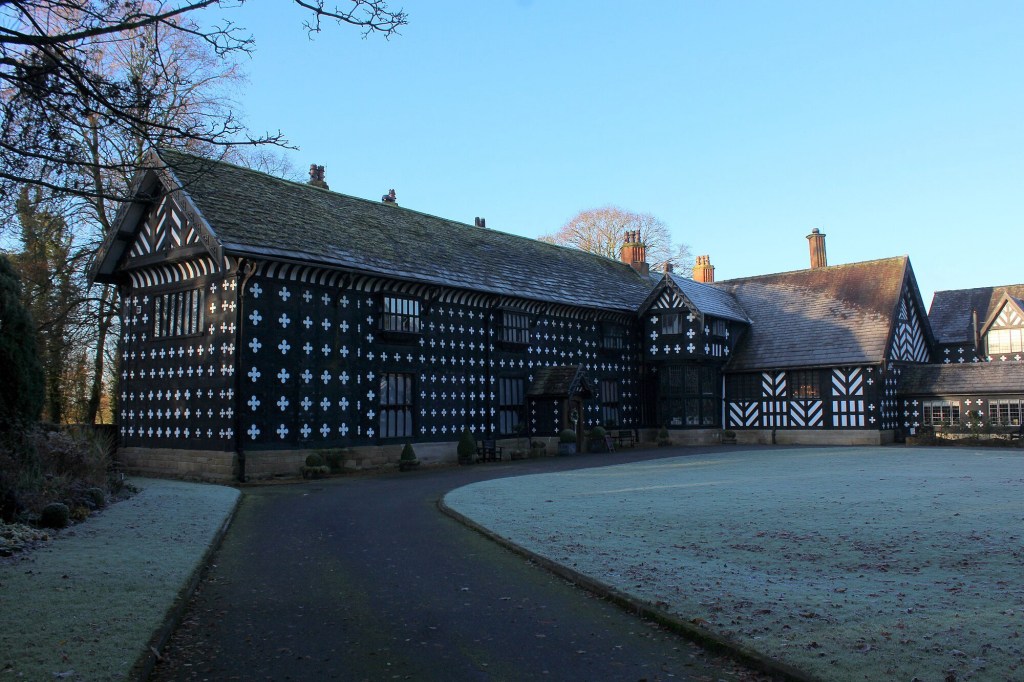
Samlesbury Hall is a beautifully maintained medieval manor house situated in Lancashire’s Ribble valley near the city of Preston with a long and rather intriguing history.
Built initially in 1325 by Gilbert de Southworth, the house has undergone numerous expansions and modifications over the centuries and is now a hodge-podge of timber framing, stone, and early brickwork. Its structure bears witness to the evolution of English architecture from primitive medieval timber halls to more elaborate Tudor designs, incorporating archaic design elements like cruck trusses and oriel windows.
Today, preserved by the Samlesbury Hall Trust since 1925, the building serves as a public historic site.
Here we examine its structural progression and how this reflects the history of Lancashire itself as it transformed through the centuries into the modern county we know and love today.
Medieval Origins (14th Century)
The earliest phase of Samlesbury Hall dates to around 1325, when Gilbert de Southworth (Sir Gilbert de Southworth, Knight, Lord of Southworth, Croft, and Samlesbury, to give him his full title) constructed the Great Hall as his family seat, replacing a structure damaged during the Great Raid of 1322 by Scottish forces, a major raid carried out by Robert the Bruce during the First Scottish War of Independence.
This initial building was a simple timber-framed hall with a thatched roof, bearing little resemblance to the grand black-and-white edifice we see today, measuring approximately 96 feet long and 35 feet wide.
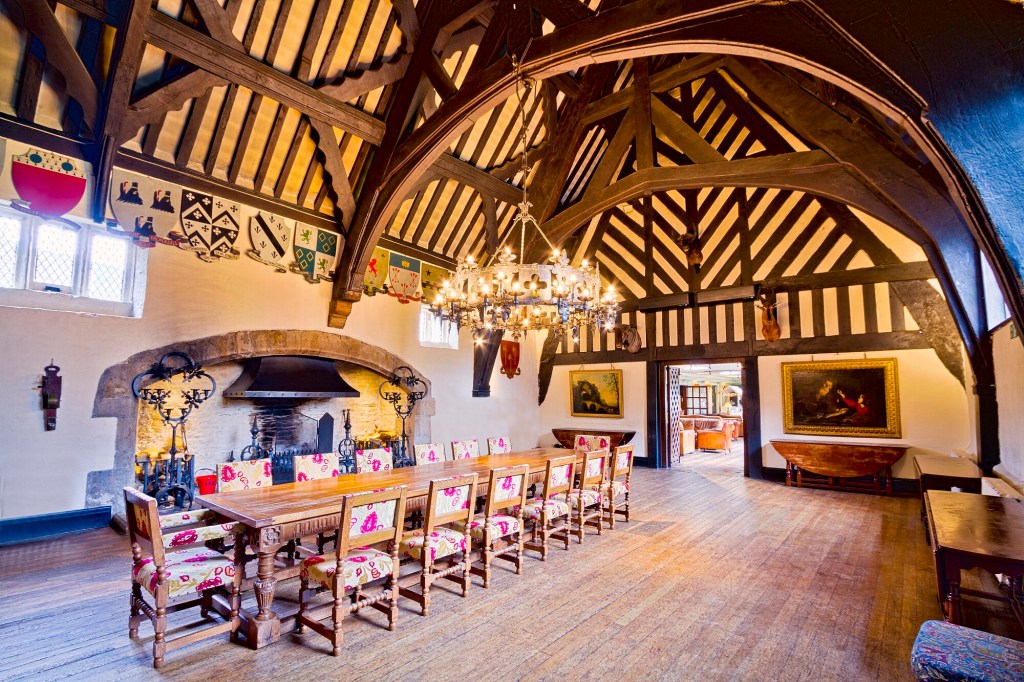
A model of early 14th-century timber construction it was characterised by a framework independent of walls and dominated by massive oak principals, which supported bold Gothic arches overhead. These principals, some measuring up to 12 by 18 inches, sprung directly from the ground, supported by crossbraced king posts and horizontal ties, creating a hull-like interior reminiscent of an inverted ship.
The structure rests on a low stone basement, with rafters resting on wall plates sustained by horizontal spars grooved into the principals, above lay an open roof, and the hall’s imposing grandeur was further enhanced by a huge arched fireplace standing 6 feet 9 inches high and 14 feet 9 inches wide.
As was the contemporary style of the time the hall was illuminated through eastward-orientated solar end windows which, as well as capturing the most light in the dark winter months, symbolised Christ’s resurrection, light, and the expected direction of the Second Coming.
These windows looked out onto a quadrangular courtyard surrounded by a moat, now largely infilled, with the western edge revetted by a mortared sandstone wall. Archaeological evidence, including geophysical surveys and trenching, has confirmed the moat’s presence, with backfills containing 18th and 19th century rubble and clay capping.
Tudor Expansions (15th and 16th Century)
Under Sir Thomas Southworth, the High Sheriff of Lancashire at the time, the hall saw significant rebuilding.
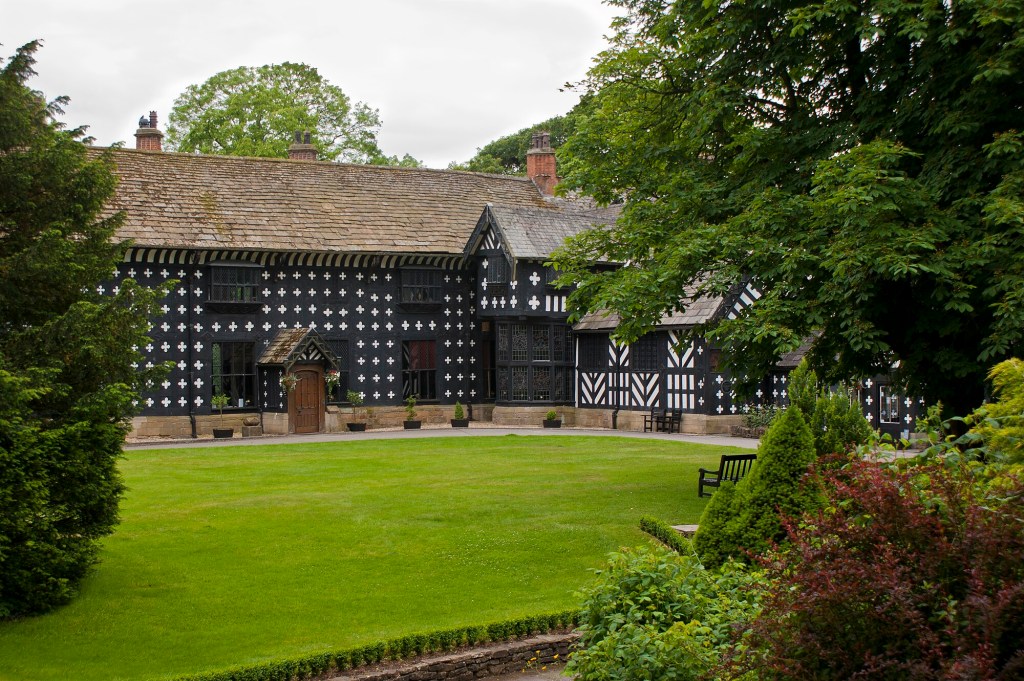
Around 1532, he refurbished the Great Hall and added the west wing, incorporating box-framing over four bays and two storeys. On the end of the west wing’s end and inner walls he had black-and-white quatrefoil patterns created on the infill panels, topped by an embattled wall plate and coving to the eaves. Other improvements included a large bay window and a huge, impressively ornate fireplace.
By 1545, the south-west wing was added, extending from the solar of the Great Hall and including a 15th-century chapel (possibly originally free-standing). Peculiarly this chapel’s connection to the main hall forms an angle of less than 90 degrees, this is attributed to the calculation of the sun’s solstice position (the means by which due east was deliberated) being more accurate 140 years after the Great Hall was first built.
The south wall of the hall includes an early 16th-century polygonal oriel with an oblong gabled upper level, this was restored around 1865 with herringbone timber framing.
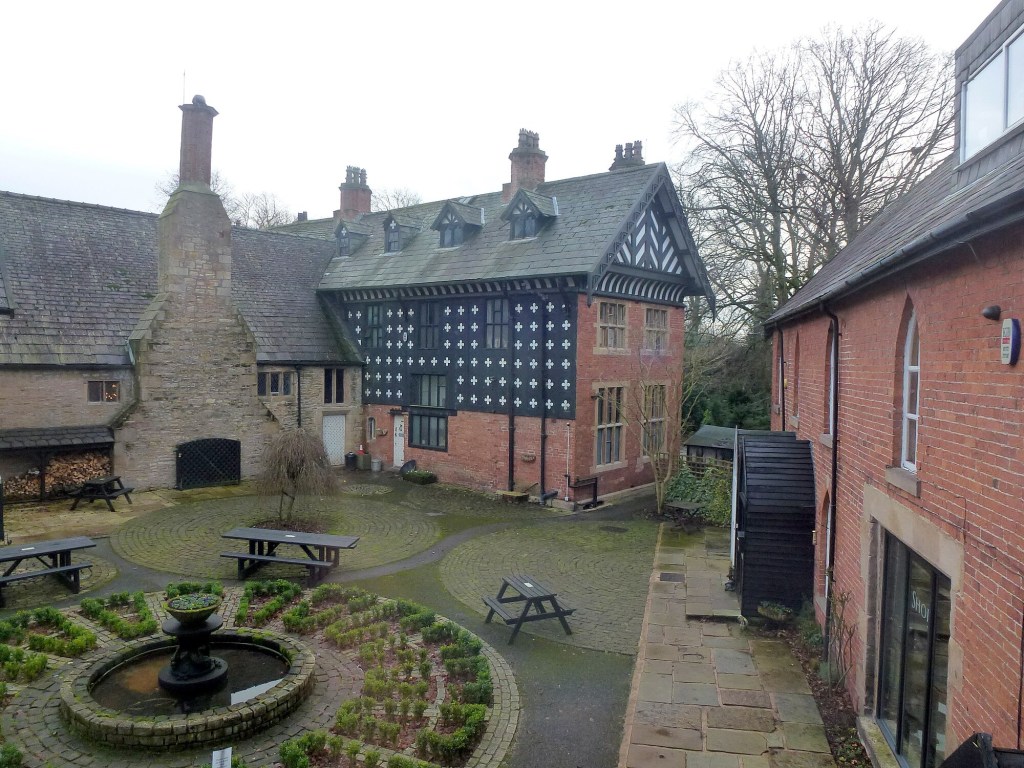
The rear walls of these additions vary widely; the hall in 16th-century rubble with a large external three-stage chimney and small two-light windows; the wing in 16th-century red brick with diaper patterning, and tall stone mullion windows with cinquefoil lights and 15th-century tracery.
The Brickwork of Samlesbury Hall
Samlesbury Hall’s brickwork represents a pioneering adoption of the material in Lancashire, marking a shift from the traditional timber and stone.
Introduced in the south-west wing during Sir Thomas Southworth’s rebuilds, it is among the earliest examples in the region, the bricklayers hired also working on nearby Rufford Old Hall.
The south front, extending 105 feet and facing the road, is constructed of brick with stone dressings and a basement, broken by three bold chimney stacks.Flues in each stack gather into a single brick shaft, terminating in a stone capping, with one bearing the Southworth armorial shield.
Enrichments include blue brick diamonds, adding decorative flair, alongside a coved cornice of lath and plaster, and square-headed windows feature cinquefoiled lights, one with rich Henry VII-style tracery salvaged from Whalley Abbey after its dissolution in 1536.
In the south-west wing, brick was added as a 9-inch outer skin around rubble cores to accommodate re-used Whalley Abbey windows, dated from post-1536 to the early 1550s. This technique; two brick skins encasing rubble, contrasts with later 19th-century solid bonds.
The west wing’s outer wall is brick, integrated into the 1532 addition, and brick partitions and drains, such as those in the chapel’s north wall, further illustrate the material’s functional role in its development of the hall through the ages.
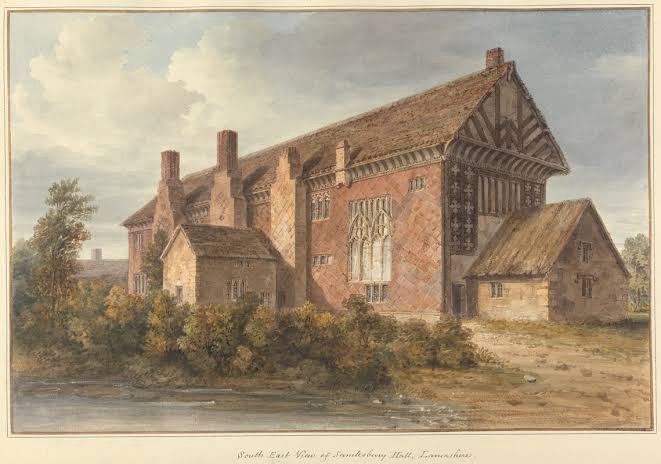
South-east view of Samlesbury Hall, painted in 1818 by John Buckler (1770-1851)
Later Modifications and Preservation
From the 17th century, now under the ownership of the Braddyll family, the hall was divided into tenements and neglected.
The 19th century brought changes: in 1835, it became the Braddyll Arms inn, with outshuts removed and panelling disassembled.
Joseph Harrison acquired it in 1862, restoring and extending the hall, rebuilding the south-west wing, adding a new staircase, and using solid brick in his additions. The Harrisons also converted it briefly to a boarding school in the 1850s.
Although it might seem inconceivable to us now the hall faced demolition in the early 20th century but in 1925, the Samlesbury Hall Trust, through the generosity of public subscription and local philanthropists, rescued it, conducting restorations like staircase repositioning, basic fabric repairs and installing a modern weather-proof slate roof.
Recent restoration work, such as replacing decayed wooden window frames and rotten supports with new oak, and major work on plasterwork, paint, and internal finishes, further ensure the hall’s structural integrity for a long time to come.
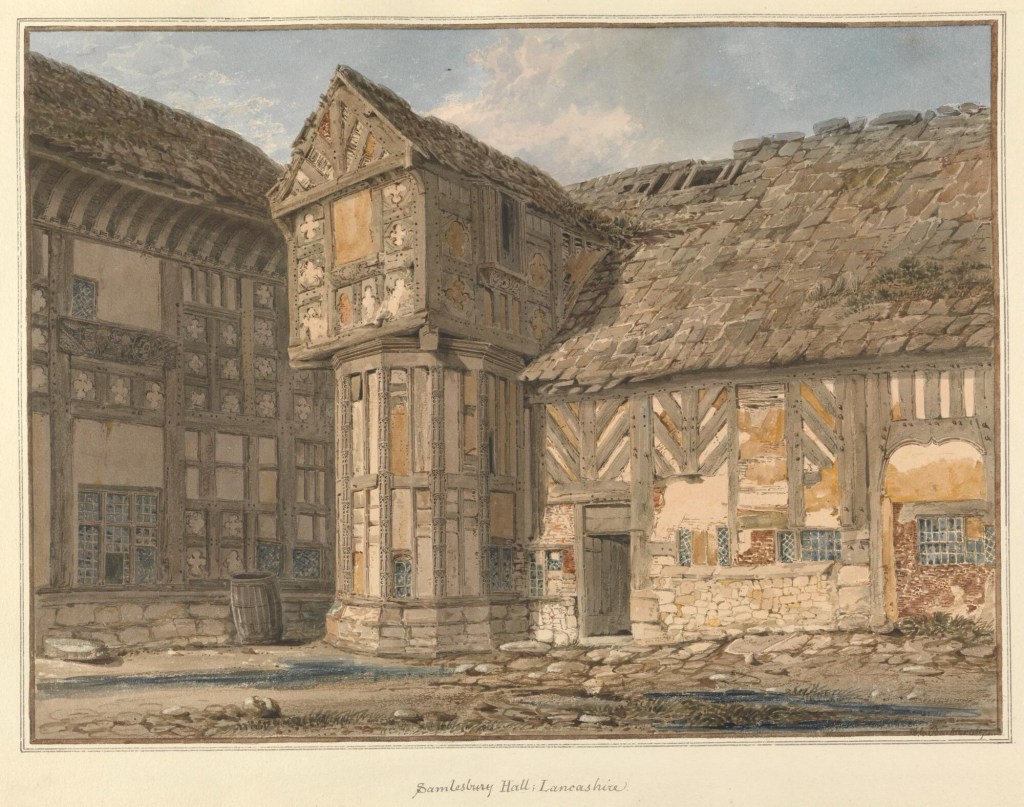
The Hall Today
Today the Grade I listed hall is regarded as one of the finest examples of a black-and-white timber-framed stately home in the whole of Britain, attracting over 50,000 visitors annually as a major heritage attraction.
Still cared for by the Samlesbury Hall Trust, whose mission focuses on protecting the hall for future generations, maintaining its fabric, and using it for recreation, education, and community benefit, it is open to the public most days of the week, typically Tuesdays through Fridays and Sundays from 10am to 4pm, though closed on Saturdays and Mondays unless special events are scheduled.
The guided tours are a must, often held on Sundays at 11am and 2pm, they are led by engaging presenters (including some with TV experience) who bring the history to life through character-led or themed experiences.
The hall also hosts a wide variety of events through the year, such as festivals, theatrical productions, fairs, special torchlight or tours (capitalising very shrewdly on its reputation as one of Britain’s most haunted places), themed dining evenings, and family activities like half-term events. It also serves as a popular wedding venue, with shepherd’s huts available for glamping-style stays. Facilities include a very popular cafe, a well-stocked gift shop and, unlike many historic properties where this is almost impossible to achieve, accessible ground-floor areas.
Beyond its physical beauty, historical importance and connections to famous historical figures (Sir Arthur Conan Doyle and Charles Dickens both stayed there and no fewer than three 20th century American Presidents are direct descendants of Thomas Southworth) the hall represents something perhaps less tangible but, to me at least, a lot more impressive.
It tells a remarkable tale of resilience, adaptation and survival through massive changes over 700 years of Lancashire’s turbulent and tumultuous history, and speaks for the many people who lived through those often hard times.
I shall tell some of their stories in the future, and maybe recount a ghost story or two come Halloween, but for now here is some footage of King Charles visiting Samlesbury Hall a couple of weeks ago on his most recent tour of the Ribble valley.
For the latest opening times, events, or to book a visit, check the official website at samlesburyhall.co.uk.
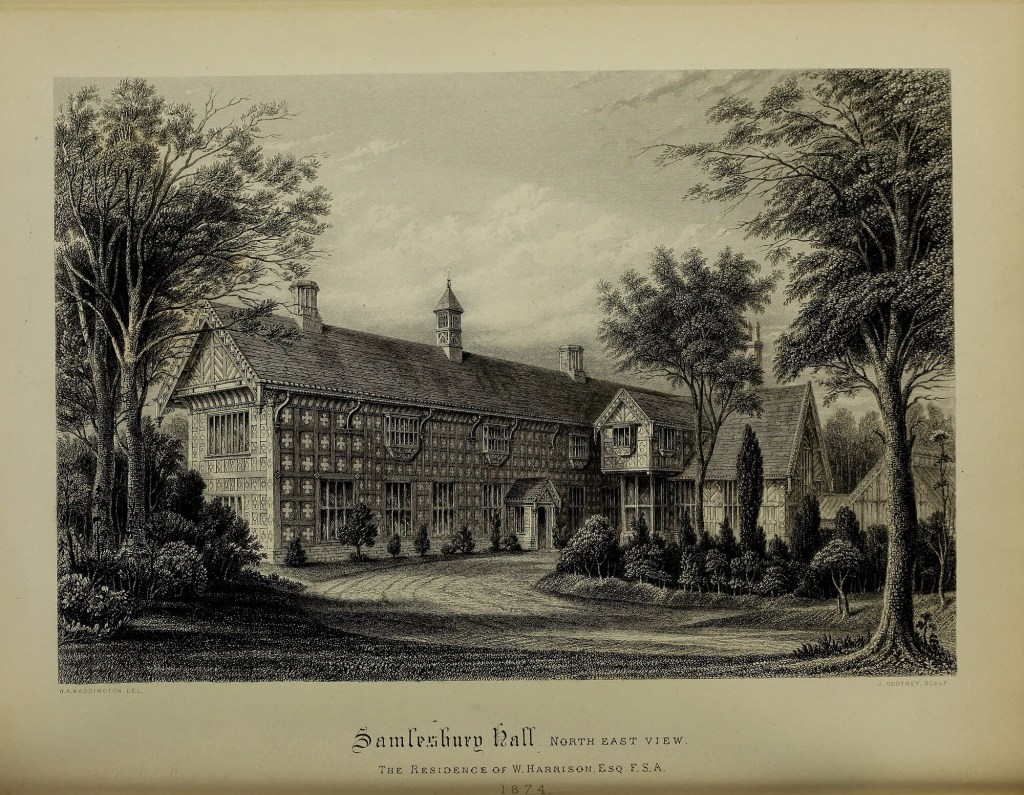
Illustration from the History of the original Parish of Whalley, by Thomas Dunham Whitaker, 1759-1821
Glossary of Architectural Terminology
Arch brace
A curved brace connecting a post or wall to a beam or tie, providing additional support and forming an arched shape for stability and aesthetic appeal.
Box-framing
A method of timber construction where the building’s roof trusses are supported by a self-contained framework of vertical posts, horizontal tie beams, and wall plates, independent of cruck-style curving timbers. This allows for multi-storey structures and is common in Tudor-era additions.
Brick diaper patterning (or diaper work)
A decorative arrangement of bricks, often in contrasting colors (e.g., blue headers forming diamond or lozenge patterns against red stretchers), often used on elevations or chimney stacks for visual interest in 16th-century brickwork.
Cinqefoiled lights (cinquefoil lights)
Window openings divided into five cusped (leaf-like) lobes or foils, a Gothic tracery style common in medieval and early Tudor windows for light admission and decoration.
Coved cornice
A concave, curved molding or projecting shelf at the top of a wall or under eaves, often formed from plaster, timber, or brick, providing a graceful transition and helping shed water.
Cruck truss (or cruck frame)
A primitive but strong roof truss formed by pairs of large, naturally curved timbers (called cruck blades) rising from ground level or low foundations to meet at or near the roof apex, creating an A-frame or arch-like support. At Samlesbury, the Great Hall features full cruck trusses with moulded through-purlins and cusped wind braces.
Cusped wind brace
A curved or arched diagonal brace with cusps (pointed indentations) for decoration, connecting purlins or other roof members to resist lateral (side-to-side) movement or ‘racking’ in the frame.
Diaper patterning (see above)
Embattled wall plate
A wall plate (horizontal timber along the top of a wall) topped with crenellations or battlements-like notches, giving a fortified or decorative appearance.
Herringbone timber framing
A decorative infill or bracing pattern where timbers are arranged in a zigzag, V-shaped motif resembling fish bones, often used in panels or gables for strength and visual effect.
King post (or king strut)
A central vertical timber in a roof truss extending from a tie beam or lower chord up to the ridge or an upper collar, often braced, to support the roof apex and prevent sagging.
Moulded through-purlin
Horizontal roof timbers (purlins) that run parallel to the ridge and support common rafters, ‘through’ meaning they pass continuously through trusses; ‘moulded’ refers to decorative shaping or profiling on their edges.
Oriel window (polygonal oriel)
A projecting bay window, often polygonal in plan and supported by corbels or brackets, rising from the wall (not from ground level like a bay window). At Samlesbury, an early 16th-century example features an oblong gabled upper level (see photo below)
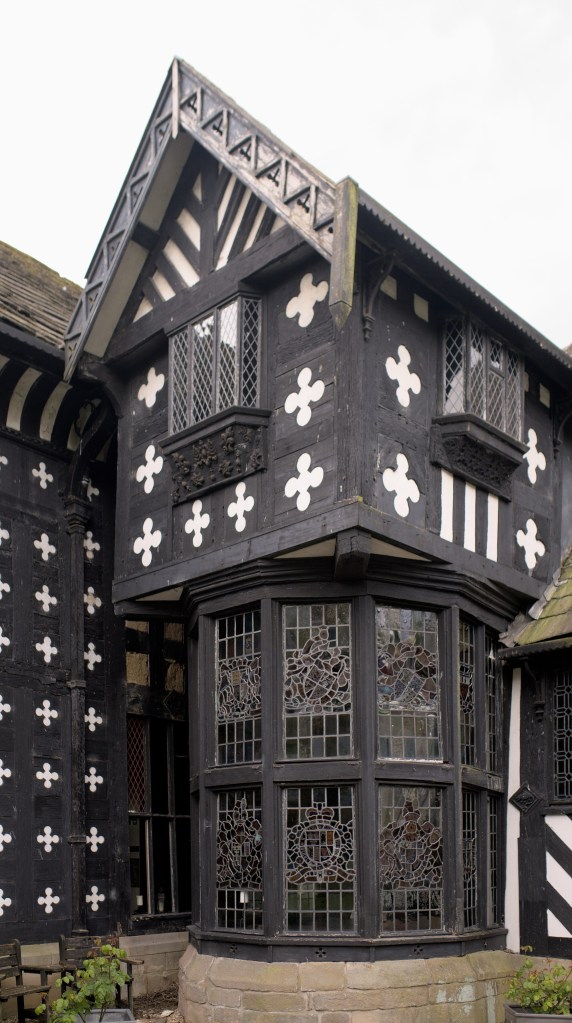
Quatrefoil
A four-lobed decorative pattern (resembling four leaves or a clover) used in timber infill panels, tracery, or brickwork for ornamental effect.
Raking strut
A diagonal or sloping strut in a truss providing additional bracing, often from a king post or collar to principal rafters.
Through-purlin
See moulded through-purlin; purlins that extend unbroken through multiple trusses for structural continuity.
Tie beam
A major horizontal timber at the base of a truss connecting the feet of opposing rafters or cruck blades, resisting outward thrust and tying the structure together.
Wall plate
A horizontal timber laid along the top of a wall (often on stone or masonry) to receive and distribute the load from roof trusses, rafters, or floor joists.
Wind brace
A diagonal timber brace in the roof plane to prevent racking (lateral distortion) and provide rigidity, often cusped or arched for decoration.
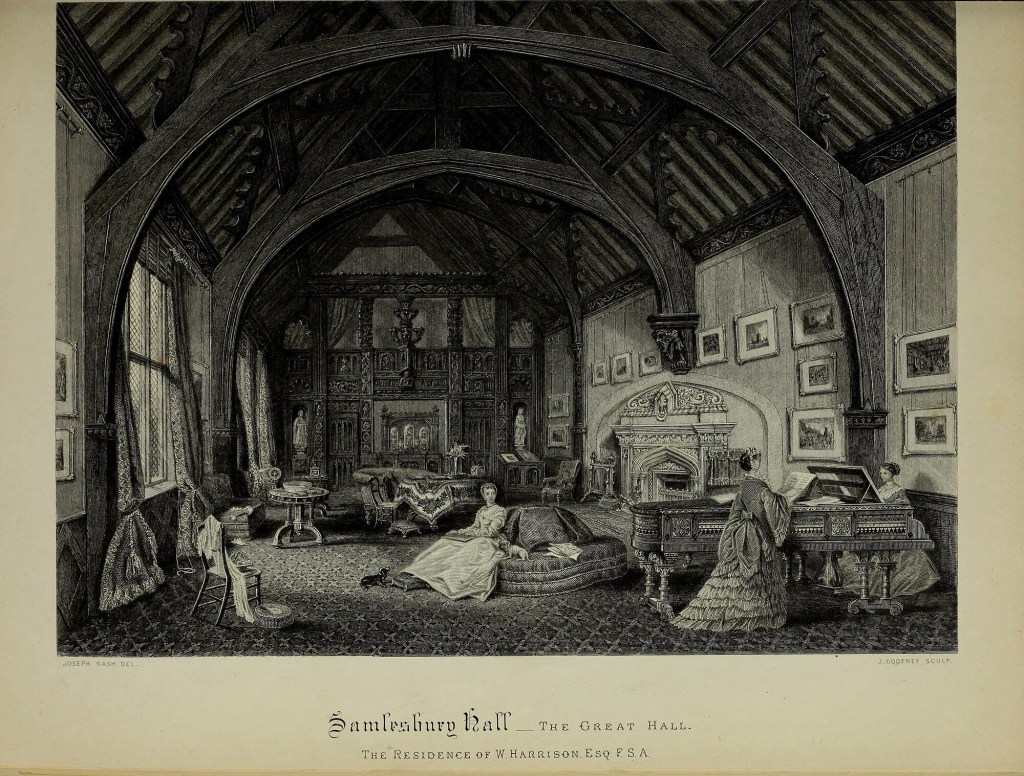
Illustration from the History of the original Parish of Whalley, by Thomas D Whitaker
If you enjoyed this you can show your appreciation by buying me a coffee, every contribution will go towards researching and writing future articles,
Thank-you for visiting,
Alex Burton-Hargreaves
(Feb 2026)
 Northwest Nature and History
Another excellent article, Alex. I’ve posted it round Preston Facebook groups
LikeLiked by 1 person
Thank-you Peter, that means a lot 🙂
LikeLike
I met princess Anne there once in the 70,s. Love to hear about the white lady we always mentioned the ghost when passing. Never been inside ….
LikeLiked by 1 person
I might write a ghost story about the white lady later on this year, she’s been seen by many visitors so there must be something to it!
LikeLike