By Gerard Manley Hopkins

Break the box and shed the nard;
Stop not now to count the cost;
Hither bring pearl, opal, sard;
Reck not what the poor have lost;
Upon Christ throw all away:
Know ye, this is Easter Day.
Build His church and deck His shrine,
empty though it be on earth;
Ye have kept your choicest wine—
Let it flow for heavenly mirth;
Pluck the harp and breathe the horn:
Know ye not ’tis Easter morn?
Gather gladness from the skies;
Take a lesson from the ground;
Flowers do ope their heavenward eyes
and a Spring-time joy have found;
Earth throws Winter’s robes away,
decks herself for Easter Day.
Beauty now for ashes wear,
perfumes for the garb of woe,
chaplets for dishevelled hair,
dances for sad footsteps slow;
Open wide your hearts that they
let in joy this Easter Day.
Seek God’s house in happy throng;
Crowded let His table be;
Mingle praises, prayer, and song,
singing to the Trinity.
Henceforth let your souls alway
make each morn an Easter Day.

A Biography of Gerard Manley Hopkins
Gerard Manley Hopkins (1844 -1889) was an English poet and Jesuit priest whose innovative and intensely observed verse made him one of the most distinctive and influential voices in English literature, though his work remained largely unpublished until nearly three decades after his death.
Born on the 28th of July 1844 in Stratford, Essex (now part of Greater London), Hopkins was the eldest of nine children in a prosperous, artistic Anglican family. His father, Manley Hopkins, worked in marine insurance and wrote poetry; his mother came from a medical background. Young Gerard showed early talent, winning poetry prizes at Highgate School, and in 1863 he went up to Balliol College, Oxford, to study classics. There he excelled academically (achieving a double first) while continuing to write verse influenced by the Pre-Raphaelites, John Ruskin, and Walter Pater.
A profound spiritual crisis led to his conversion to Roman Catholicism in 1866, and he was received into the Church by Cardinal John Henry Newman. This decision strained relations with his family and in 1868 he entered the Jesuit novitiate, burning his early poems as an act of renunciation, believing poetry might conflict with his religious vocation. He trained for nine years across various Jesuit houses in England, was ordained a priest in 1877, and spent the following years in pastoral and teaching duties in places including London, Oxford, Liverpool, Glasgow, and Stonyhurst College here in Lancashire.
Hopkins resumed writing poetry in 1875 at the request of a superior, producing his masterpiece ‘The Wreck of the Deutschland’ (inspired by the drowning of five Franciscan nuns in a German maritime disaster) and a burst of extraordinary sonnets such as ‘God’s Grandeur’ (as recited here by HRH King Charles III), ‘Pied Beauty’, ‘The Windhover’, and ‘Spring and Fall’.
His style was radically original: he developed ‘sprung rhythm’ (a stress-timed metre that mimicked natural speech), coined compound words, and used vivid, sensory imagery to celebrate the ‘inscape’ (the unique inner essence) and ‘instress’ (the unifying force) of creation, all infused with deep religious awe and, later, profound spiritual desolation.
From 1884 until his death, he served as Professor of Greek at University College Dublin. The move to Ireland brought professional strain, isolation, and worsening health. He died of typhoid fever on 8 June 1889 at the age of 44 and was buried in Glasnevin Cemetery, Dublin.
His friend, the poet Robert Bridges, published the first collected edition of Hopkins’s poems in 1918. The volume revealed a voice of startling modernity; musical, compressed, and theologically rich, that profoundly shaped 20th-century poetry, influencing writers from W.H. Auden and Dylan Thomas to Seamus Heaney and beyond.
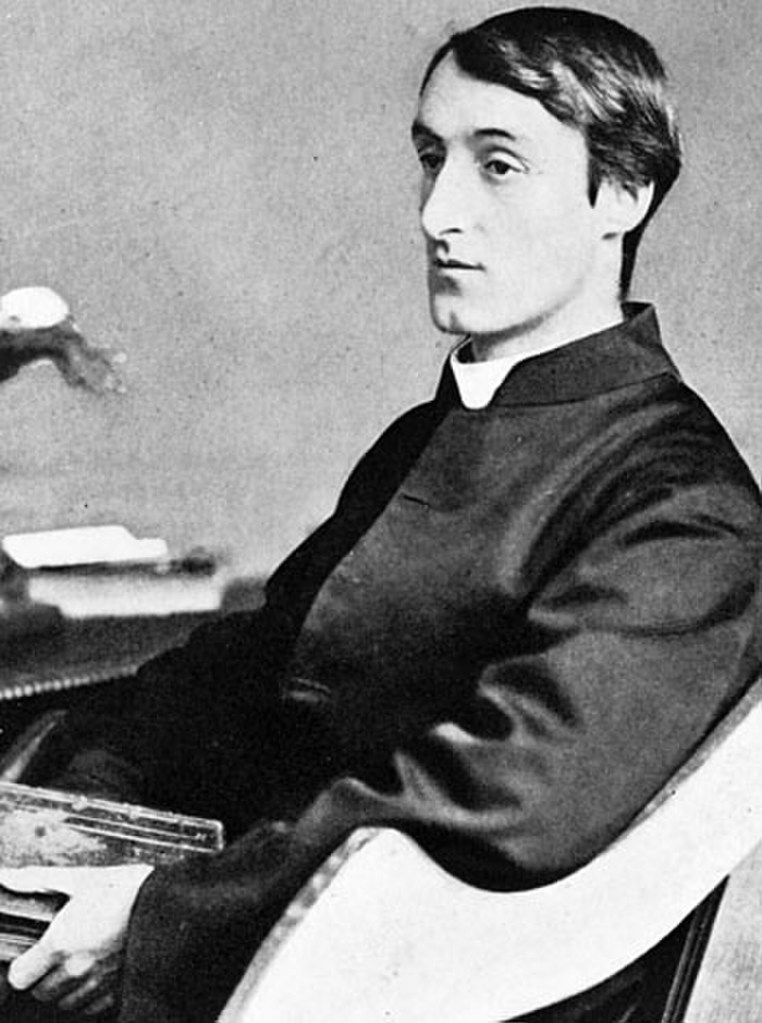
(1844-1889)
Alex Burton-Hargreaves
(Easter 2026)
 Northwest Nature and History