Ecology, Habitat, and Uses of Sneezewort (Achillea ptarmica)
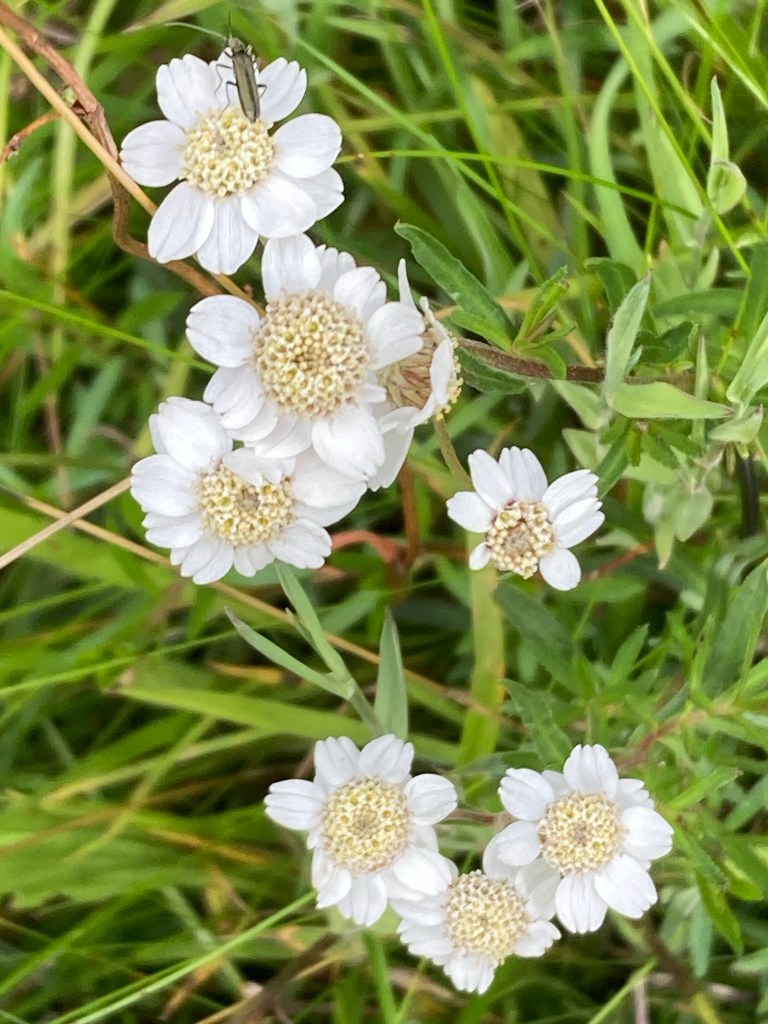
On the southern fringes of the Lancashire town of Padiham lies an expanse of over 600 acres of common land bordered by the Leeds/Liverpool canal, a B-road, a housing estate and an industrial estate.
This land, known locally as Hapton Moor and part of Hapton commons, is ecologically quite diverse, being composed mainly of successional scrub and unimproved pasture, with two streams, a pond and some mature woodland thrown in for good measure.
I spend a lot of time on’t moor, living as I do on the housing estate to the north, and every time I’m on there I find something new, often in plain site where I’ve walked dozens of times before.
On my last visit I walked across the middle of the moor, cutting through a meadow around which dog walkers usually circuit, and spotted a scattering of white flowers of a species which I hadn’t seen here before. These belonged to a member of the Daisy family and told me a little bit about how the moor has been used over the years since the Towneley family acquired it and turned it into a deer-park in the late 1400’s.

Sneezewort
Sneezewort (Achillea ptarmica) is a perennial member of the Asteraceae (daisy) family and typically grows between 30 and 60cm tall, occasionally a little higher, with stiff, upright stems that may be slightly hairy in the upper parts. The leaves are narrow, lance-shaped and finely toothed along the margins, quite different from the feathery, much-divided foliage of its cousin Yarrow, which is also found on Hapton moor.
The flower-heads appear from July into September in loose, rather flat-topped clusters, and each head is pure white (never the pinkish tinge sometimes seen in Yarrow), with eight or more short, barrel-shaped ray florets surrounding a small, greenish-white disc.
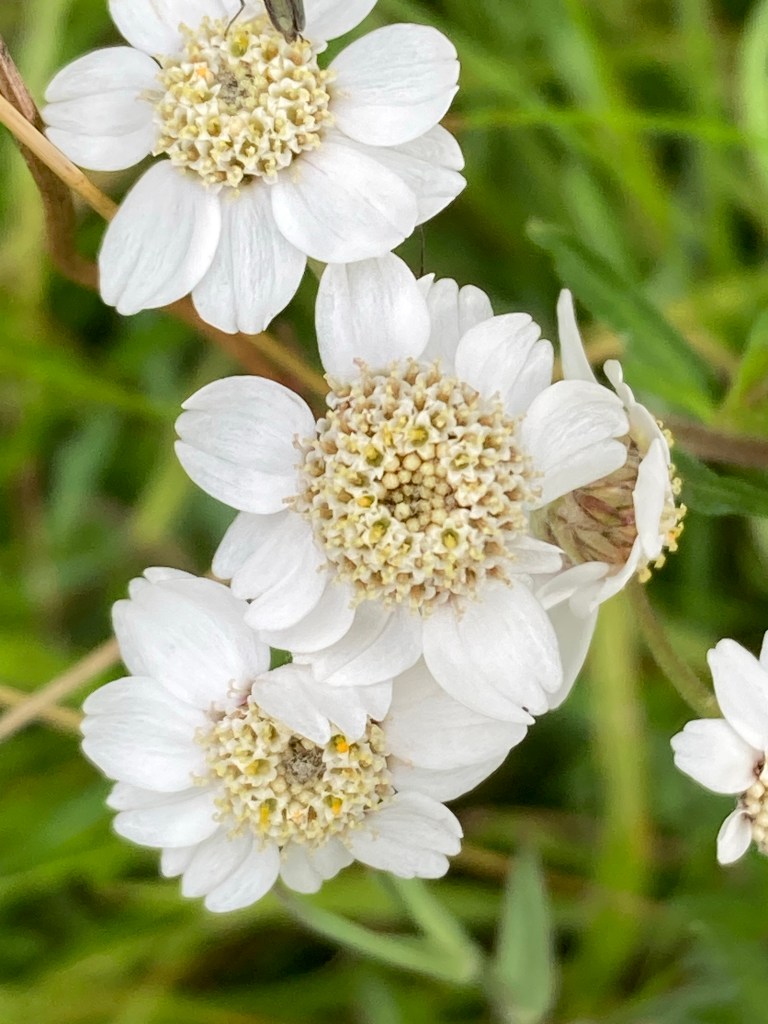
The scientific name is revealing; Achillea recalls the Greek hero Achilles, who was said to have been taught the healing properties of plants in this genus by the centaur Chiron, and the specific epithet ptarmica comes from the Greek ptairo (πταίρω), an onomatopoeic word meaning ‘to sneeze’.
This is no poetic flourish as the dried and powdered leaves or roots of the plant were once deliberately used as a sternutatory, a sneezing powder, both as a folk remedy for clearing the head and, one suspects, as a practical joke. Chewing the root or leaves was also recommended for toothache; the plant producing a mild numbing, tingling sensation in the mouth, not unlike Sichuan pepper, which the Chinese use in Five Spice Powder.

Habitat
The part of the meadow I found this colony of Sneezewort on is damp in winter, as water seems to spring up from this spot, but it doesn’t get waterlogged, even though I suspect field-drains were never put in here, the soil is also slightly acidic, both conditions that suit this plant very well.
Habitats you are most likely to meet it in include:
- Rushy pastures and wet meadows
- Stream and ditch margins
- The edges of ponds or winter-wet hollows
- Less-improved grassland on heavier clay soils
It is more frequent in the north and west of Britain than in the south and east, where drainage and agricultural intensification have reduced its numbers. Here in Lancashire and the surrounding counties it remains a reasonably familiar plant of damper ground, though colonies can be local and easily overlooked until the white flower-heads appear in midsummer.
Like many of our traditional meadow plants, it has suffered from the wholesale improvement and drainage of wet grasslands over the last century, where it survives it indicates less intensively managed land, a small but welcome signal of continuity.

Mike Pennington
Ecologically Valuable
Sneezewort is a useful plant for pollinators, its open, accessible flower-heads attracting a range of insects, including various bees, Hoverflies and smaller butterflies, it also serves as a food plant for the larvae of certain moths. The plant spreads both by seed and by short rhizomes, allowing it to form modest colonies where conditions remain suitable.
In the garden it is easily grown from seed or division and makes a good addition to a damp border or wildlife-friendly area, particularly when planted with other moisture-loving natives. Double-flowered forms (sometimes called ‘Bachelor’s Buttons’) have long been grown in cottage gardens and occasionally escape, but the wild single form is the one of real ecological value.
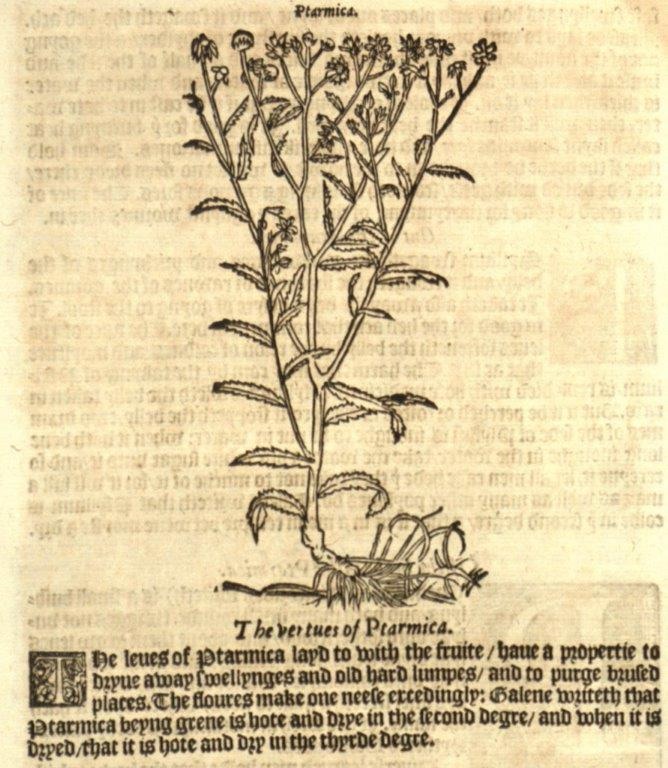
Illustration of sneezewort from A New Herbal, (1551), by William Turner
Historical Uses
Beyond its use as a sneezing powder and toothache remedy, Sneezewort appears in older herbals under various names: Arnica, Pellitory, White tansy, Goose tongue and Fair-maids-of-France. Like many members of the daisy family it was once more widely employed in folk medicine, though its reputation never quite matched that of its cousin yarrow. The dried leaves were also said to act as a mild insect repellent.
Its presence on Hapton Moor and elsewhere in the landscape is a small reminder of the wetter, more varied grasslands that once characterised much of lowland Lancashire and the surrounding counties. In an age of drainage, re-seeding, and outright loss of our pastures to development, every surviving colony is worth noting and, where possible, protecting.

Achillea
In the hush of a still summer evening,
when the meadow was holding its breath,
I found then standing, quiet and white,
among the grasses in the soft green depth.
Eight pure petals, neat as a thought,
on a stem that rose without fuss or claim,
upon which a bee crawled slow through the drowsy heat,
with the soft summer breeze seeming to whisper its name.
No show, no shout, just a modest little star,
in the long green grass where the light fell mild.
I knelt a moment, then walked on, but not far,
and carried the small, clean moment home with me; a memory of the wild.
Thank-you for reading. If you enjoyed this piece (and tolerated my dire attempt at poetry) and would like to support further articles on the wildlife and history of the Northwest, you can buy me a coffee here.
Alex Burton-Hargreaves
(August 2026)

