A Guide to the Three Main Species of Nightshades found in Northern England
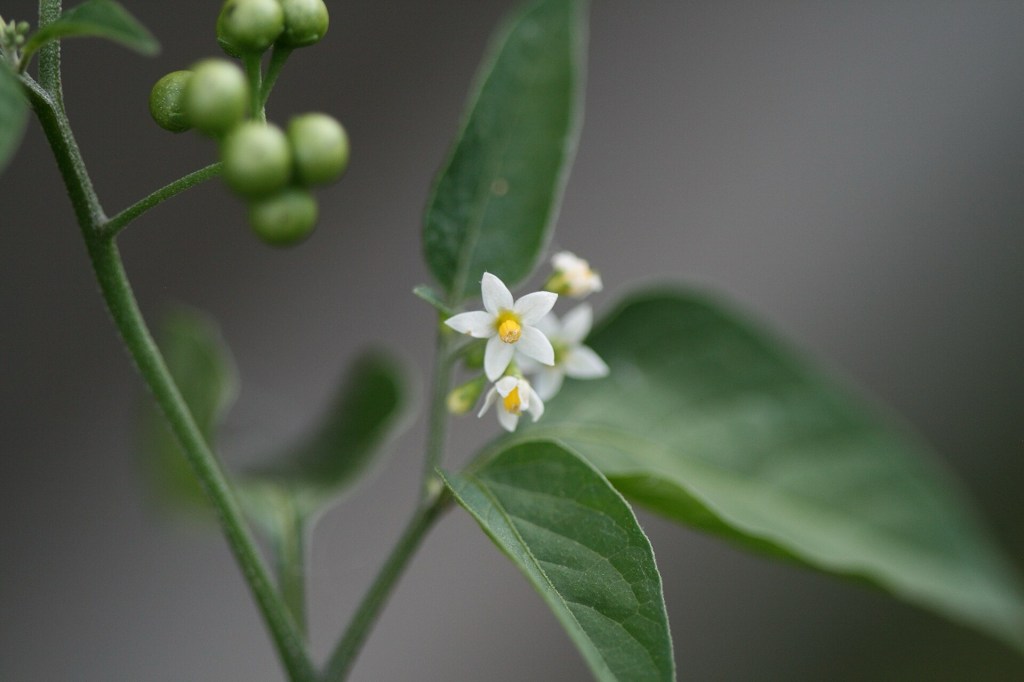
(Arthur Chapman)
The Nightshade family (Solanaceae) includes the familiar food plants Potato, Tomato and Aubergine, yet several of its members are toxic.
Three of these poisonous species are found in Northern England:
Woody Nightshade (Solanum dulcamara), Deadly Nightshade (Atropa belladonna) and Black Nightshade (Solanum nigrum).
The three species differ markedly in appearance, toxicity, and habitats, here we look at these differences, how to identify them, and the roles the plants have played in our culture and history.
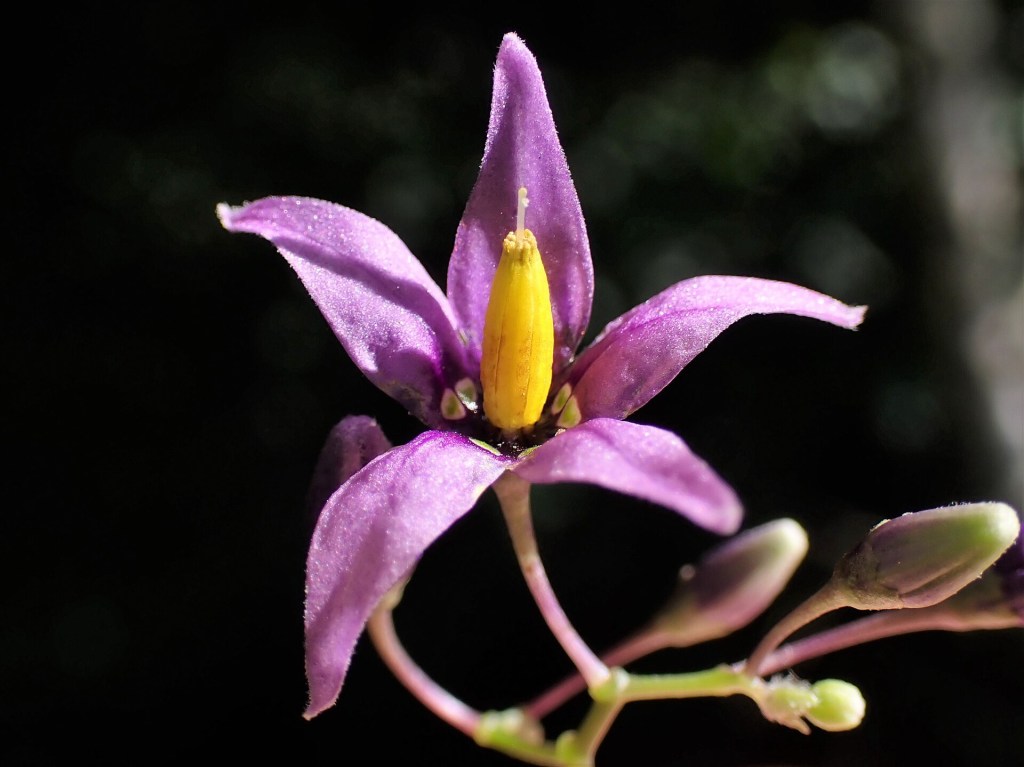
(Kenraiz)
Harmful Herbage
Woody Nightshade
Woody Nightshade is also known as Bittersweet, or Climbing Nightshade, and all parts are toxic, containing steroidal glycoalkaloids (solanine and related compounds).
The bright red berries are particularly poisonous, causing nausea, vomiting, diarrhoea, dilated pupils and, in severe cases, more serious neurological effects. Fatalities in humans are rare, partly because the berries taste intensely bitter before a sweet aftertaste develops. Birds, however, suffer no repercussions from consuming its fruit and readily eat the ripe, red berries, dispersing the seeds widely across the countryside.
The plant is less toxic than Deadly Nightshade.
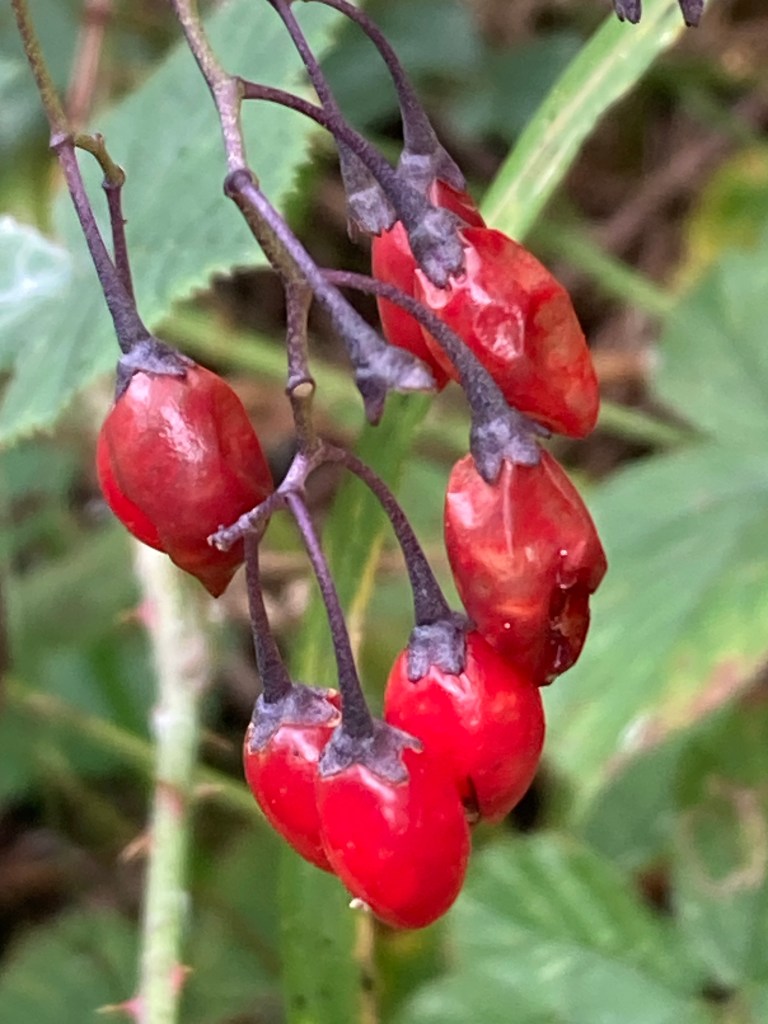
(author)
Deadly Nightshade
This species, commonly known as Belladonna is, as its name warns, extremely poisonous. All parts, especially the roots, leaves and shiny black berries, contain tropane alkaloids (atropine, hyoscyamine and scopolamine) and consumption of a just a few berries can prove fatal.
Symptoms include a very dry mouth, dilated pupils, blurred vision, rapid heartbeat, confusion, hallucinations, delirium, convulsions and potentially death from respiratory failure or circulatory collapse. Skin contact or eye exposure can also cause problems.
It is one of Britain’s most toxic native plants.
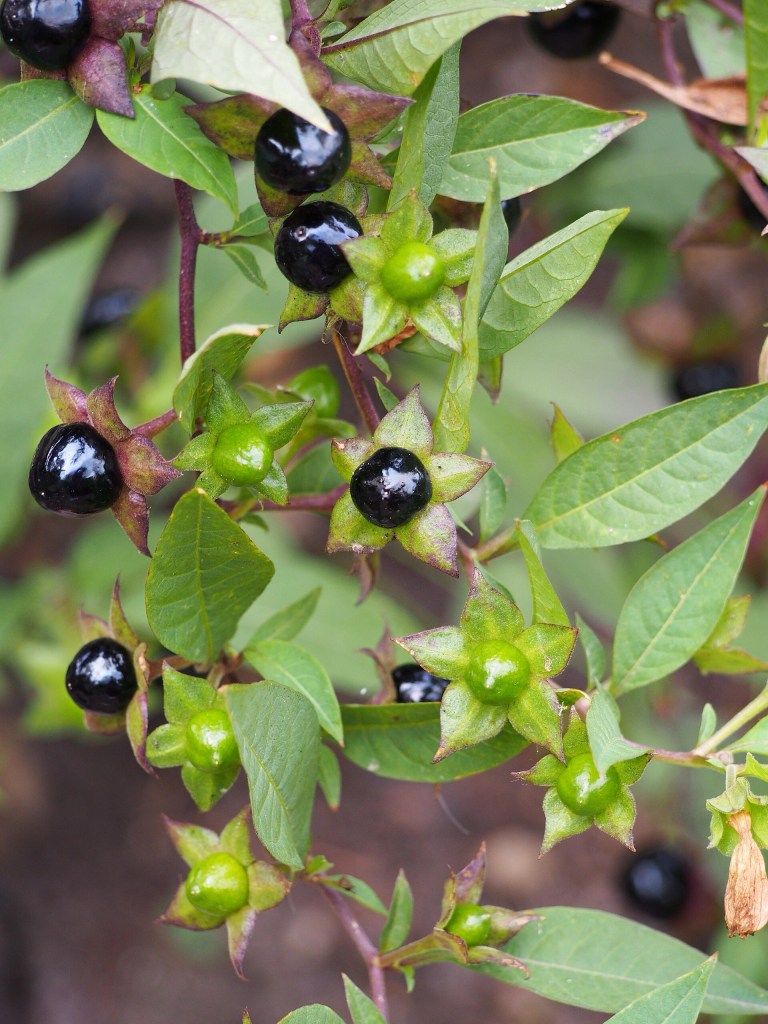
(Nova)
Black Nightshade
Black Nightshade, also known as Garden Nightshade, contains solanine-type alkaloids and its unripe green berries and leaves are most toxic, causing gastrointestinal upset, sweating, confusion and abdominal pain.
Ripe black berries of some varieties (this species is a ‘complex’ with many forms) are less toxic and are eaten in other parts of the world after cooking, but the wild British plant should be regarded as poisonous and left well alone.
Toxicity varies with plant maturity, growing conditions and the individual.
All three belong to the Solanaceae and share the characteristic star- or bell-shaped flowers with prominent yellow anthers typical of the family.
(Robert Flogaus-Faust)
Identification
Woody nightshade
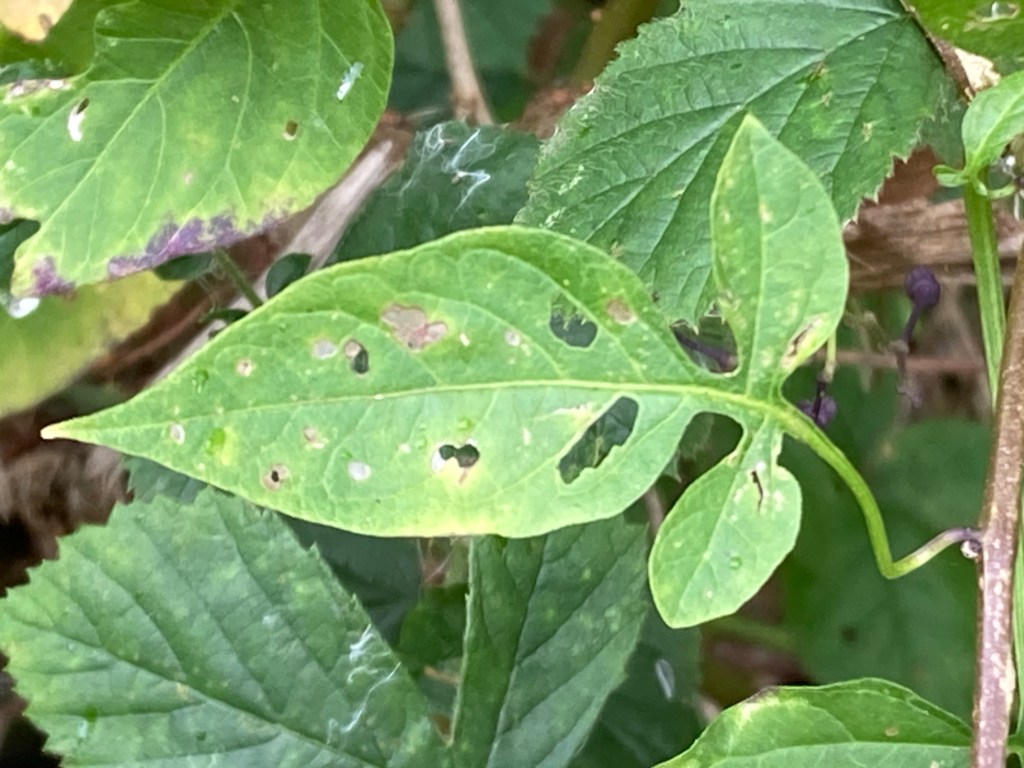
Woody Nightshade (Solanum dulcamara)
is a scrambling or climbing perennial with stems that become woody at the base and can reach 2 to 4m (occasionally more) when supported by other plants.
Leaves are alternate, often distinctly three-lobed on the lower parts of the plant (a large central lobe and two smaller side lobes) and simpler higher up.
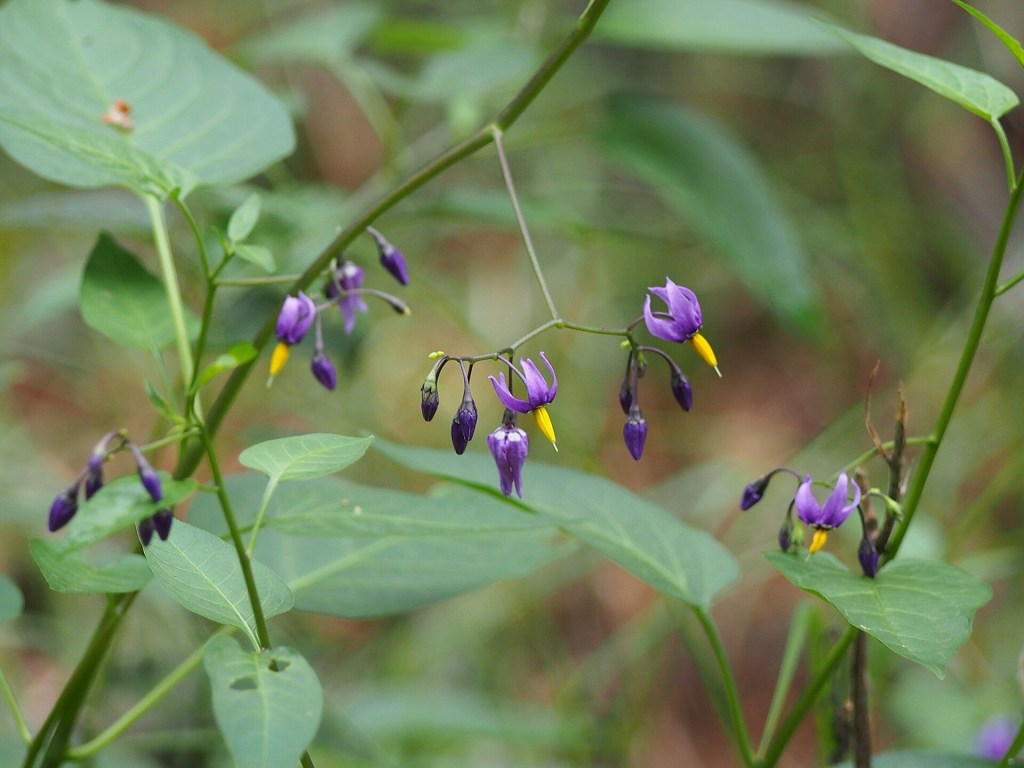
Flowers appear from June to September in loose clusters: five purple (rarely pale) petals that curve backwards around a conspicuous bright-yellow cone of anthers.
Berries start green, turn orange, then ripen to shiny scarlet red and hang in clusters, often remaining on the plant into late autumn.
(author)
Deadly Nightshade
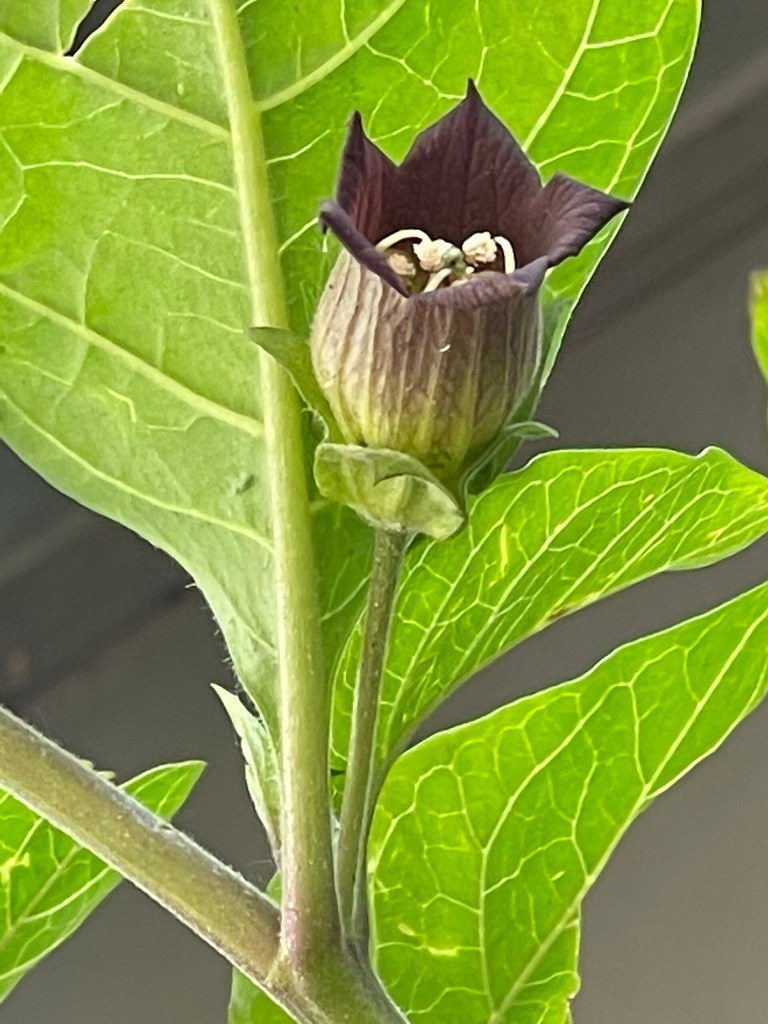
Deadly nightshade (Atropa belladonna) is an upright, bushy perennial growing 1 to 1.5m tall with stout, branched stems.
Leaves are large (up to 20cm), oval, pointed, dark green and untoothed, arranged alternately.
Flowers are solitary or in pairs in the leaf axils: dull purplish-brown or greenish-purple, bell-shaped and nodding, appearing from June to August.
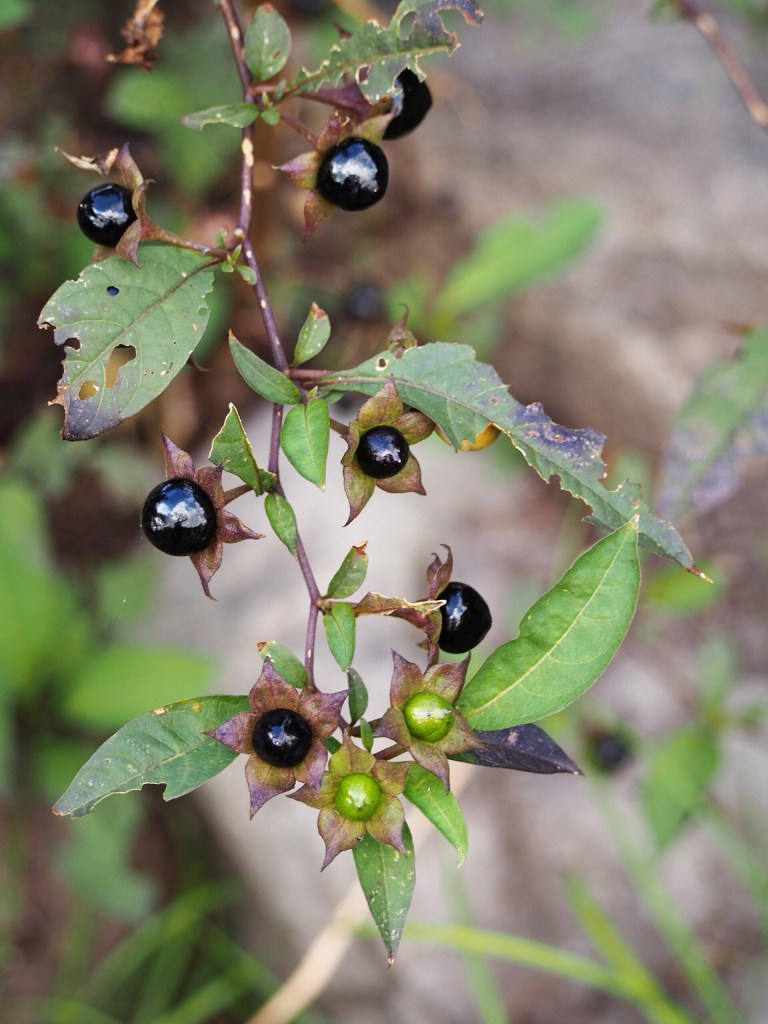
The fruit is a single, shiny black, cherry-like berry about 1cm across, sitting in a persistent star-shaped green calyx.
The overall impression is of a robust, somewhat sinister-looking herb rather than a climber.
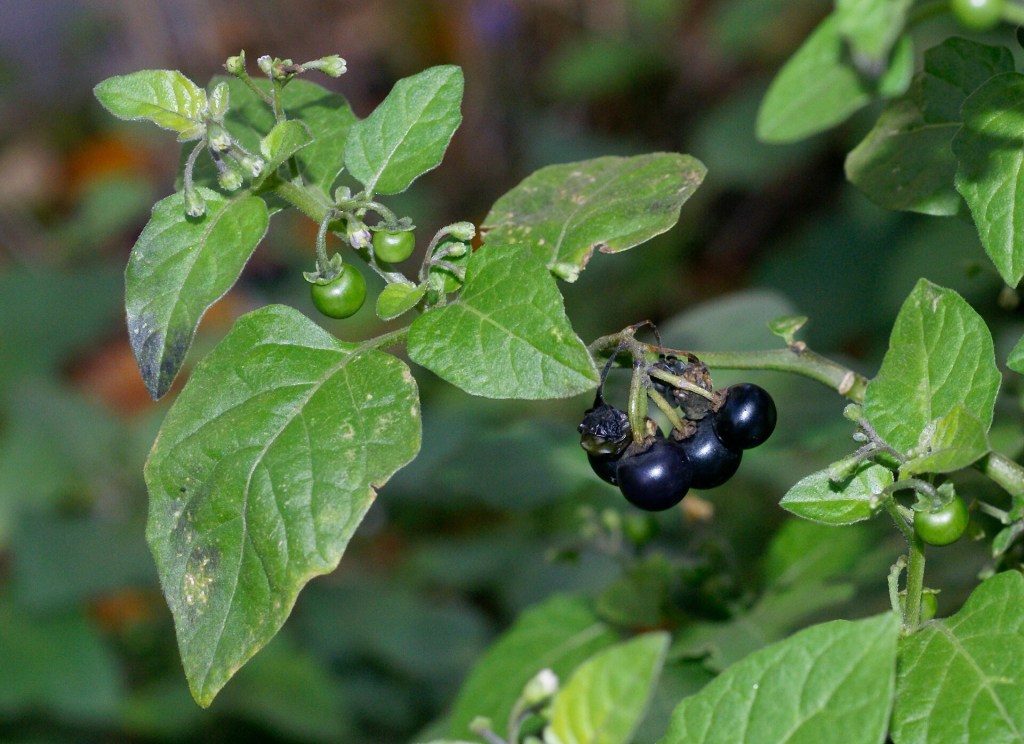
Black Nightshade
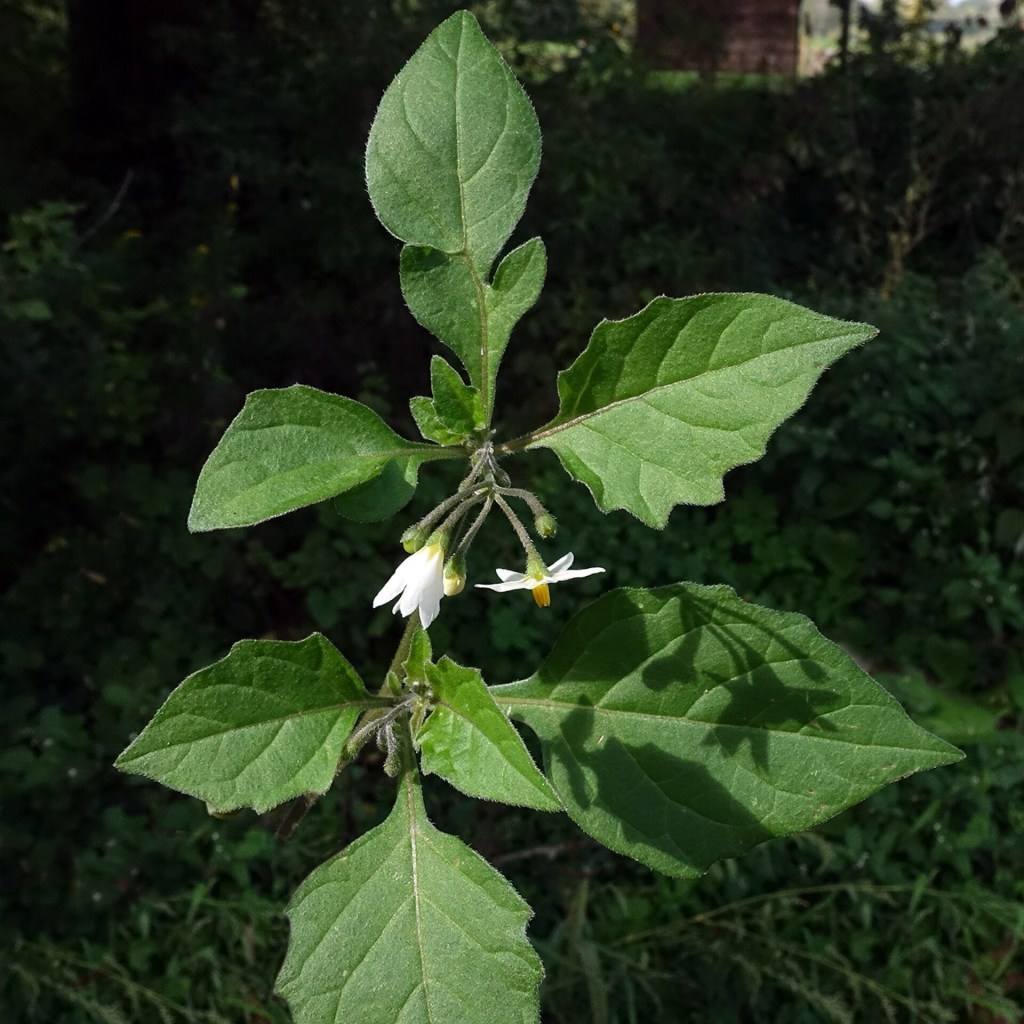
Black nightshade (Solanum nigrum) is a low to medium annual (or short-lived perennial) growing 30 to 70cm tall, often with darkish stems.
Leaves are oval to diamond-shaped, sometimes slightly toothed or wavy-edged.
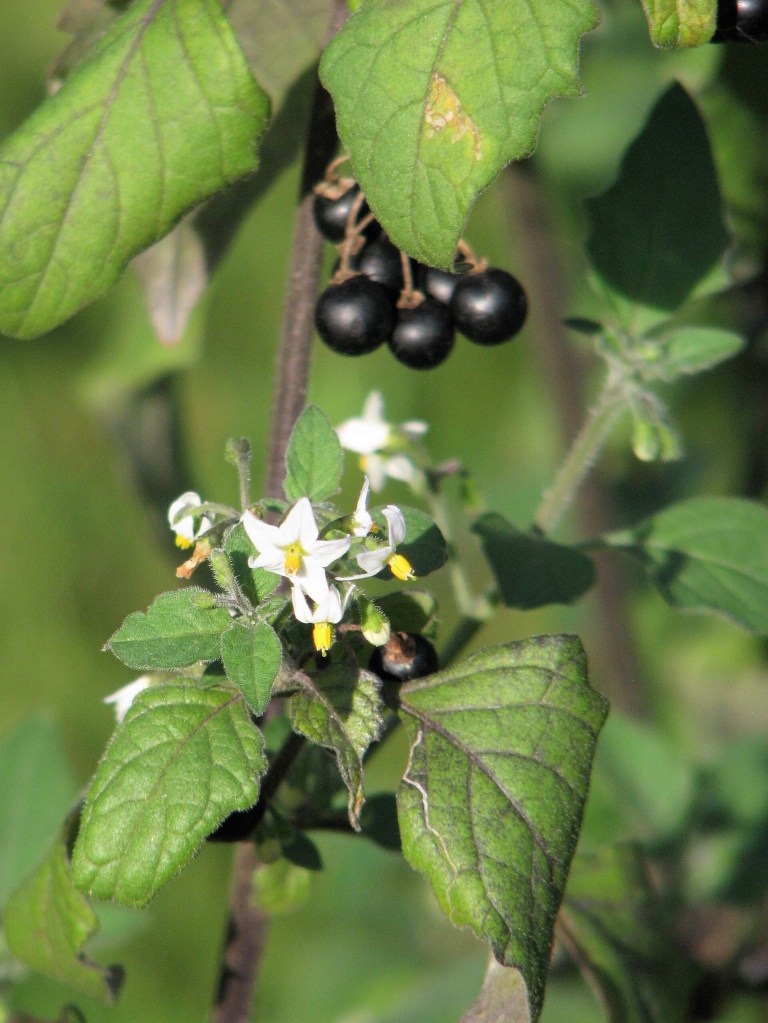
Flowers are small, white, star-shaped with yellow anthers, held in clusters of 5 to 10, appearing July to October.
Berries are round, start green and ripen to dull black (not shiny like deadly nightshade), held in clusters.
Key differences at a glance
- Habit:
Woody nightshade climbs or scrambles.
Deadly nightshade is upright and bushy.
Black nightshade is low and bushy or spreading.
- Flowers:
The Woody’s are purple with a yellow anther cone.
Deadly’s are dull purple-brown bells.
Black’s are small white stars.
- Berries:
Woody: shiny red in clusters.
Deadly: shiny black, solitary, with large starry calyx.
Black: dull black in clusters.
- Leaves:
Woody are often three-lobed.
Deadly are large and entire.
Black are smaller and often slightly toothed.
Confusion most often arises between Woody and Deadly Nightshade because both have purple flowers and the shared ‘Nightshade’ name.
The climbing habit, red berries and yellow anther cone of Woody Nightshade, versus the upright growth, black berries and bell-shaped flowers of Deadly Nightshade, provide reliable separation.
Black Nightshade is distinguished by its white flowers and dull black berries.
(Nova)
(Nova)
Habitat and Distribution in Northern England
Woody Nightshade
Woody Nightshade is the most widespread of the three. It thrives in damp or moist lowland habitats: hedgerows, woodland edges, scrub, river and canal banks, ditches, fens and rough grassland.
It tolerates both sun and partial shade and in Northern England it is common in the lowlands of Yorkshire, Lancashire, Greater Manchester, lowland Cumbria and the Northeast, but becomes scarce or absent above about 310m and is largely missing from the higher Pennines, Lake District fells and upland Northumberland. It is generally lowland and more coastal in the far north.
Deadly Nightshade
Deadly Nightshade prefers calcareous (chalk or limestone) soils and disturbed ground: open woodland, woodland margins, scrub, field margins, hedgerows, old quarries, ruins and waste ground. It is native mainly in southern and central England on chalk and limestone.
In Northern England it is much scarcer and often occurs as scattered colonies or relics of former medicinal cultivation. It is recorded in the Peak District (Derbyshire limestone dales), parts of Yorkshire and occasionally further north (including Cumbria), but becomes rare north of the Tyne and is largely absent from acidic uplands. Many northern records may represent historical introductions rather than continuous native populations.
Black Nightshade
Black Nightshade is a plant of nutrient-rich, disturbed ground: cultivated fields, gardens, waste places, manure heaps and arable land. It is common in southern and central England but becomes progressively scarcer northwards. In Northern England it is local or casual, more frequent in the lowlands of Yorkshire and Lancashire than further north, and largely absent or only temporary in Scotland and the far north. It rarely persists in colder or less fertile sites.
In summary, in lowland Northern England you are far more likely to encounter woody nightshade than either of the other two. Deadly nightshade is a notable botanical find when it appears, usually on limestone, while Black Nightshade is mainly a weed of cultivation and disturbed ground.
Literary and Historical Legacy
Nightshades have a long and often sinister literary history.
In classical antiquity, Dioscorides (from the 1st century AD) described several ‘strychnos’ plants, one of which corresponds to Black Nightshade (Solanum nigrum); he noted that the garden form could be eaten without danger and used it for cooling inflamed parts, Theophrastus also referred to nightshade-like plants in his work.
Deadly Nightshade and related tropane-alkaloid plants (including Henbane and Mandrake) were known as poisons and anaesthetics, the Romans associated Nightshade with political poisoning; Livia, wife of Augustus, was rumoured to have used its juice, and it appears in accounts of military sabotage, indeed the genus name Atropa derives from Atropos, the Fate who cuts the thread of life.
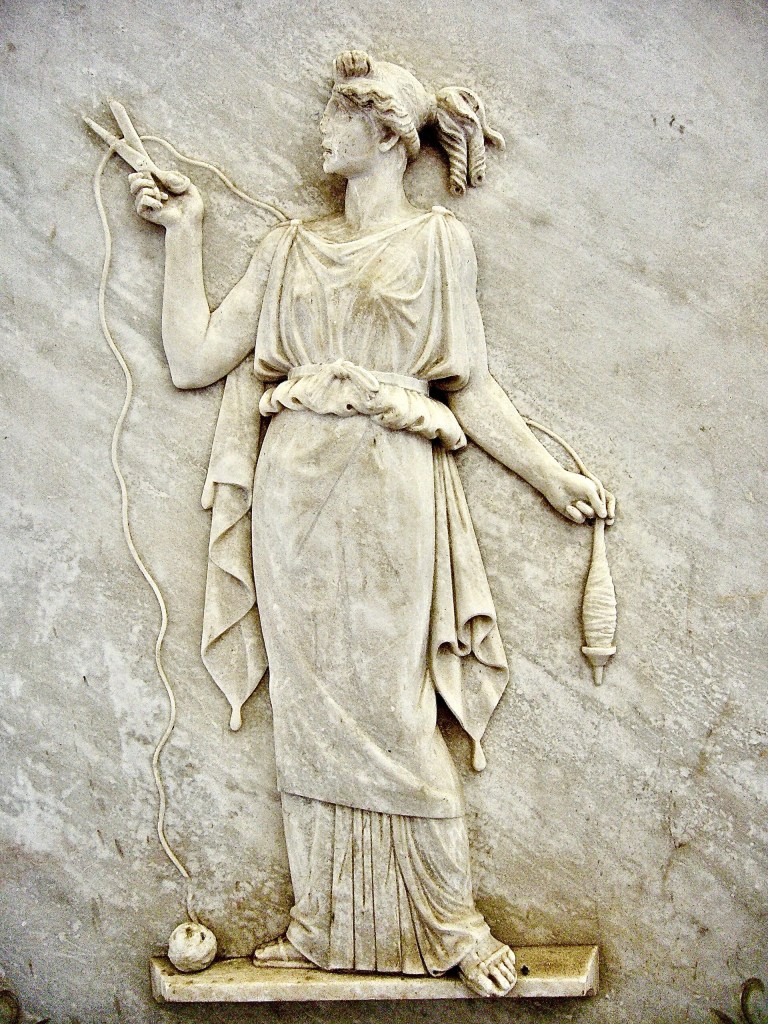
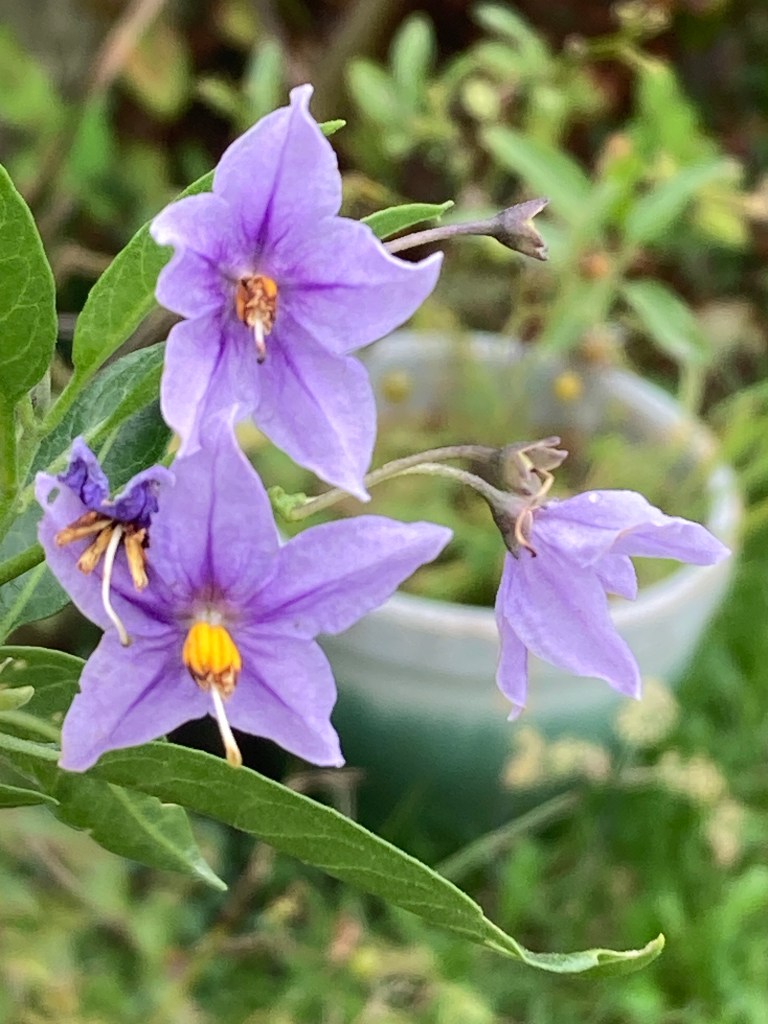
(Text and image by Tom Oates)
Woody Nightshade (Solanum dulcamara) was known to medieval and Renaissance herbalists. William Turner coined the English name “bittersweet” in the 16th century from the Latin dulcamara (sweet-bitter), referring to the taste of the stem.
John Gerard, in his Herball (an immensely valuable tome published in 1597 which I refer to regularly for my work), praised its juice for treating bruises from falls and distinguished ‘Woody Nightshade’ from the far more dangerous ‘Deadly Nightshade’.
Nicholas Culpeper later described its external uses for skin complaints while warning against internal use, and shepherds hung Woody Nightshade around the necks of cattle as a charm against the evil eye.
Deadly Nightshade features prominently in later literature and folklore, and Gerard wisely warned householders to banish it from gardens because children were attracted to the shiny black berries:
‘This kind of Nightshade causeth sleep, troubleth the mind, bringeth madness if a few of the berries be inwardly taken, but if more be given they also kill and bring present death…
…banish therefore these pernicious plants out of your gardens and all places neare to your houses where children do resort’
It appears in Scottish tradition (Buchanan’s History of Scotland) in the story of troops poisoned during a truce, an episode that influenced Shakespeare’s Macbeth. Witches’ ‘flying ointments’ of the early modern period often included Belladonna, Henbane and other solanaceous plants. The Italian name belladonna (‘beautiful lady’) refers to the historical use of diluted extracts to dilate the pupils for cosmetic effect.
Black Nightshade was known to classical writers as a milder relative and appears in medieval herbals as ‘petty morel’, distinguished from the ‘great morel’ (Deadly Nightshade). Dioscorides’ account of an edible garden nightshade is generally linked to this species or a close relative.
These references demonstrate a long awareness of both the danger and the ambiguous usefulness of the nightshades but today the plants are subjects of botanical interest and caution rather than of practical herbal use. Accurate identification, a healthy respect for their toxicity, and an understanding of their preferred habitats allows a safe appreciation of these distinctive plants, and it is with that aim that I write this and hope you find it useful.
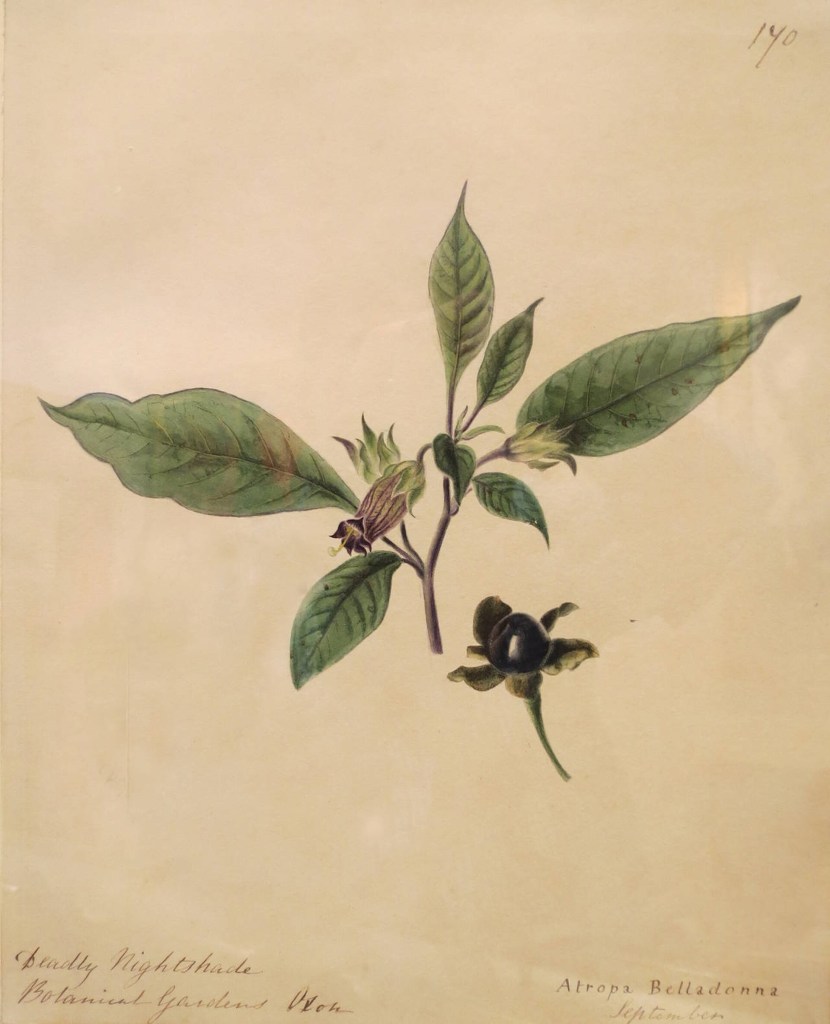
No, no, go not to Lethe, neither twist
Wolf’s-bane, tight-rooted, for its poisonous wine;
Nor suffer thy pale forehead to be kiss’d
by nightshade, ruby grape of Proserpine;
Make not your rosary of yew-berries,
Nor let the beetle, nor the death-moth be
your mournful Psyche, nor the downy owl
a partner in your sorrow’s mysteries;
For shade to shade will come too drowsily,
and drown the wakeful anguish of the soul.
From John Keats’ Ode on Melancholy (written in 1819, published 1820)
Thank-you for reading. If you enjoyed this piece and would like to support further articles on the wildlife and history of the Northwest, you can buy me a coffee here.
Alex Burton-Hargreaves
(September 2026)


Although poisonous, it’s a very interesting subject.
LikeLiked by 1 person
It is, my wife has a few fascinating books about poisonous plants, I’m not worried, although I hope nobody crosses her!
LikeLike