Biology, Ecology, Behaviour, Mythology etc of the Mute Swan Cygnus olor. Including notes on Occurrences on the Canals of Northwest England
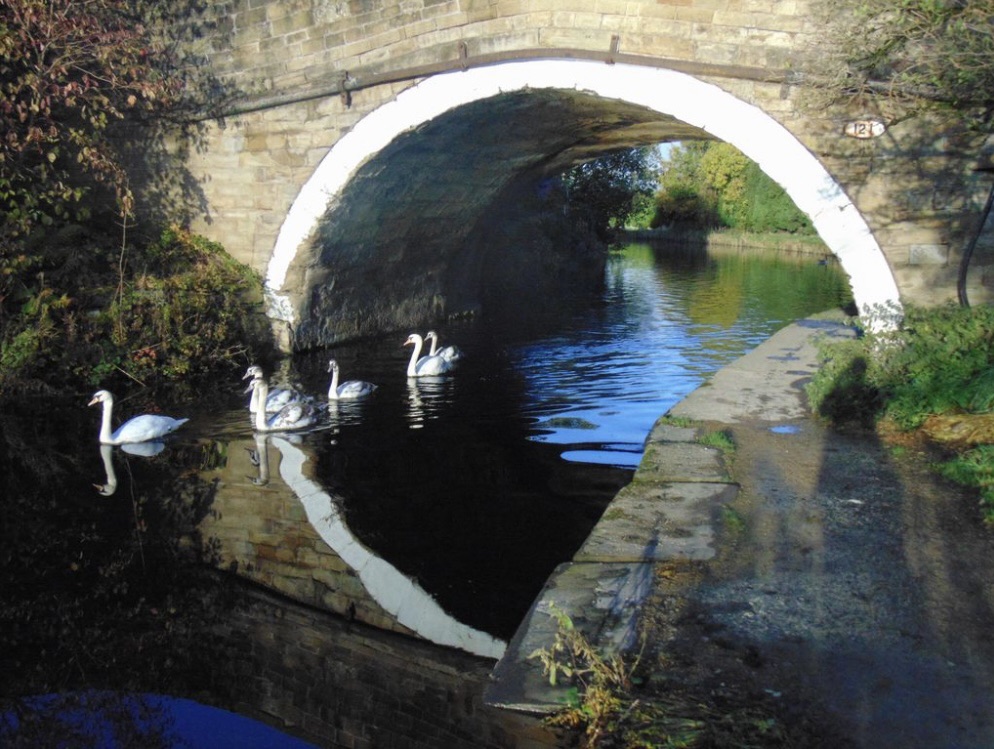
Mute swans (Cygnus olor), with their snowy white plumage, elegant S-curved neck, and bright orange bill topped with a black knob, are one of Britain’s most iconic waterbirds and particularly fond of our 2,700-odd miles of canals.
Here in the Northwest we are lucky enough to have over 438 miles of these waterways, namely the Lancaster, Leeds & Liverpool, Bridgewater, Macclesfield, and Manchester Ship canals, upon which these majestic birds are a common and welcome sight, even in the heart of our largest and busiest cities.
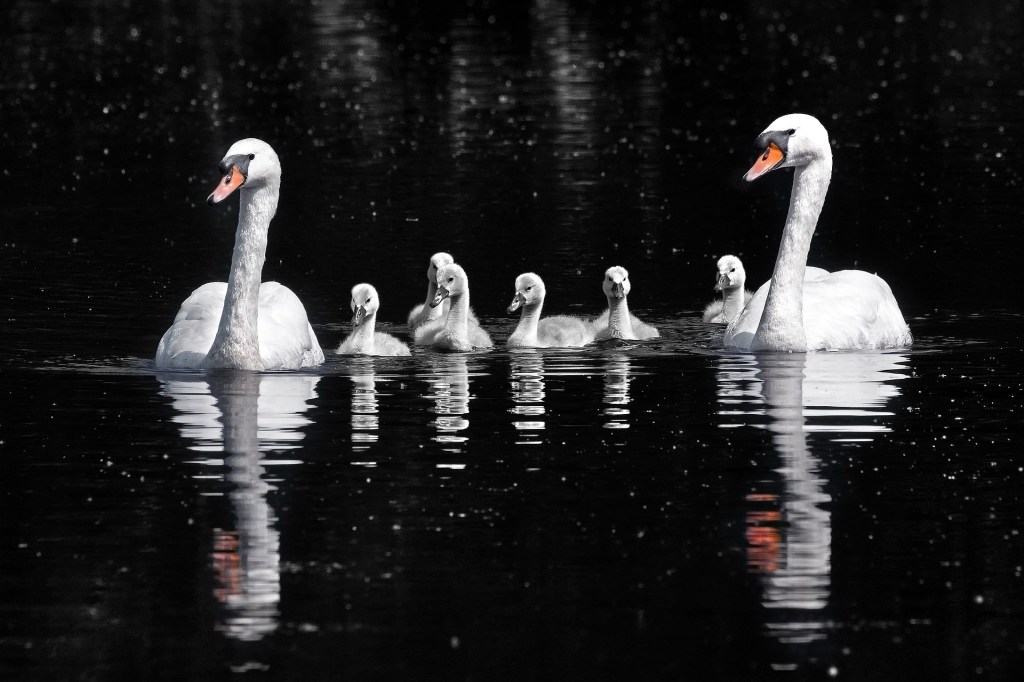
(Charles J Sharp)
Cygnus comes from the Ancient Greek name for the swan: kúknos (κύκνος) and olor is the Latin name for swans, therefore its scientific name translates as ‘swan swan’
A Royal History
Mute swans swim deep in our cultural history, long considered ‘royal birds’ unmarked mute swans historically belonged to the monarch, a tradition tied to medieval swan-keeping for feasts.
At that time they were prized as a luxury food and served at royal and aristocratic banquets, making them a powerful status symbol. The Crown therefore claimed ownership of all unmarked ones, while wealthy landowners, guilds, abbeys, and other institutions could own swans by purchasing an official ‘swan mark’ (a unique pattern cut into the birds’ beaks).
This system allowed practical management of the birds, helping to control numbers and organise harvests, and each year, swan round-ups, most famously the Swan Upping Ceremony on the River Thames, were held to mark cygnets and confirm ownership.
The tradition is specific to Mute Swans in England (and to some extent Wales), and although the King still technically retains the right to claim unmarked mute swans, this is now exercised only on certain stretches of the Thames.
Today, they enjoy strong legal protection under the Wildlife and Countryside Act 1981 and it is illegal to harm them, disturb their nests, or damage their eggs without special permission.
They are viewed as a quintessentially British bird, their presence as widespread residents dating back to those medieval times, and are mostly non-migratory, with many individuals spending their lives in the same river valley or canal system that they hatched in.
Cygni canalibus ubique apparent
Canals are an ideal habitat for Mute Swans, providing slow-moving or still water rich in aquatic vegetation, safe nesting spots among reeds, and proximity to humans that means supplementary food.
Here in the Northwest you may see them on all of our canals, in particular the Lancaster Canal, which, as it is less busy than its cousins is famously home to several dedicated pairs, including resident pairs at Preston and Lancaster that have stayed loyal enough to their patches to have become local celebrities. One such pair at Lancaster has reliably raised 6 to 9 cygnets annually for over 14 years!
Nationally, Britain hosts around 32,000 resident mute swans and about 7,000 breeding pairs. The population has more than doubled since the 1970s, largely due to the 1987 ban on lead fishing weights, which had caused widespread poisoning. Improved water quality, milder winters, and increased winter food sources like autumn-sown crops have also helped.
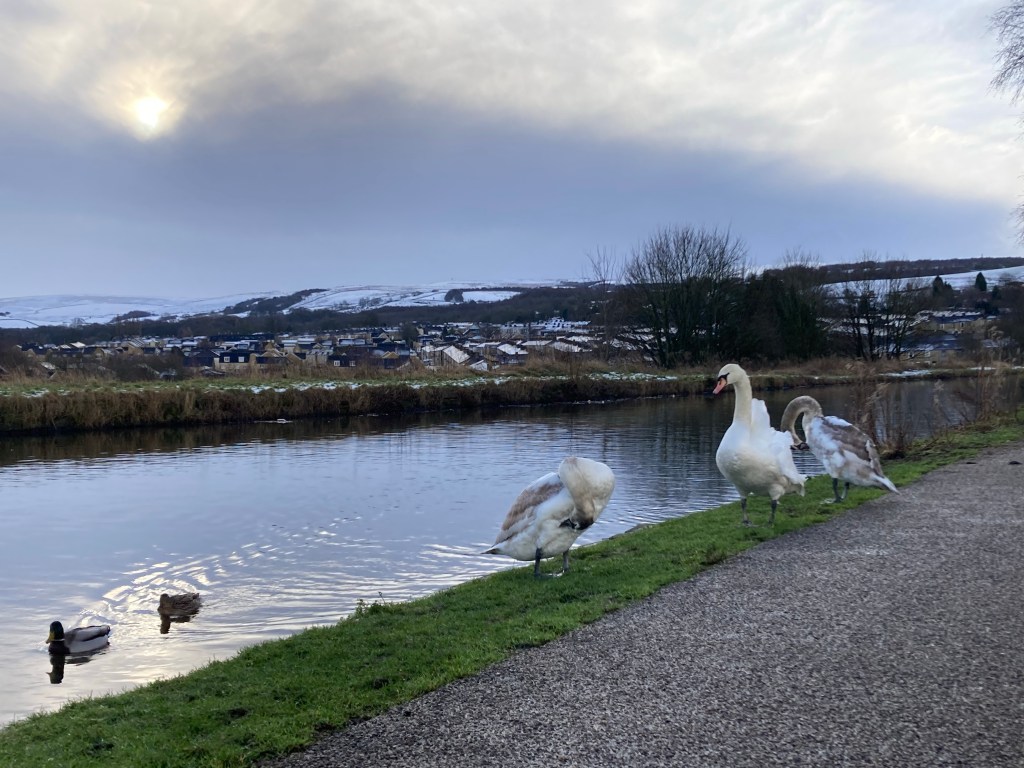
In winter, they may gather in larger flocks on reservoirs or estuaries if canals freeze or food becomes scarce, ringing studies have shown that some individuals wander up to 100km, though most are very site-faithful.
Life on the Canal: Behaviour and Breeding
Mute swans are strongly territorial, especially during breeding season. The male (cob) and female (pen) form lifelong pairs and in spring they build large nests from reeds and vegetation, often on canal banks or islands. A typical clutch is 4 to 7 eggs, with cygnets hatching after about 35 to 38 days. The fluffy grey youngsters ride on their parents back for safety in the early weeks.
Cygnets fledge at 4 to 5 months but may stay with their parents into winter. Adults are mostly silent (hence ‘mute’), communicating with hisses, grunts, or wing-flapping displays when threatened. They can be aggressive in defending nests or territory, intimidating even given their size; up to 1.5m long, with a 2.2 to 2.5m wingspan and weight of 9 to 11.5kg.
They primarily eat aquatic plants, algae, and grasses, but readily accept offerings like sweetcorn, lettuce, oats, and peas from canal visitors, though bread is strongly discouraged as it provides little nutrition (yet somehow it’s perfectly ok for us to eat!)
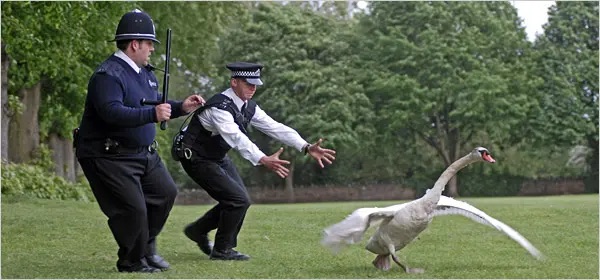
“It’s just the one swan, actually”
(bonus points if you can guess which film this image and quote is from)
Challenges and Conservation
Despite their success (Mute Swans having recently been reclassified from Amber to Green on the Birds of Conservation Concern list) they still face several threats. Avian influenza (bird flu) caused significant mortality in 2021 and 2022, and collisions with boats or overhead cables, fishing line entanglements, pollution, and habitat disturbance remain concerns.
Monitoring through schemes like the Wetland Bird Survey (WeBS), habitat protection, and rehabilitation by swan sanctuaries has helped them reach this green status and will hopefully keep them aloft.
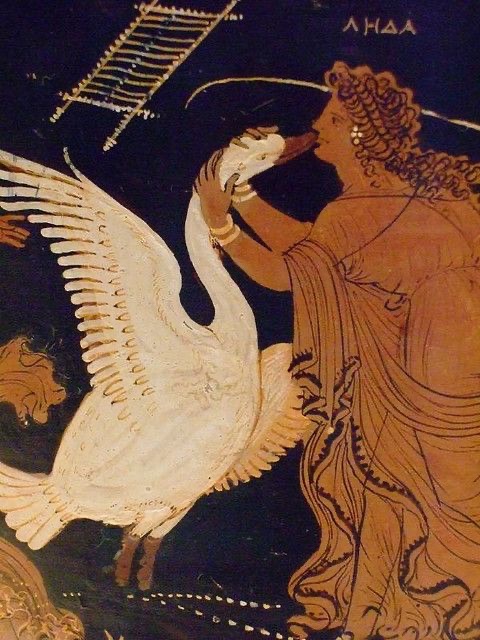
The Legend of the Swan’s Song
An enduring legend in Western culture is that of the ‘swan song’, the belief that Mute Swans, which are largely silent during their lives, produce a beautiful and mournful song just before they die.
This idea originated in ancient Greece, where swans were linked to Apollo, the god of music and poetry, and writers such as Plato, Ovid, and Aesop referenced the tale, portraying the swan’s final melody as a poignant farewell or even a prophetic lament.
In Plato’s Phaedo, Socrates compared himself to swans, which are sacred to Apollo (although it is not known which species) by arguing that his impending death is a joyful transition rather than a tragedy:
“Will you not allow that I have as much of the spirit of prophecy in me as the swans? For they, when they perceive that they must die, having sung all their life long, do then sing more than ever, rejoicing in the thought that they are about to go away to the god whose ministers they are”
The story was later adopted by Roman authors and passed into European folklore, giving rise to the idiom ‘swan song’, which is used today for a final performance or appearance before retirement or death.
In reality, the legend has no scientific basis and Mute Swans are not truly silent, they produce hisses, grunts, and other calls, while their wings make a distinctive humming sound in flight, and the only anecdote I can remember hearing about the phenomenon of swan song is in a book by the famous naturalist Mike Tomkies, possibly On Wing and Wild Water but it’s in storage so I’m not too sure.
Whether true or not the legend has inspired centuries of art, music, literature, and symbolism, and from ancient poetry to more modern expressions remains a powerful metaphor, reminding us of how compelling stories can endure long after science has corrected and sterilised them.
The Silver Swan
The silver swan, who living had no note,
when death approached, unlocked her silent throat,
leaning her breast against the reedy shore,
thus sung her first and last, and sung no more:
Farewell all joys! O Death, come close mine eyes;
More geese than swans now live, more fools than wise
Thank-you for reading. If you enjoyed this piece and would like to support further articles on the wildlife and history of the Northwest, you can buy me a coffee here.
Alex Burton-Hargreaves
(May 2026)


Beautiful blog, and there’s a beautiful musical setting of The Silver swan by Orlando Gibbons
LikeLiked by 1 person
Thank-you, I’m glad you like it ,I’ve looked at various performances of the Silver Swan and am deciding which one to link in the article as there are some very beautiful ones, thanks for telling me about this
LikeLike