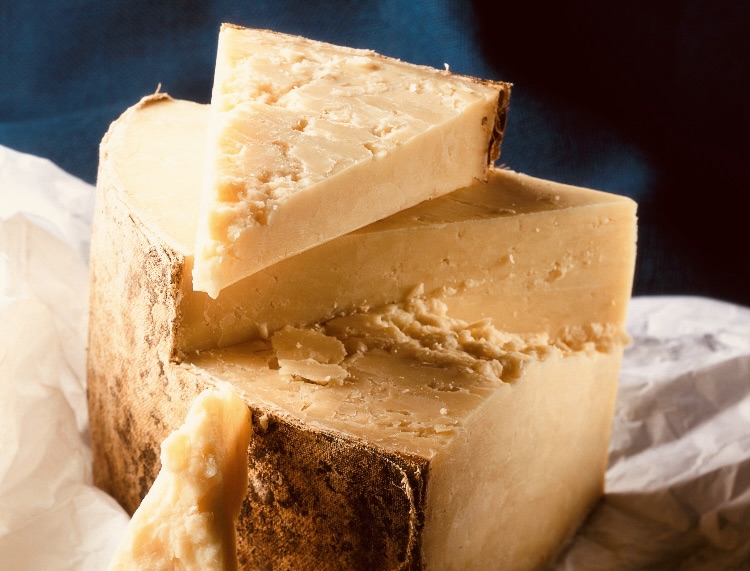
Lancashire cheese is one of Britain’s most traditional cow’s-milk cheeses and widely renowned for its distinctive creamy-to-crumbly texture and a mild, buttery flavour that develops complexity with age.
Here we look at the history of this cheese’s production from the earliest records to the modern day, concluding with a nice, simple recipe for a traditional cheese & onion pie.
Early History
Cheese-making in Lancashire dates back centuries, with evidence suggesting similar cheeses have been produced here from as early as the 13th century. On small family farms, dairying was central to the mixed farming economy with farmers’ wives typically making cheese from surplus milk that could not be sold fresh.
Because individual farms often lacked enough milk from a single day’s milking to produce a full cheese, curds were accumulated over two or three days. Each day’s curd developed different levels of acidity and maturity, and blending them created the cheese’s characteristic texture and flavour profile. This practice is what sets Lancashire apart from most other British territorial cheeses.
By the 17th century, Lancashire cheese was traded beyond the region, with records of it being shipped from Liverpool to London. Production grew steadily, and by the mid-20th century, before World War II, over 200 farms and creameries in the area produced around 4,800 tonnes annually.
Standardisation: The Gornall Method
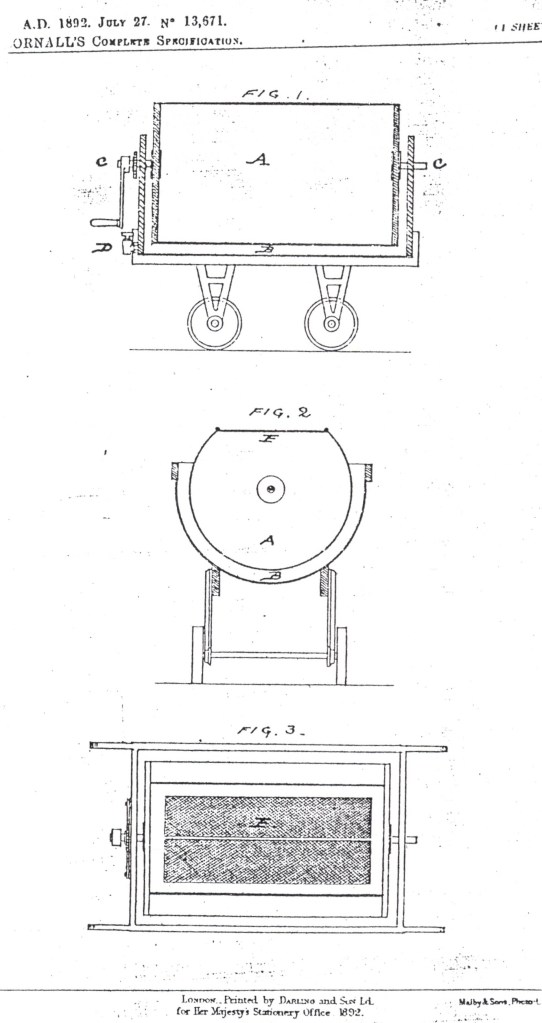
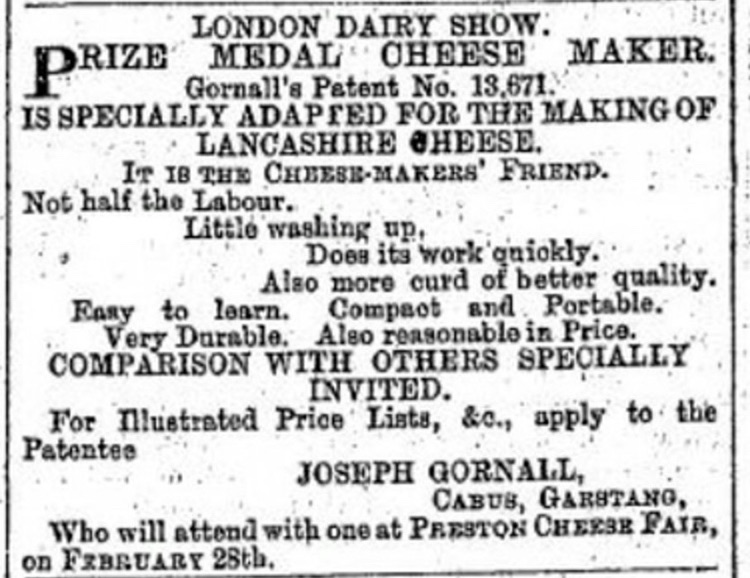
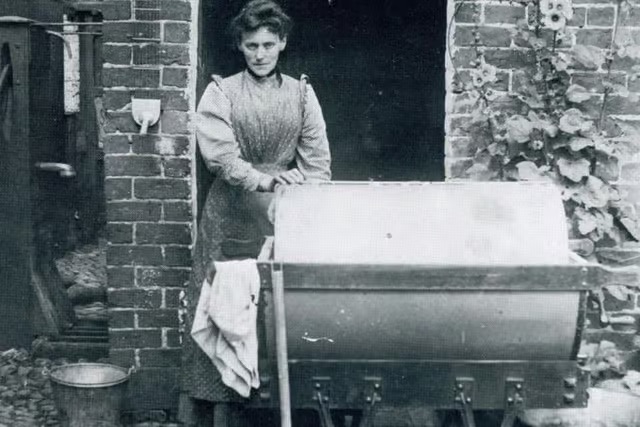
The traditional process of making Lancashire cheese was formalised in the 1890s by Joseph Gornall, a Lancashire county council employee from Garstang and Pilling. He visited numerous farms in his official role as ‘itinerant cheese instructor’, documented variations, and established a standardised recipe and method known as the ‘Gornall method’, even patenting a cheesemaking device which was sold between 1892 and 1919.
This method emphasised gentle handling of curds from multiple days, light pressing, and slow maturation, all techniques that preserve the cheese’s unique qualities.
Varieties of Lancashire Cheese
There are three main varieties of Lancashire cheese which may be commonly found in our nation’s cheesemongers, these are:
- Creamy Lancashire: Matured for 4 to 12 weeks. It has a soft, fluffy, buttery texture ideal for melting or toasting. Mild and fresh in flavour.
- Tasty Lancashire: Matured longer (often 3 to 24 months). It develops a firmer, more crumbly texture with nutty, savoury, and tangy notes.
- Crumbly Lancashire (usually known as “Crumbly Lancs”): A more modern, mass-production-friendly style made from a single day’s milk. It resembles Cheshire or Wensleydale in texture and is typically milder, matured for 6 to 8 weeks.
Traditional Production Process
- Milk Preparation: Full-fat cow’s milk (often raw for traditional makers) is gently warmed (around 30 to 32°C). Starter culture and rennet are added for slow acidification and coagulation.
- Curd Making Over Days: Each day’s milk is coagulated, cut into small cubes (about 1 cm), gently stirred, and drained. The curd is lightly pressed or broken into chunks and stored.
- Blending: On the final day, curds from Day 1 (more acidic) and Day 2 (sweeter, less acidic) are combined in roughly equal parts. This mixing of different maturities is unique to Lancashire and contributes to its creamy/crumbly character.
- Milling and Salting: The blended curds are milled into pea-sized pieces, salted (about 2% by weight), and mixed thoroughly.
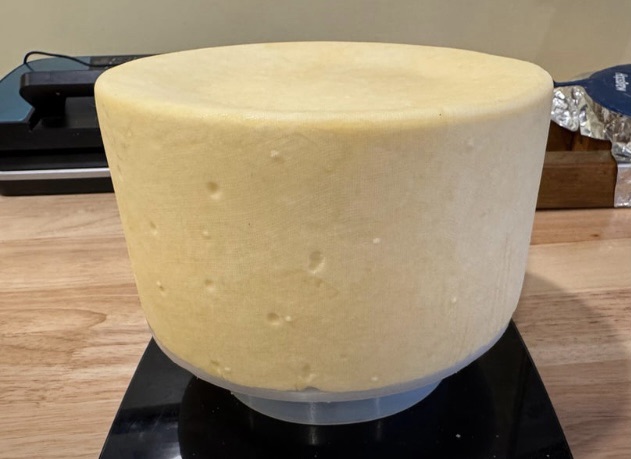
- Pressing: The curd is packed into cloth-lined moulds and pressed lightly (progressively increasing weight). Traditional cheeses are often cylindrical, around 10 kg.
- Finishing and Maturation: After pressing, cheeses are air-dried, then bandaged with cloth (often buttered or waxed) or sometimes left natural. They mature in cool, humid conditions (around 11 to 13°C). Creamy versions are ready in weeks; Tasty ones develop deeper flavours over months.
The process is deliberately slow and gentle to retain fat and moisture, avoiding the rapid acidification used in industrial versions.
Beacon Fell Traditional Lancashire Cheese (PDO)
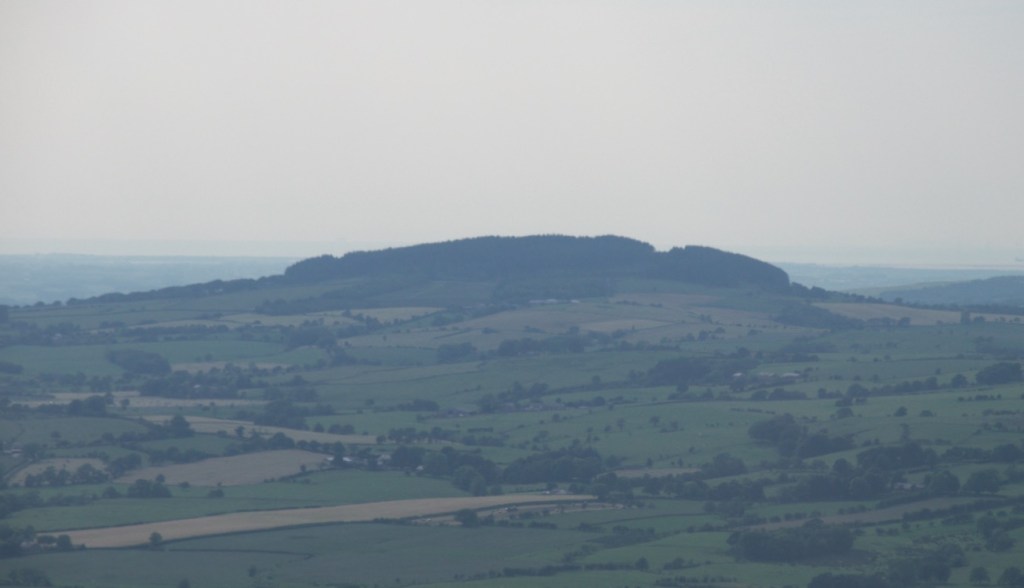
Beacon Fell Traditional Lancashire Cheese holds a Protected Designation of Origin (PDO) status. It must be made using traditional methods (following Gornall principles) with milk from a defined area north of the River Ribble (including the Fylde, Preston, and Beacon Fell itself) and produced within that region, this guarantees authenticity for this heritage product.
Modern Producers and Challenges
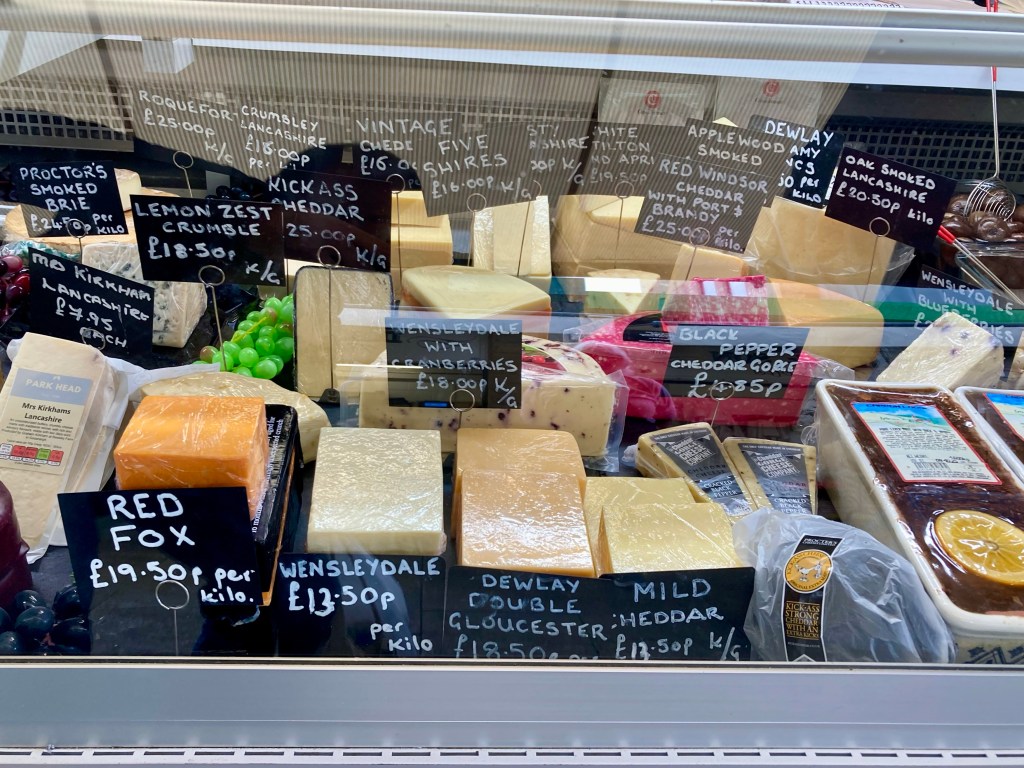
Today, traditional raw-milk, farmhouse Lancashire is rare. Mrs Kirkham’s, at Lower Beesley Farm near Goosnargh, is widely regarded as the last remaining producer, having faithfully followed the multi-day, raw-milk, cloth-bound method across three generations. Other notable makers include Dewlay, Singleton’s Dairy, Butlers and Leagram’s, which produce excellent versions, some pasteurised or in the crumbly style.
Like many British cheeses, farmhouse production declined sharply after World War II due to rationing, economic pressures, and the rise of industrial dairies. However, renewed interest in artisanal, traceable foods has helped preserve and revive an appreciation for the traditional.
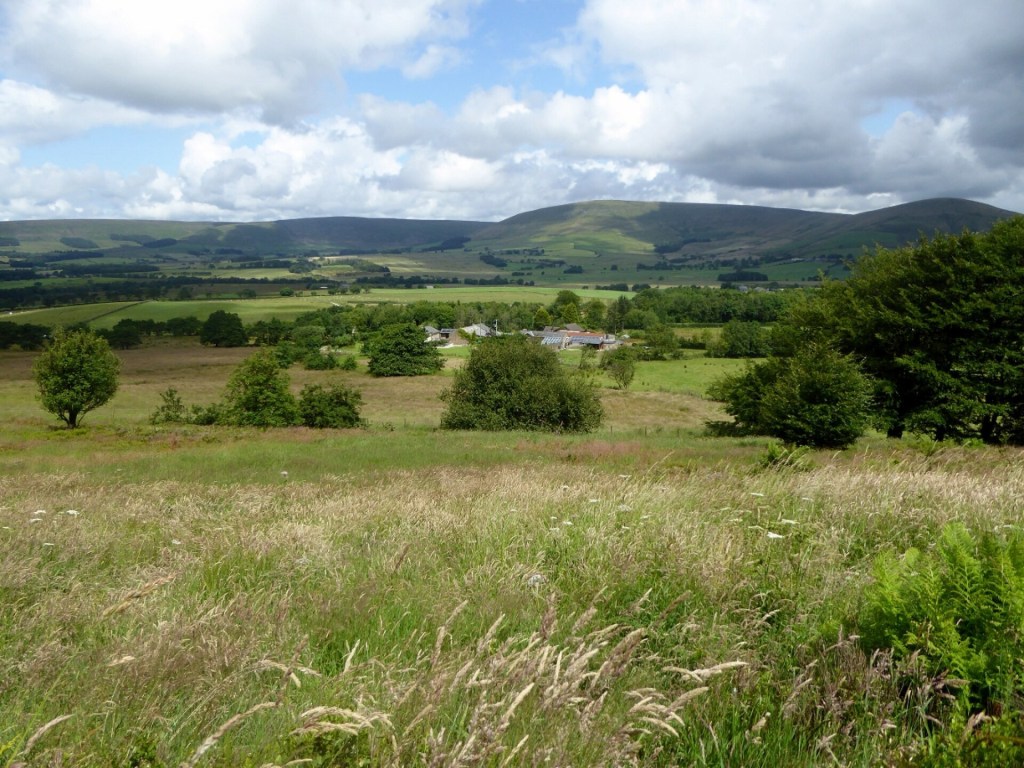
Northwest Recipes: Traditional Lancs Cheese & Onion Pie
Lancs cheese is, like the people of the county it comes from, honest, dependable and versatile, so can be used in a huge variety of ways. Young Creamy Lancashire is excellent melted on toast, in sandwiches, and especially on Welsh rarebit, and mature Tasty Lancashire offers a surprising complexity for cheeseboards, pairing very well with chutneys, apples, ale or even fruit cakes!
Here, to demonstrate this character, I’ve decided that a straightforward, down-to-recipe is most apt, and what better than a good old cheese & onion pie?
Serves 4 to 6
Ingredients
Pastry:
• 300g of plain flour
• 150g of cold butter, diced
• Cold water to bind
(or there’s nowt wrong with using ready-made shortcrust!)
Filling:
• 400g of Tasty or Creamy Lancashire cheese, grated or cubed
• 3 to 4 large onions, thinly sliced
• 25g of butter
• 2 tbsp of plain flour
• 300ml of full-fat milk
• 1 tsp of mustard powder
• Salt & white pepper
• Optional: chopped chives or spring onions
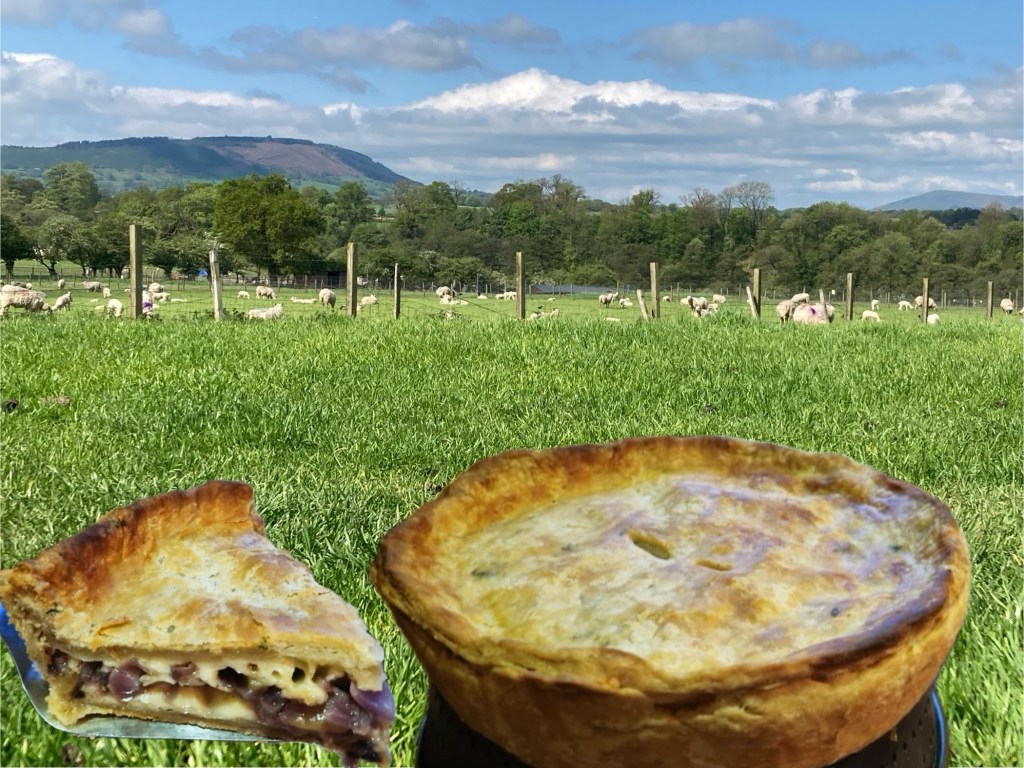
Method
1. Make pastry and chill for 30 minutes.
2. Gently fry the onions in butter until soft and sweet (10 to 15 mins). Then sprinkle in flour, cook for 1 to 2 mins, then gradually add milk to make a thick sauce. Season well.
3. Remove from heat, stir in most of the cheese (don’t forget to reserve some for topping). Cool slightly.
4. Line a pie dish with ⅔ of the pastry, fill with cheese-onion mixture, top with remaining pastry, crimp edges, and brush with milk. It’s important to cut a steam hole too.
5. Bake at 190°C (375°F) for 35 to 45 minutes until golden, sprinkle reserved cheese on top for the last 10 minutes.
Serve hot with pickled red cabbage or a ladle of steaming hot mushy peas.
Tuck in afore it goes cold!
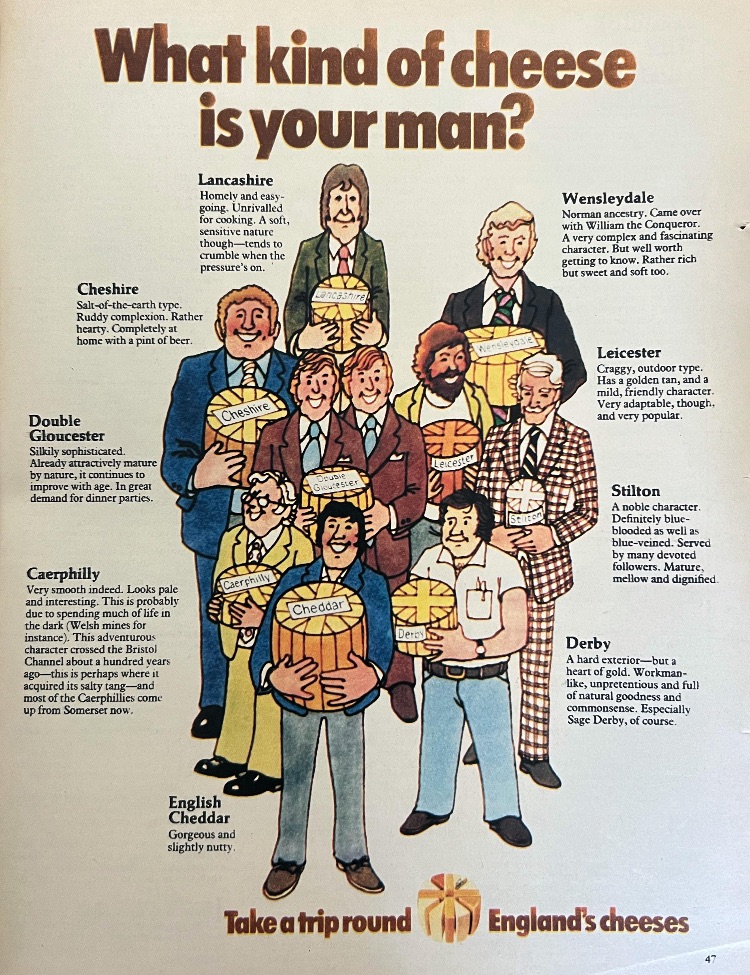
A Poem About Cheese
By John Welford
The challenge is to tell a tale
That makes one long for Wensleydale,
Or maybe pen a line or two
That calls for Brie or Shropshire Blue.
Of course it never should be said
That there’s no place for Leicester, Red.
And could you ever be so silly
Not to try a good Caerphilly?
Was ever soul so lost or deader
That would ignore the claims of Cheddar?
The land of Shakespeare, Blake and Milton
Is famed for Lancashire and Stilton.
Perhaps it’s once more time to foster
A taste for good old Double Gloucester.
It surely would be far from fair
To spurn a piece of Camembert.
Or will you go for something rarer
Like Trappista or Graviera?
Some folk say you can’t do better
Than Mozzarella, Yarg or Feta.
Can I hear you shouting louder
For Emmental, Edam or Gouda?
Or are you only merely thinking
Bishops should be eaten Stinking?
One only hopes that lines like these
Have made you want to eat some cheese.
Thank-you for reading. If you enjoyed this piece and would like to support further articles on the wildlife and history of the Northwest, you can buy me a coffee here.
Alex Burton-Hargreaves
(May 2026)


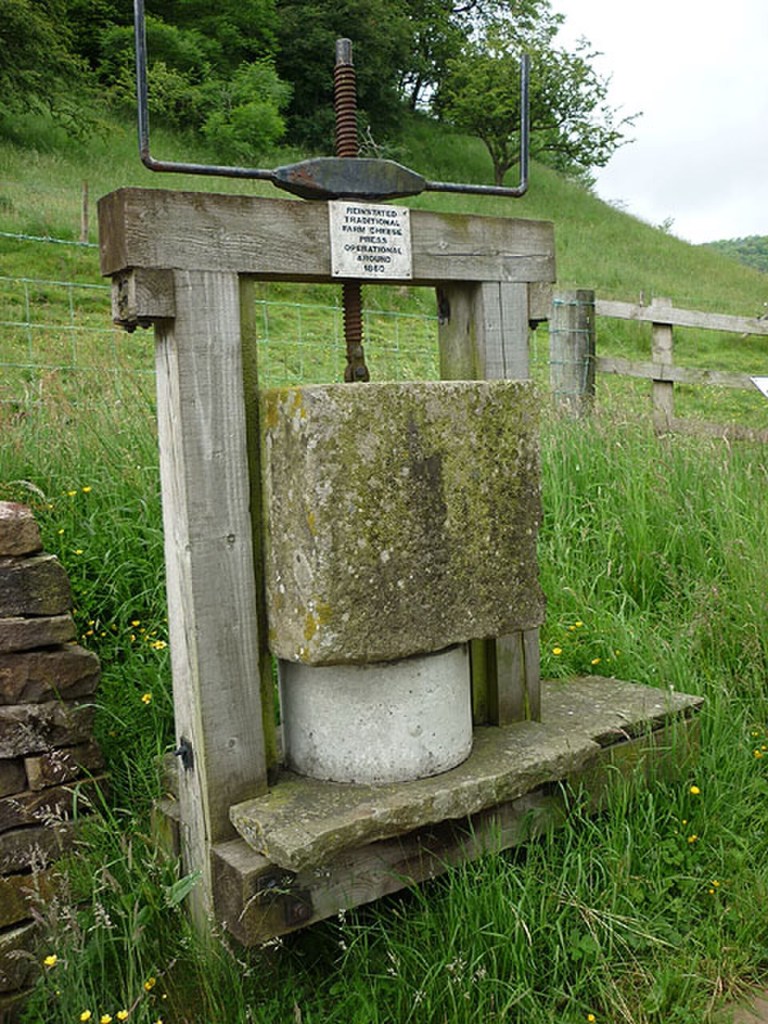
I grew up on a farm in Chipping where many of my ancestors had made cheese. My paternal grandmother grew up on a farm on Beacon Fell where they also made cheese. Because five generations of my family had lived on the farm very little was thrown away, we still had some of the cheese making tools including the cheese press. My childhood bedroom at one time was ” the cheese room” where the cheeses were stored to mature. I love cheese but my dad hated it and never ate it, saying he’d had too much of it as a child.
LikeLiked by 2 people
That’s a wonderful anecdote, and some great memories it seems, there’s some lovely farms around Chipping, I know the area well as I used to cycle around there on my way to Beacon fell and back from where I lived near Bashall / Cowark, I can imagine it was a lovely part of the world to grow up in
LikeLiked by 1 person
Some folk say it was Isaac Newton whom coined ‘We build too many walls and not enough bridges,’ but that sounds like something scribbled after three warm ales and a sheep escaped through t’hedgerow. Truth is, old lad probably weren’t on about peace at all — he’d just spent fourteen bloody hours trying to wheel a cheese cart over a muddy wallow with no proper crossing, muttering, ‘By ‘eck, another wall? Tha daft bastards.’
Anyway, I just wanted to complement your post. 🧀
LikeLiked by 1 person
I like the image of our Isaac pushing a cheesecart and muttering under his breath in a broad Lancastrian brogue, I find it very easy to picture that for some reason! Anyway thanks Chuckster, glad you liked my post 🙂 🧀
LikeLiked by 1 person
🤣
LikeLiked by 1 person