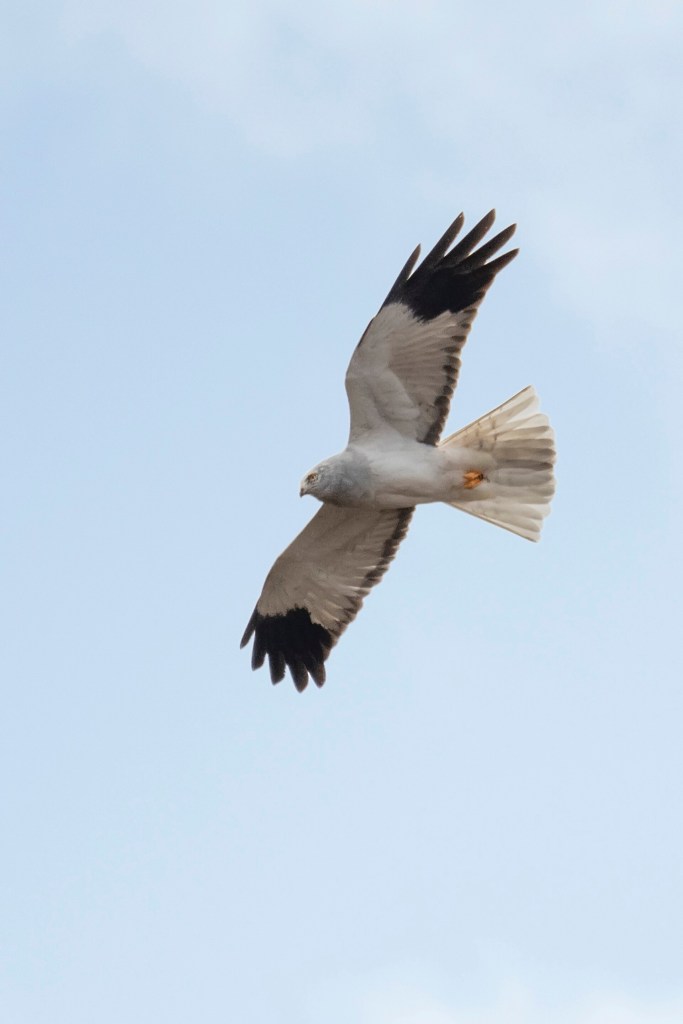
(Caroline Legg)
“The hen harrier’s courtship flight is ballet and theatre and poetry inscribed on air”
(Mark Cocker)
In Part One of this continuing series we left the Hen Harrier in the recent past, with the mixed fortunes of 2022 to 2024: record fledging years giving way to weather-hit productivity, satellite tags failing silent, and the brood-management trial paused for review.
As promised, we now step further back into the bird’s deeper history on these hills, weigh the trial itself, and look ahead to what the future may hold for the skydancers of Bowland and beyond.
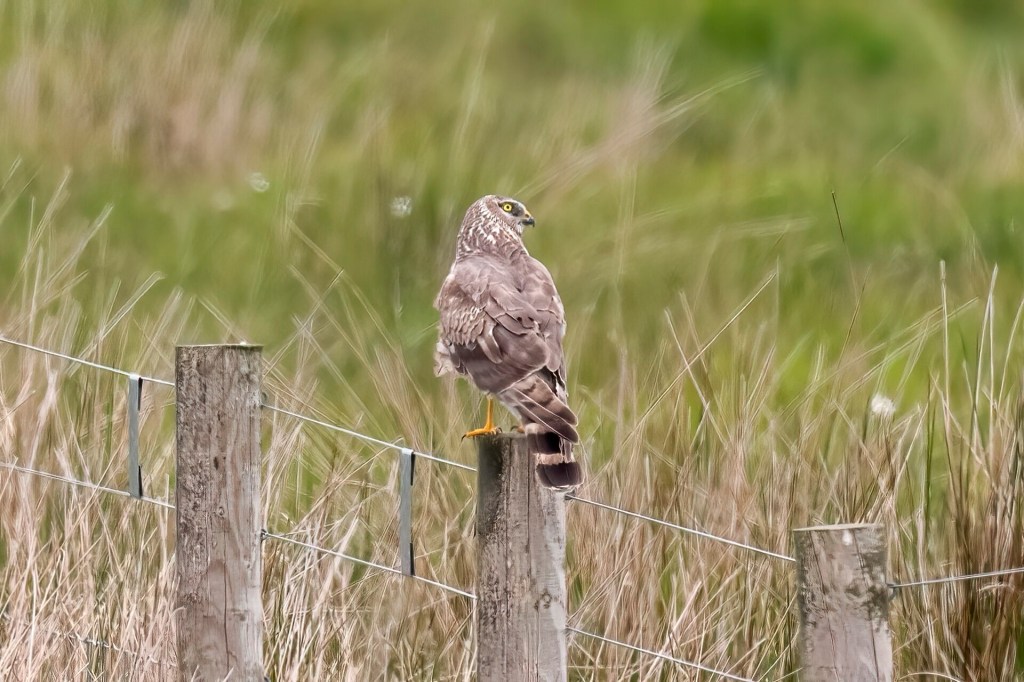
(Caroline Legg)
Rise and fall and rise again
The Hen Harrier’s story in England is one of ubiquitous abundance, then near-erasure followed by a successful, yet controversial, recovery.
Once common enough in medieval times to have been regarded as a general agricultural pest (hence the name “Hen-Harrier”), by the mid-to-late nineteenth century the proliferation of firearms, in particular shotguns, coupled with intensifying game and livestock preservation efforts and sweeping changes in land use had driven the species to near extinction as a breeding bird across most of mainland Britain.
Ground-nesting, relatively confiding near the nest, and an efficient hunter of game-birds, it was an easy, obvious and valid target. Keepers shot, trapped and poisoned them; egg- collectors and taxidermists also took their fair-share, only on the more remote Scottish islands and Orkney did small populations cling on.
A slow recolonisation began after the Second World War, when keepering intensity eased. Birds filtered back into northern England, and by the 1980s Bowland held a significant proportion of the English breeding population, sometimes the only reliable stronghold. Numbers fluctuated, but the trajectory remained precarious, and persecution continued to suppress the population; in some years successful nests in England could be counted on one hand. By 2013 the known English breeding population hit zero.
The recovery since then, particularly the sharp rise after 2018, has been remarkable, yet it remains geographically uneven and vulnerable to both natural and human pressures.
Bowland has been central to this story. The United Utilities estate, managed in partnership with the RSPB and local keepers and farmers who largely leave the birds alone in the breeding season, has repeatedly carried a disproportionate share of the English population.
Private estates and other land holdings have contributed too, but the contrast between the managed grouse moors of Bowland, and those elsewhere, remains stark.
The brood-management trial
Natural England’s brood-management trial (2018 to 2024) was designed as a practical response to long-standing conflict. Where Hen Harriers nested on participating grouse moors, eggs or chicks could be removed under licence, reared in captivity by specialist partners including the International Centre for Birds of Prey, and released later into suitable habitat.
The trial was delivered in partnership with United Utilities, the Moorland Association, the RSPB, the Game & Wildlife Conservation Trust, Natural England, the Hawk & Owl Trust and others. It offered a lawful ‘safety valve’ intended to give land managers confidence that rising harrier numbers need not make grouse shooting unviable.
The results were encouraging in several respects. During the trial years the English population rose substantially, peaking at 54 breeding attempts and 141 fledged chicks in 2023, numbers increased notably on some grouse-moor areas where the option of brood management was available.
Brood-managed birds showed high fledging success and respectable first-year survival. Participating estates demonstrated a willingness to host nests and to work openly with conservation bodies. Natural England and its independent scientific advisers concluded that the availability of the tool had probably contributed to population growth, mainly by reducing nest disturbance and encouraging greater settlement on certain managed moors.
The accompanying satellite-tagging and monitoring programme is also thought to have helped by increasing scrutiny and accountability.
Illegal killings and disappearances of tagged birds did continue in some places during the trial period, and independent modelling suggested that improvements in survival and settlement rates were the larger drivers of recovery overall. Weather, prey cycles and the simple presence of well-protected core areas also mattered.
Yet the trial showed that progressive elements within the shooting community are prepared to engage constructively. Many keepers already control foxes, stoats and other ground predators that pose a serious risk to ground-nesting harriers (as we saw with the case of fox predation noted in Part One). When that work is combined with tolerance of the birds themselves, both grouse and harriers can benefit.
The formal trial has now concluded and a subsequent licence application was not granted, but the evidence it generated remains valuable. It has shown that partnership is possible and that many in the shooting world wish to demonstrate their commitment to wider wildlife conservation alongside their traditional land management.
The Brood Management Trial
(Moorland Association)
Controversy surrounding the trial
Many conservationists followed the brood-management trial very closely, with some regarding it favourably and others not.
Here are some key points of controversy:
• Effectiveness vs distraction: Supporters (including Natural England’s evaluation and many in the shooting community) said it contributed to more nesting on participating estates by reducing disturbance and improving settlement. Critics argued the direct boost to productivity was small, that population growth was driven more by improved survival/settlement and protected sites (especially Bowland), and that the scheme distracted from the core problem of illegal persecution.
• Ongoing illegal killing: Tagged birds continued to disappear during the trial, often on or near grouse moors. Critics said this showed the approach failed to stop persecution; supporters noted that crime ‘hotspots’ did not overlap strongly with brood-managed areas and that some reduction in disturbance appeared to occur where the option was available.
• Ethics and principle: Many conservationists viewed removing wild chicks as an inappropriate intervention that effectively rewarded or accommodated the very land-use practices linked to the species’ decline. Others saw it as a pragmatic, temporary tool for coexistence.
• Partnership and trust: The trial involved the Moorland Association and other shooting interests. Some praised the collaboration; others saw it as legitimising intensive grouse-moor management while persecution continued elsewhere.
• Aftermath: When the trial ended, Natural England declined at least one subsequent licence application. This left a policy gap that both sides interpret differently: some as evidence the approach had limited long-term value, others as a missed opportunity to continue a workable management option.
Crossens Marsh, Ribble Estuary National Nature Reserve, Lancashire, October 31st 2025 (Ron Jackson)
The Recent Picture
By 2025 the English total stood at 39 breeding attempts, 33 successful, and 106 chicks fledged. Bowland again performed strongly, with around 15 females and more than 40 fledglings within the SPA (Special Protection Area) exceeding the formal threshold of 12 pairs for a second consecutive year.
In 2026 breeding numbers in Bowland were a little lower than the previous record year but productivity was high: nine nests monitored on the United Utilities estate produced 30 young from eight successful attempts, with two further successful nests on private land adding another six chicks. The overall picture is one of stabilisation at a level comparable to the better years of the early 2000s.
Elsewhere the recovery remains patchier, yet the sustained success in Bowland illustrates what can be achieved when landowners, tenants, keepers and conservation organisations discard their differences and pull in the same direction. Diversionary feeding and careful monitoring have helped reduce pressure on neighbouring shoots while allowing the birds to raise their young.
A male Hen Harrier shows his skills in the air for a female
(Joseph Huggard)
What the future may hold
The hills these birds call home are dynamic. Wetter springs, fluctuating vole and grouse numbers, and long-term land-use decisions all influence breeding success, and climate and habitat condition will matter more as the years pass.
The single largest controllable factor remains the need to keep disturbance and persecution to an absolute minimum. At the same time, the practical skills of keepers in predator control and habitat management are genuine assets for ground-nesting raptors when they are directed constructively.
Partnership working, already proven effective on the United Utilities land and at sites such as Geltsdale, offers the clearest path forward. Transparent monitoring, rapid response to nest problems, continued tracking where it is useful, and honest dialogue between conservationists, landowners and keepers is essential.
Many in the shooting community have already shown they value healthy upland ecosystems that include harriers as well as grouse. Brood management or similar tools may yet reappear in refined form if they can command broad confidence; diversionary feeding and habitat measures that support a range of upland wildlife also have important roles.
I have watched them on the Bowland fells in every weather: the male’s ghost-grey form quartering low over the heather, the female’s white flash as she rises to meet an intruder, the sudden explosion of feathers when a strike succeeds. They are not gentle birds, nor are they pests, they are simply part of the living system of these hills, efficient, beautiful, but still rarer than the habitat could support.
Their fates and fortunes remain bound up with ours. The recovery of the last decade shows that progress is possible when people from different schools of thought choose to work together. Whether the next decade brings a wider, more secure population will depend on continued goodwill, practical management, and a shared recognition that these remarkable birds belong in the uplands.
The skydancers are still here. That, after two centuries of near absence, is already something worth protecting, and something in which many within the shooting community have played, and can continue to play, a constructive part.
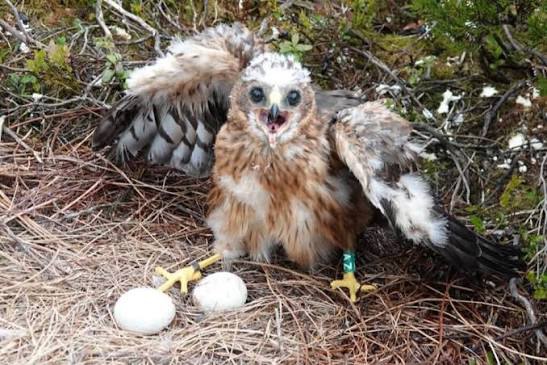
(Natural England, 2023)
Primary Sources
Natural England:
- Numbers of nesting hen harriers in England have risen slightly in 2025
- Drop in numbers of nesting hen harriers in 2024
- Conclusion of Hen Harrier Brood Management Trial (updated)
- Hen Harrier Brood Management Trial (July 2026)
- Research Report NERR153 – Hen Harrier Brood Management Trial Evaluation
- Hen Harrier Brood Management Trial Evaluation reports
RSPB:
- Another record year for Hen Harriers in the Forest of Bowland (2025)
- Sustained success for Hen Harriers in the Forest of Bowland (2026)
Additional:
- BTO Research Report – Assessment of recent Hen Harrier population trends in England through population modelling
- Historical accounts of Hen Harrier decline and recovery in northern England (drawn from Natural England and published ornithological summaries)
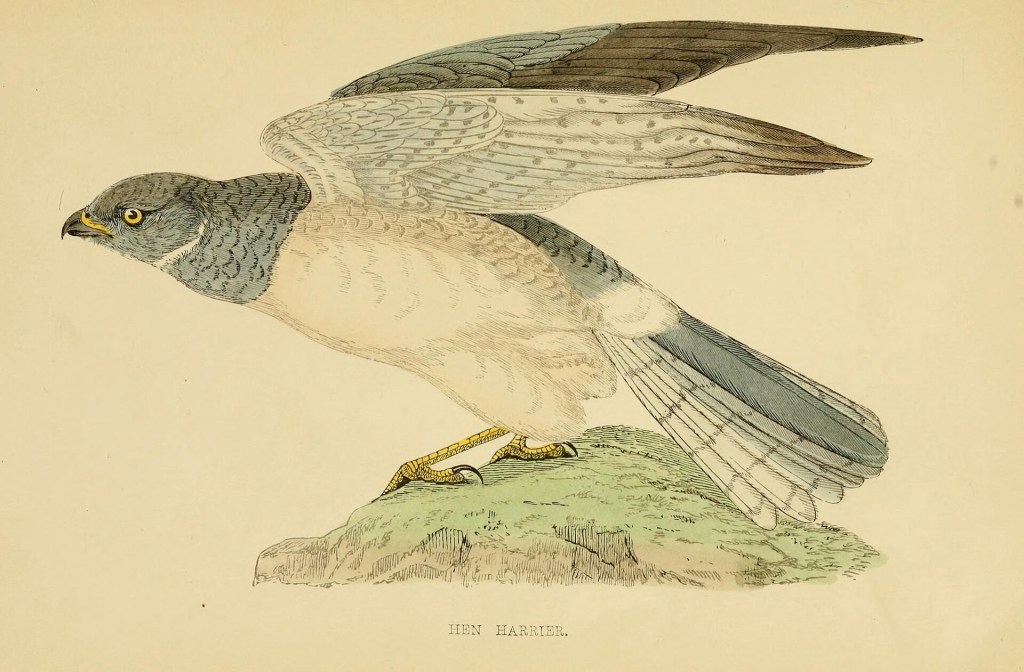
By the Rev. F.O. Morris (1862)
Endangered
By Anneliese Emmans Dean (1963-2022)
Silver shimmer
Heather skimmer
Ring tailer
Air sailor
Grouse catcher
Pipit snatcher
Big dipper
Trip flipper
Sky dancer
Slim chancer
Hope carrier
Hen Harrier
Thank-you for reading. If you enjoyed this piece and would like to support further articles on the wildlife and history of the Northwest, you can buy me a coffee here.
Alex Burton-Hargreaves
(September 2026)


Lovely post! Your article is informative, thorough, and well-written. Thank you for sharing and for spreading awareness!
LikeLiked by 1 person
Thank-you Lina 🙂
LikeLiked by 1 person