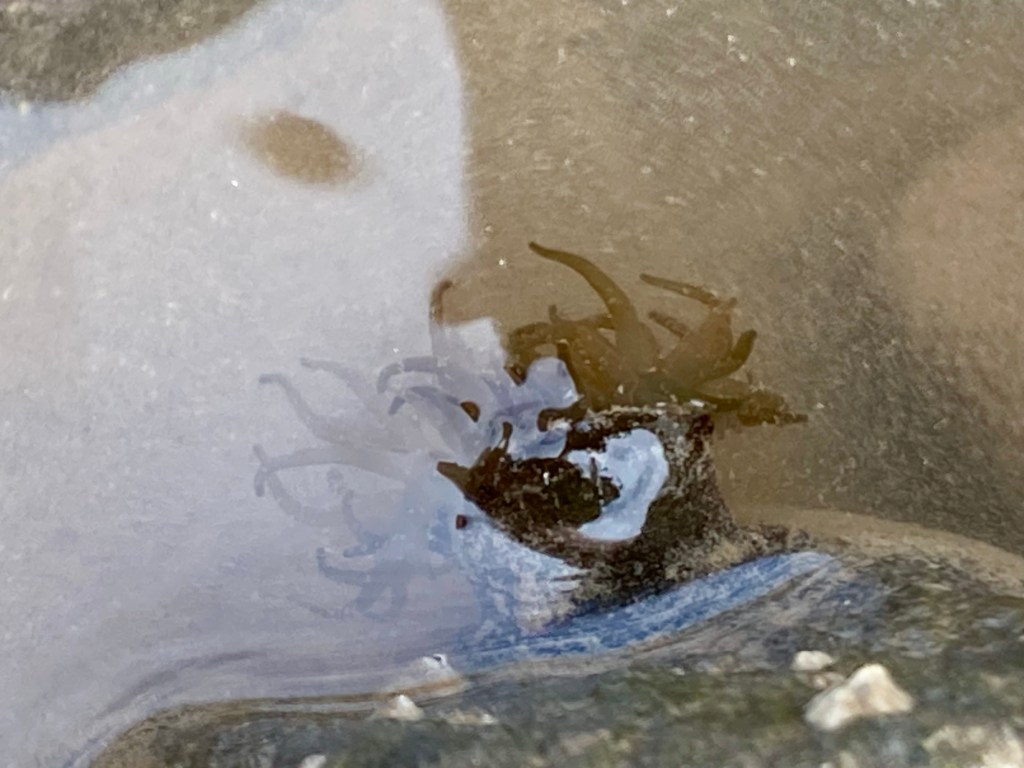
Actinia derives from the Greek aktis, meaning ‘ray’ or ‘beam’, and describes their radial, flower-like appearance
Soft arms sway in blue,
an open flower of the deep,
waiting for a meal.
Lancashire’s coast offers a great plethora of habitats for sea creatures trying to find a home, here you may find wide expanses of sandy beach, mile-upon-mile of glutinous mudflat and salt-marsh, hidden rock-pools, secret coves and a bewildering variety of man-made structures including piers, groynes, jetties, and sea walls.
While much of the shoreline is soft sediment with its own contingent of worms, shellfish and the like, the harder substrates, both natural and artificial, support a small but tough community of sea anemones (order Actiniaria). These soft-bodied cnidarians, cousins to the jellyfish and corals, attach firmly to these harder surfaces and use their stinging tentacles to capture prey.
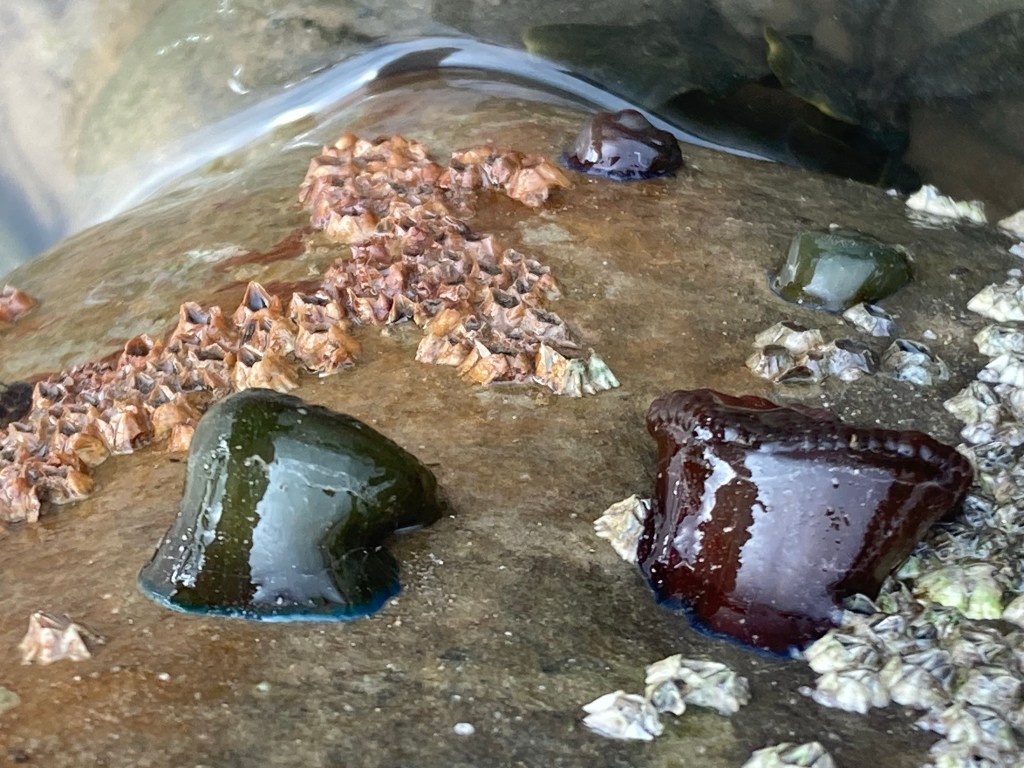
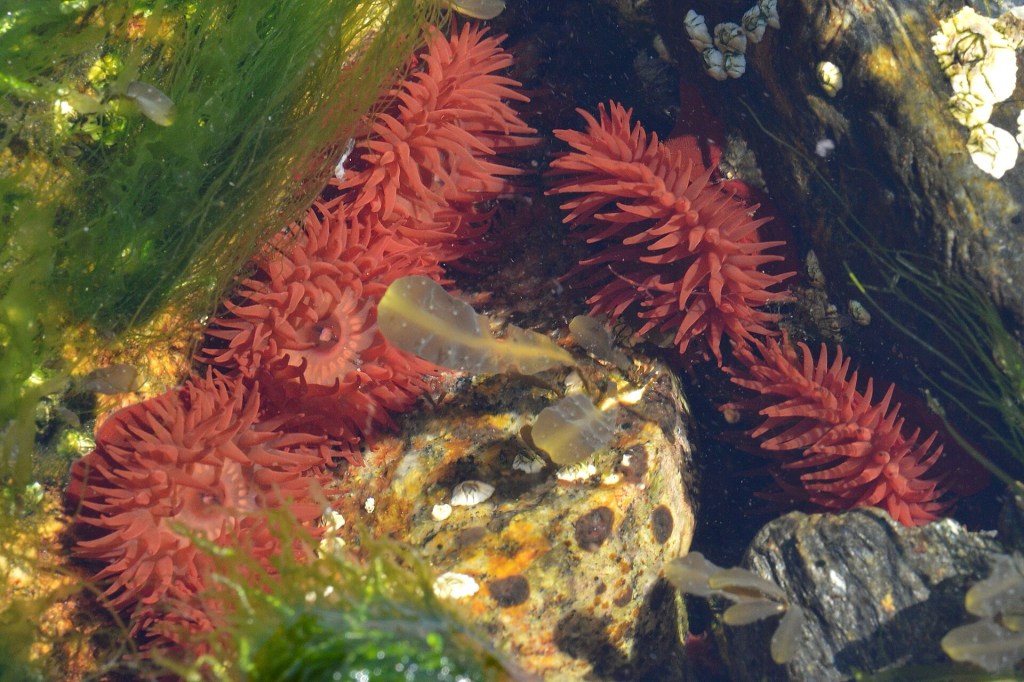
Three Common Species
Sea anemones are not plants despite their flower-like appearance when expanded, rather they are predatory animals that retract or expand their tentacles according to conditions. On Lancashire’s coast the most frequently encountered species are the highly adaptable intertidal specialists and those that favour structures with good water flow. The three most common are the Beadlet Anemone, the Plumose Anemone, and the Dahlia Anemone.
Beadlet Anemone (Actinia equina)
This is by far the most abundant and widespread sea anemone on the Lancashire coast and around the entire British Isles. It is a classic intertidal species, thriving from the upper to lower shore on any firm surface: natural rock, boulders, sea walls, groynes, or the piles of piers.
When the tide is out it appears as a smooth, jelly-like blob (usually deep red, but also brown, green, or orange), up to about 5cm across the base. Blue bead-like structures (acrorhagi) often form a ring just below the tentacles; these are packed with stinging cells used in territorial disputes with neighbouring anemones (yes that is an episode of octonauts!) When submerged, it expands up to around 192 short, stout tentacles arranged in circles. It is very tolerant of desiccation, temperature extremes, and varying salinity, which allows it to survive high on the shore and even in places temporarily covered by sand.
Beadlets feed on small crustaceans, worms, and other invertebrates that come within reach of their tentacles. They can reproduce both sexually and asexually (by producing fully formed young inside the body cavity). Look for them in rock pools or on shaded crevices and vertical surfaces around Morecambe Bay, Heysham, Fleetwood, and artificial structures along the Fylde coast. They are present year-round.
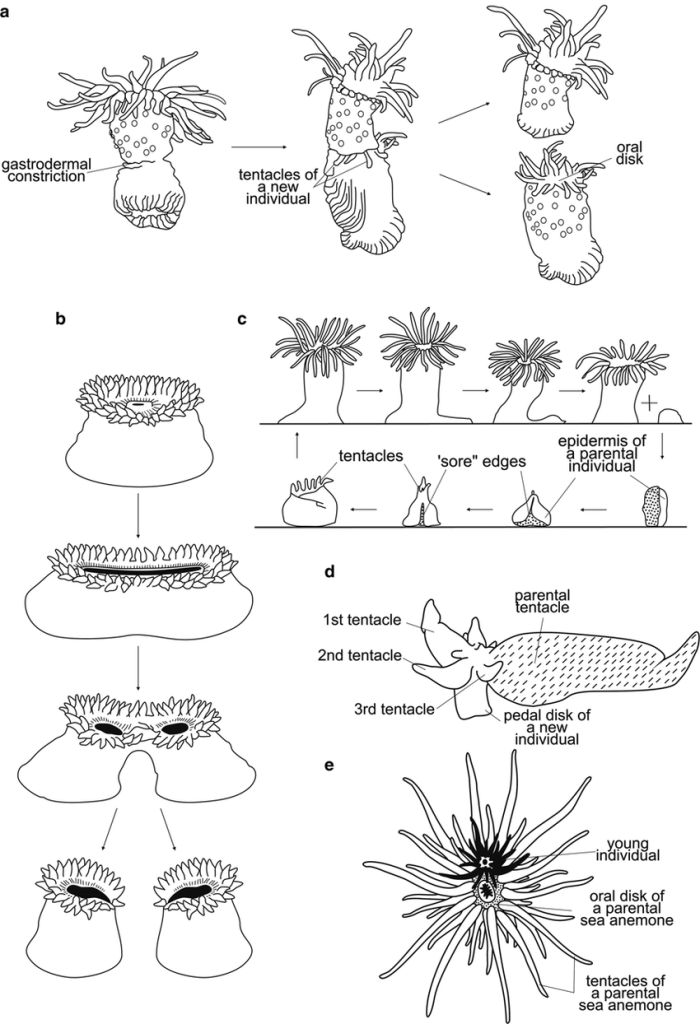
B: longitudinal fission
C: pedal laceration
D and E: tentacle autotomy
(Ekaterina Bocharova)
Plumose Anemone (Metridium senile)
Also known as the frilled or fluffy anemone, this species is regularly recorded on the Lancashire coast, particularly on jetties, piers, and other structures with a moderate to strong tidal flow.
It is larger than the beadlet, with a column that can reach 30cm in height in deeper water (smaller intertidally). When expanded it displays a dense plume of fine, feathery tentacles that give it a fluffy appearance; colours are typically white or orange, though brown, green, or other shades occur. Out of water it often collapses into a limp, soggy mass resembling a deflated balloon or rubber glove. It prefers areas with good current that bring planktonic food, and it frequently forms colonies.
Plumose anemones are more common lower on the shore or just subtidally, but low spring tides can expose them on suitable structures.
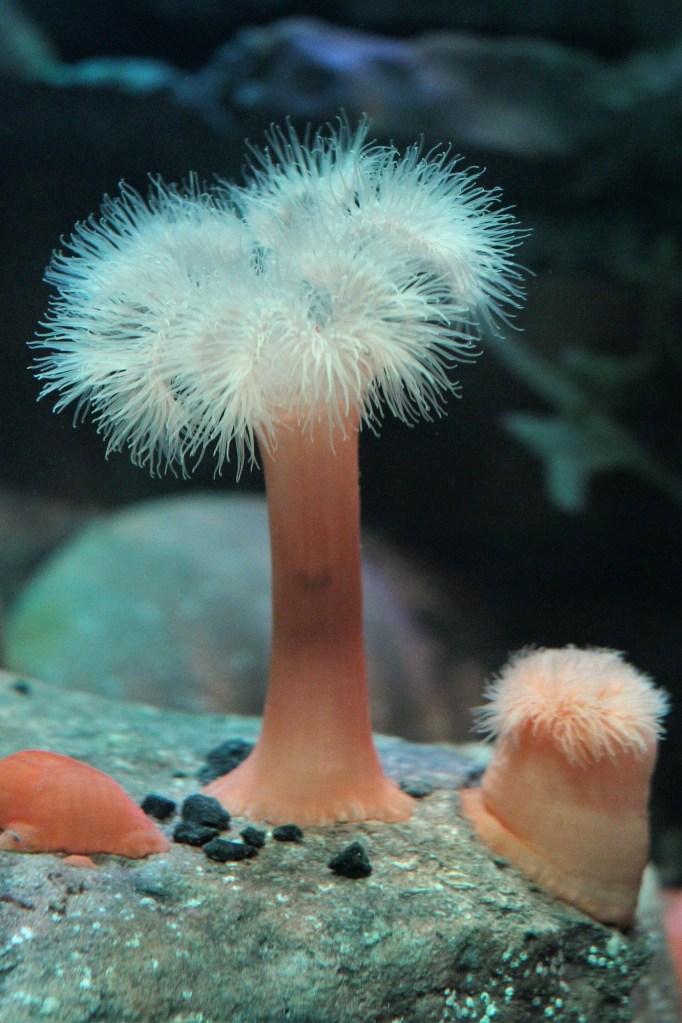
Metridium is Latin and derives from the Greek word mētrídios, meaning ‘having a womb’ or ‘fruitful’,
(Emőke Dénes)
Dahlia Anemone (Urticina felina)
This is the largest of our commonly encountered shore anemones and occurs all around the British Isles. It favours the lower shore and shallow sub-tidal, especially on wave-exposed or current-swept rock, in gullies, or at the interface of rock and sand where it tolerates scouring by water-borne sand.
The column is stout and warty, often with gravel, shell fragments, or sand stuck to the adhesive verrucae for camouflage (these have no relation to the verrucas me or you might get!). When expanded it shows up to 160 short, thick tentacles (frequently banded) arranged in multiples of ten; the overall diameter can reach 15cm or more (larger offshore). Colour is highly variable, reddish-brown is common, but pinks, purples, yellows, oranges, and patterned forms occur. When closed it can be easily overlooked as a gravel-covered lump.
Dahlia anemones are powerful predators capable of taking crabs, mussels, and small fish. They are present year-round on appropriate hard substrates, particularly in the more rocky sections of Morecambe Bay and exposed lower-shore sites.
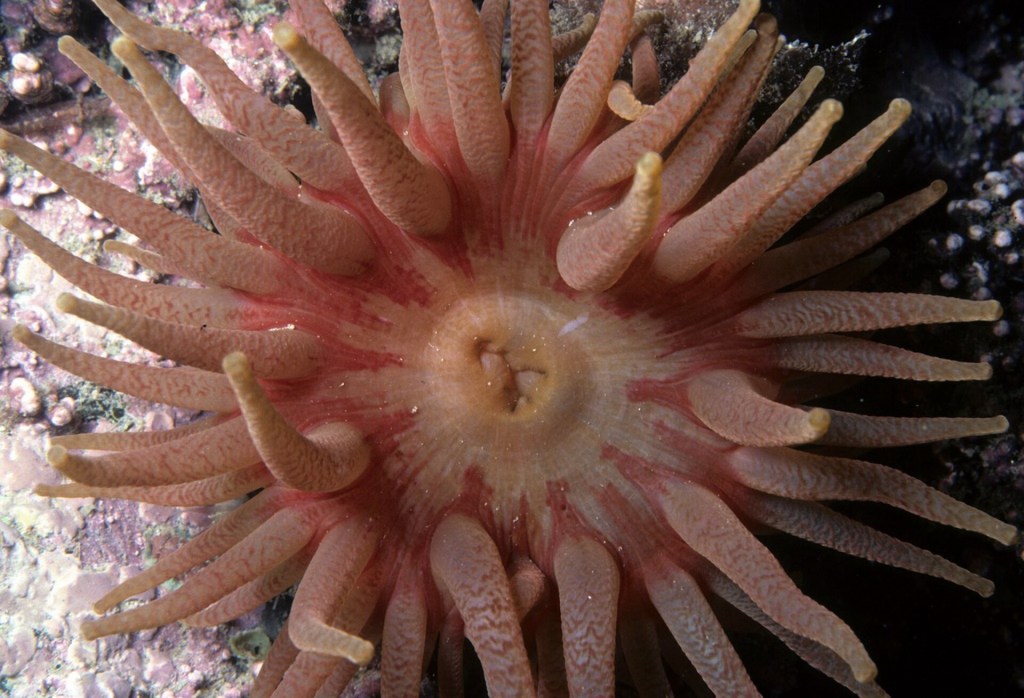
Urticina translates to ‘nettle-like’ referencing its powerful stinging cells, called nematocysts
(Derek Keats)
Searching for Sea Anenomes
The best places to search for these beautifully be-tentacled sea-beasts are rocky outcrops and pools. Anenome haunts on the Lancashire coast include Morecambe Bay, artificial hard structures at Fleetwood, Cleveleys, Lytham and Blackpool, and any lower-shore rock or jetty bases exposed on a good low tide. Always check tide times carefully; Morecambe Bay in particular is infamous for its fast-moving channels and dangerous soft sediments.
When exploring, please leave animals where they are, replace any overturned rocks, and remember that this realm into xwhich you intrude is their whole universe and a very, very fragile one at that.
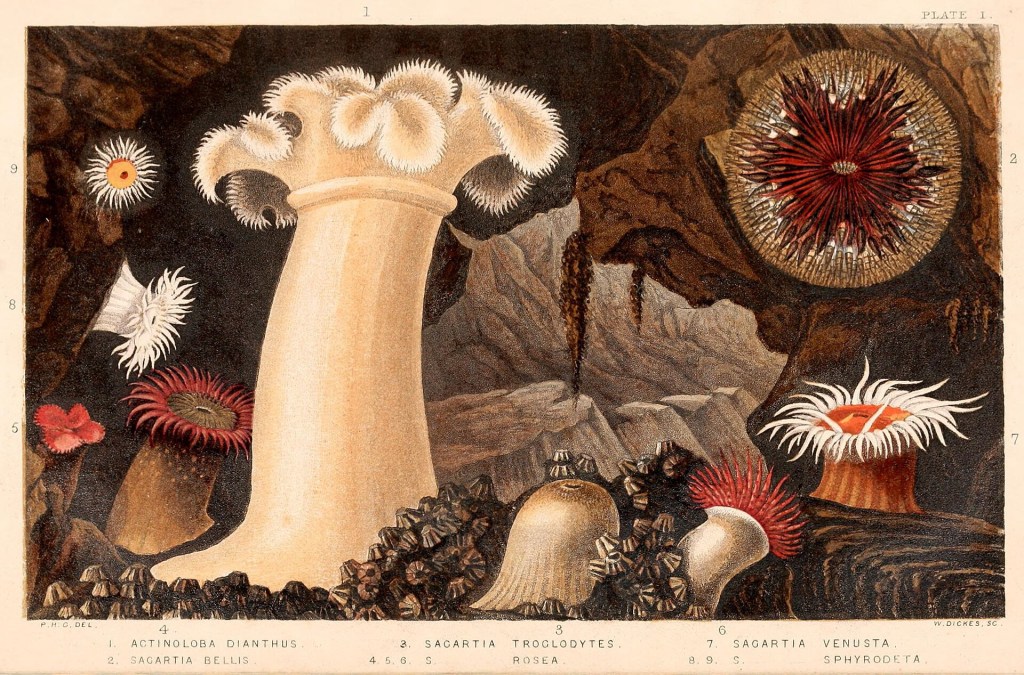
Actinologia britannica: a history of the British sea-anemones and corals
Philip Henry Gosse, 1860
Beadlet Poem
Penned by Rachel ‘onemorething’ for National Marine Week
A sea does not journey without obstacle,
it divides and foams across stone,
a slave to tides, it swirls, waves
over the living and dead it carries –
all passengers, all hungry for something
as it gasps the friction of their stories
upon shingle or sand.
Or here,
meeting land, it casts itself onto rocks,
blasts new water into the worlds
of the cut-off, the alienated,
those adapted to ravage:
beadlet anemones worn by pools
as if they were bloody wounds
that exposed their suffering, toxic,
lashing out whips of survival
where life involves many forms of fighting.
Thank-you for reading. If you enjoyed this piece and would like to support further articles on the wildlife and history of the Northwest, you can buy me a coffee here.
Alex Burton-Hargreaves
(Nov 8th 2026)

