The Story of the KX100 Phone Box at Dunsop Bridge: From Local Landmark to Listed Heritage
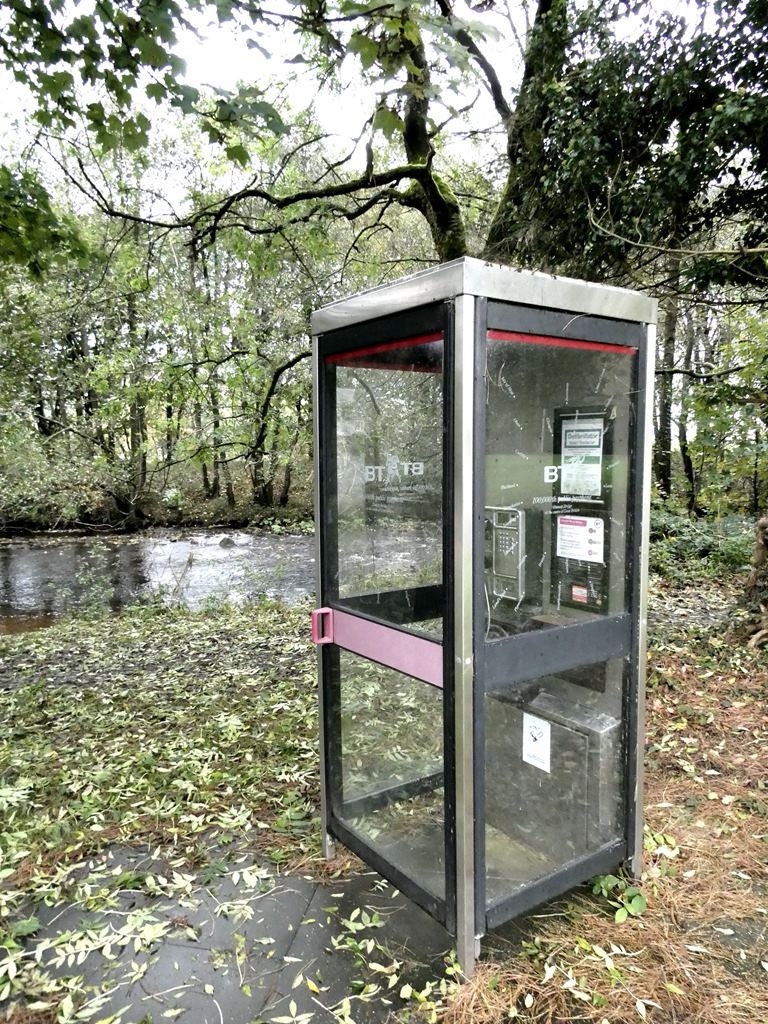
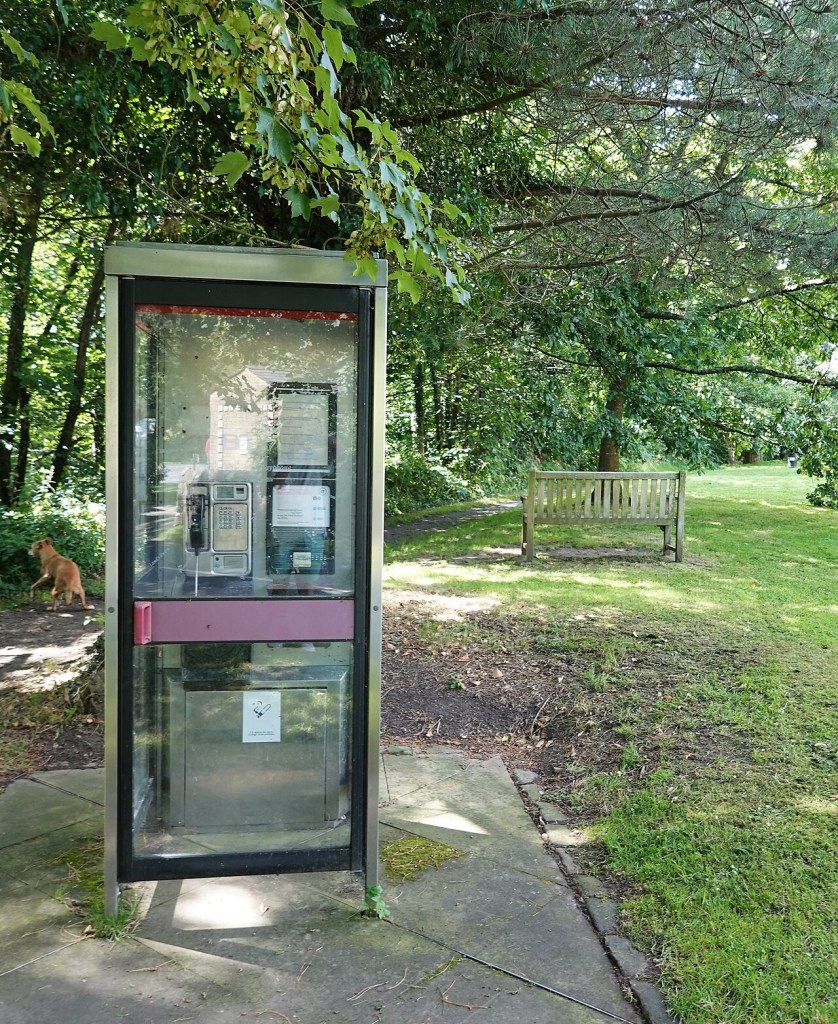
Deep in the heart of the Forest of Bowland, standing in the corner of a tidy and well-kept village green that is reckoned to be the closest to the centre of the United Kingdom, stands an unassuming steel-and-glass telephone kiosk that holds a very special and unique place in British history.
This is no ordinary phone box though, for it is the Mark 2 KX100, British Telecom’s 100,000th public payphone, and was deliberately sited here, near the geographical centre of Great Britain, to be opened with ceremony by the explorer Sir Ranulph Fiennes and, in October 2026, it became the first of its design to be granted Grade II listed status.
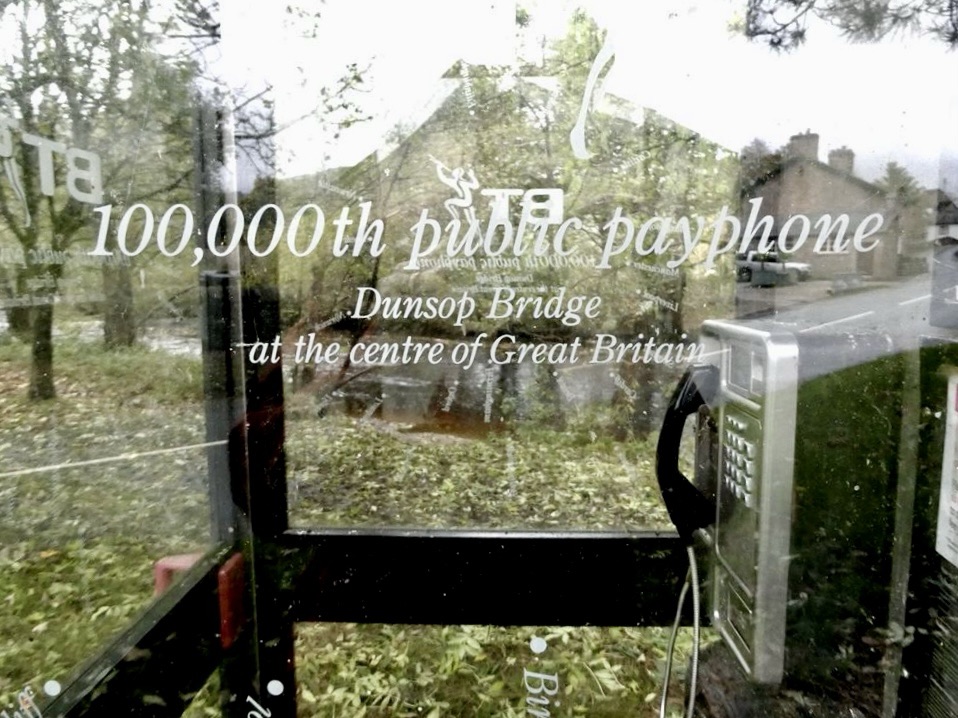
(image by Oliver Dixon)
The Rise of the KX Series
By the late 1970s, British Telecom recognised that the classic red telephone boxes, primarily Sir Giles Gilbert Scott’s K2 and K6 designs, needed successors.
The older kiosks were heavy, hard to clean, vulnerable to vandalism, and inaccessible to wheelchair users. So, in 1979 the industrial design firm David Carter Associates (DCA) of Warwick developed a range of prototypes intended to be robust, vandal-resistant, easy to maintain, and wheelchair-friendly. The project was paused, then revived in 1983, and under David Carter’s direction, designer Digby Redshaw and engineer Tony Hume refined the designs into the KX range.
BT was privatised in 1984, and the KX series was officially launched on the 20th of June 1985 in London. Manufactured mainly by GKN Sankey in Telford, the kiosks featured a steel and aluminium frame with toughened glass panels. The KX100, the freestanding outdoor model, became the most widely installed variant, early Mark 1 examples had adjustable cylindrical legs and multi-panel backs; the improved Mark 2 (introduced soon after) featured a more weather-resistant ‘biscuit-tin lid’ roof, simplified construction, and better fittings. In 1991 a rebrand brought the BT wordmark, the ‘Piper’ logo (in blue and burgundy), burgundy door handles and modesty panels, and updated signage.
Public reaction was mixed. Many preferred the solid, classical red boxes, and the new designs were sometimes dismissed as clinical or bland. Yet the KX100 represented the final generation of purpose-designed public telephone kiosks before mobile phones transformed communication forever.
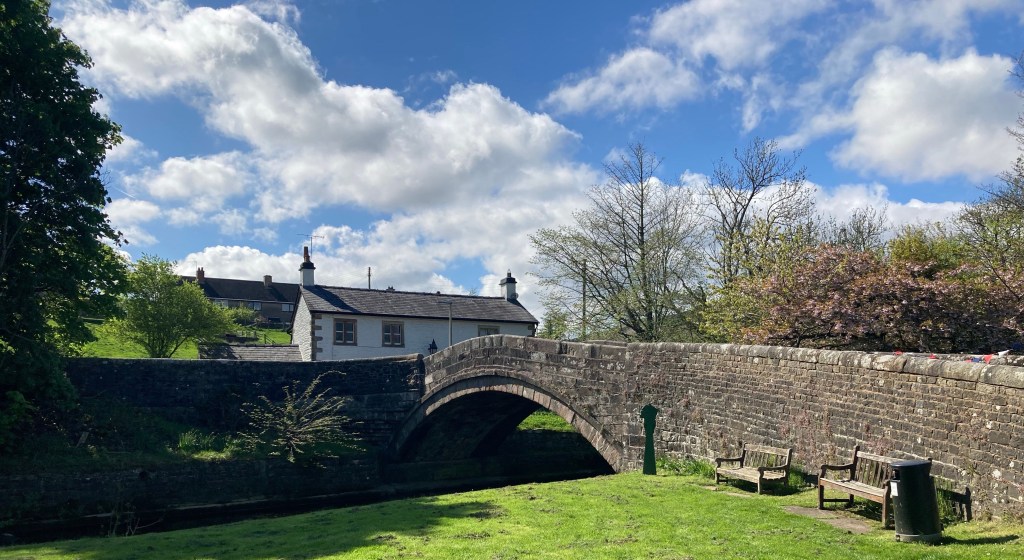
(author)
The Village at the Centre of the Kingdom
Dunsop Bridge is a handsome little village at the confluence of the River Dunsop and the River Hodder, surrounded by the rolling hills of Bowland. It is often cited as the geographical centre of Great Britain, though the precise point calculated by Ordnance Survey (including the mainland and 401 associated islands) lies at Whitendale Hanging Stones, roughly 3 miles to the northwest.
In 1992 BT chose the village, which has long embraced this symbolic status, for a special installation. On the 29th of June that year, a Mark 2 KX100, BT’s 100,000th public payphone, was unveiled on a the village’s green beside the river. Thirty children from nearby Thorneyholme RC Primary School helped install the kiosk and attended the ceremony, local dignitaries were also present.
The guest of honour was Sir Ranulph Fiennes, one of Britain’s most celebrated explorers. Often described as the world’s greatest living explorer, Fiennes is renowned for extraordinary polar and endurance feats including leading the first surface circumnavigation of the Earth via both poles (the Transglobe Expedition of 1979–82), multiple attempts on the North and South Poles (supported and unsupported), and later challenges such as completing seven marathons on seven continents in seven days. By the early 1990s he was a household name, considered by many to be the very embodiment of British adventure.
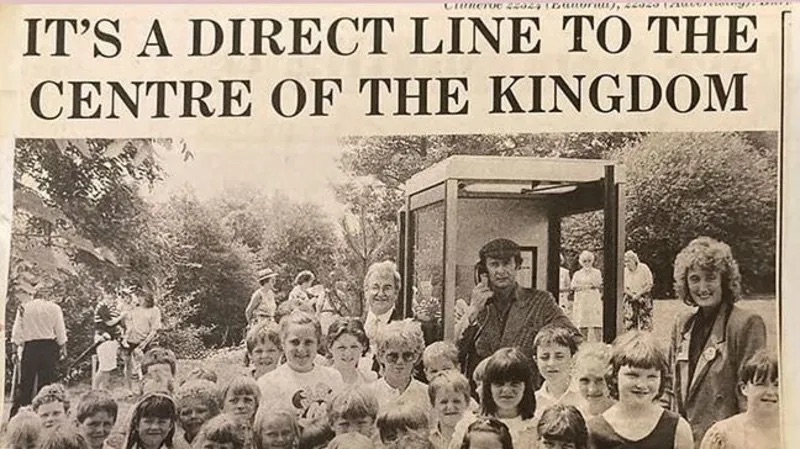
(from the Clitheroe Advertiser)
His presence at the opening carried symbolic weight: a man who had reached the ends of the Earth inaugurating a telephone box at the centre of Great Britain. Fiennes made the first call from the kiosk, to Ordnance Survey, announcing its presence, a gesture to symbolise the connection of people from all around the world to a single point in space and time.
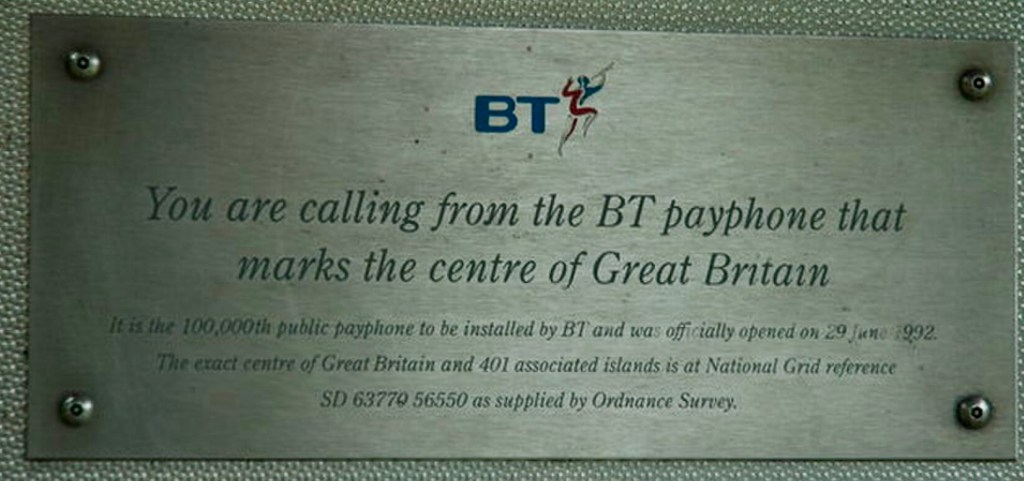
A commemorative plaque inside the kiosk stated: ‘You are calling from the BT payphone that marks the centre of Great Britain’, giving the precise Ordnance Survey grid reference. (The plaque was later stolen.) What further set the kiosk apart was its bespoke design by Wolff Olins, the glass panels were etched with the text ‘100,000th public payphone / Dunsop Bridge / at the centre of Britain’, surrounded by the names of major British places radiating outward: Oxford, Birmingham, Bristol, Cardiff and others, along with the BT Piper logo.
This is believed to be the only KX100 in England given such a site-specific treatment and the kiosk was set on stone paving with compass-point timber posts and planting to set it apart from phone kiosks elsewhere in the country.
Decline, Campaign, and Listing
As mobile phones spread, public payphones became less essential, so BT began reviewing and removing underused kiosks under Ofcom rules. By the 2020s the KX models, once ubiquitous, were disappearing rapidly. The Twentieth Century Society (C20), which had long campaigned to protect the earlier red boxes (more than 3,000 of which are listed), turned its attention to the KX generation. In 2024 it applied to list three significant examples, one each in England, Scotland and Wales, arguing that the KX100 represented the last flourish of design-led public telecommunications infrastructure.
Catherine Croft, then director of the Society, described the design during the campaign: “It’s not the kind of heavy, chunky, red, solid phone box which is modelled a bit on classical architecture, but it’s a design classic in its own right”. She also highlighted the symbolism of Fiennes’ involvement: “BT put it at the geographical central point of Great Britain and they got the explorer Ranulph Fiennes to come and open it. So I guess that was someone symbolising someone who had been to every end of the earth”.
The Dunsop Bridge kiosk was the English candidate. Historic England recommended listing, and on the 23rd of October 2026 the Department for Digital, Culture, Media and Sport designated it grade II. It was the first KX100 to receive this protection.
Jayne Rimmer, Historic England’s North Region listing team leader, said: “This KX100 is historically significant as it was installed as a landmark on account of its location and being the 100,000th kiosk to be opened in the country with some unique design features. It also makes an important contribution to our understanding of the historic development of the telecommunications industry in England before the introduction, and subsequent widespread use, of mobile phones. As part of the last generation of the public telephone boxes, it is a nationally significant kiosk, and we are delighted it has been given Grade II listed status and protection”.
“A Small Part of our National Story”
Oli Marshall, campaigns director at the Twentieth Century Society, welcomed the decision with characteristic reflection: “We’re absolutely delighted that the KX100 kiosk at Dunsop Bridge has been designated Grade II, as Twentieth Century Society’s famous telephone boxes campaign comes full circle. There’s no small irony that it was the arrival of the KX100 that first spurred the Society into action back in 1985 – once the slayer of traditional red telephone boxes, that we fought vigorously to repel, now itself being given heritage protection”.
He continued: “While widely unloved and underappreciated in comparison to the classic red telephone boxes, the ‘ugly duckling’ KX100 model has developed a cult following in recent years. The unique example at Dunsop Bridge is not only pub quiz trivia as the dead centre of Great Britain, it’s the final flourish of telecoms design in the public realm and a small part of our national story”.
Ribble Valley Borough Council leader Simon Hore added a local perspective: “This is just another reason to visit the small but wonderful Dunsop Bridge, which is at the geographic centre of Britain and on part of the King’s Duchy of Lancaster estate. The phone box has a special place in local people’s hearts”.
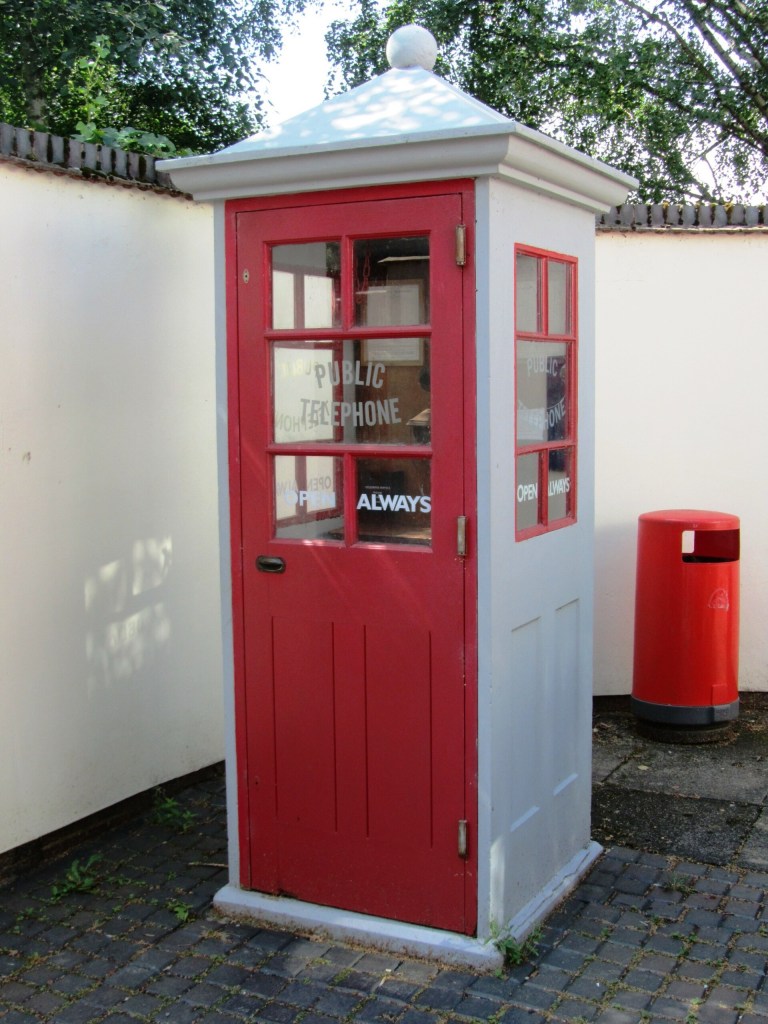
(designed in 1921)
Avoncroft Museum, Bromsgrove
(Anne & David)
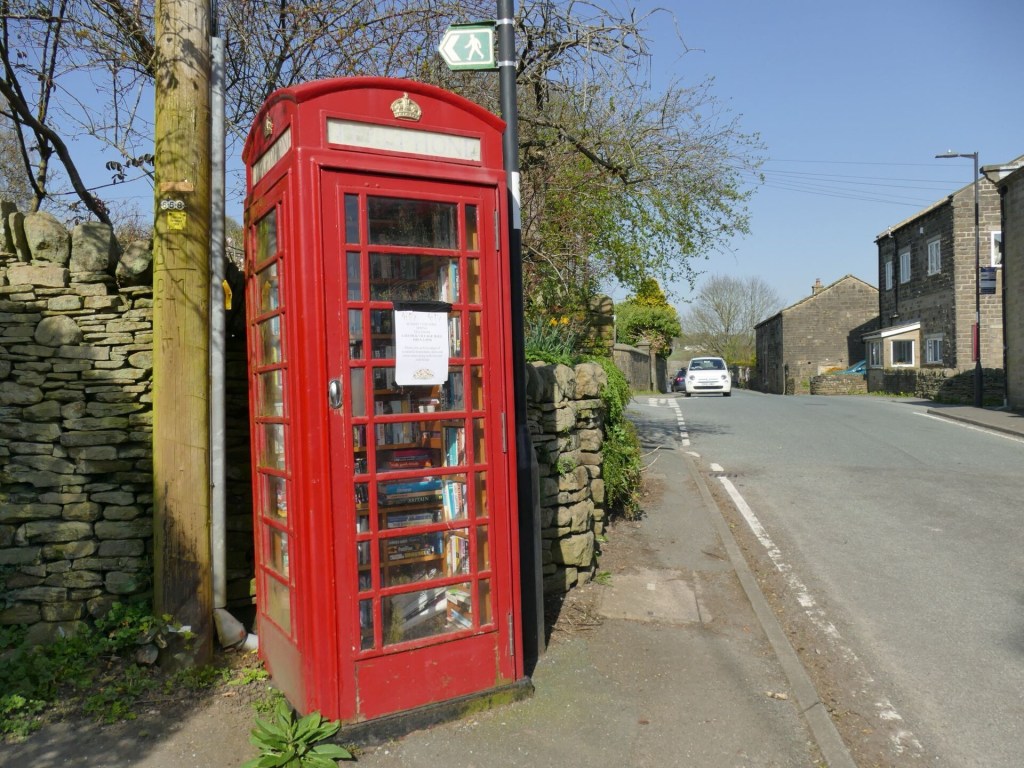
(Stephen Craven)
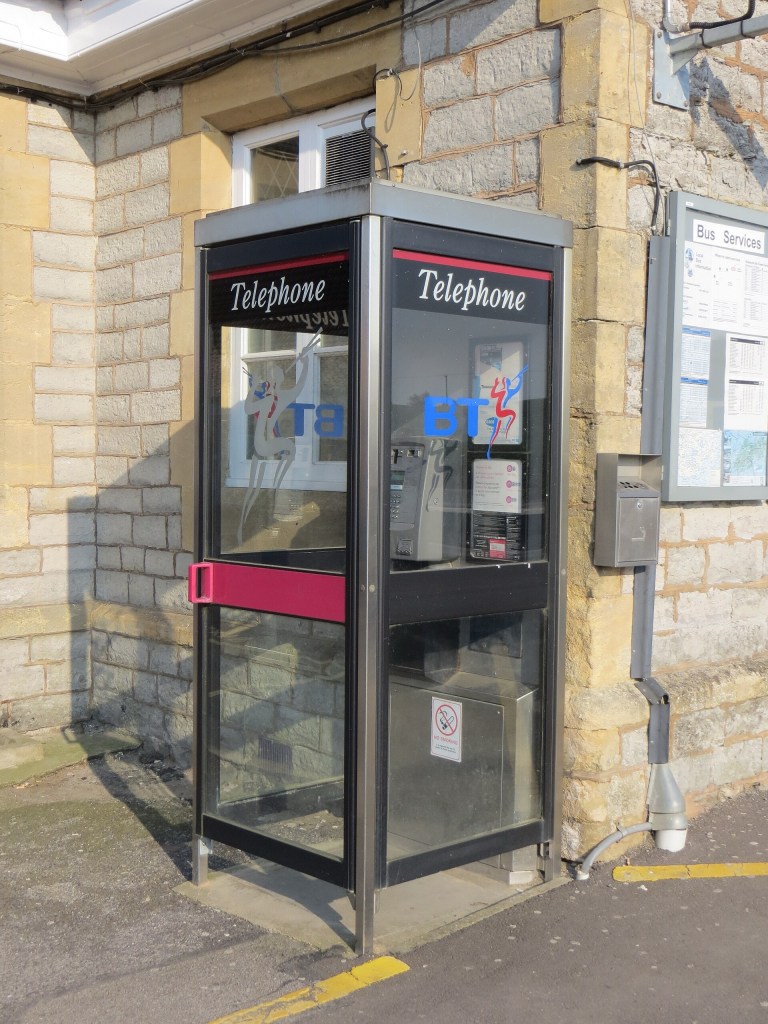
Castle Cary, Somerset
(Alex Lives)
The Kiosk Today
The kiosk stands today beside the River Dunsop on the village’s green, near to the car park and Puddleducks Tea Room, and within view of the Grade II-listed post-medieval bridge. Though public payphones are largely obsolete, this one is still regularly used (both by tourists and locals because the mobile phone signal here is poor) so endures as both a functional remnant and cultural marker, a tangible link to the time before mobile phones became universal, and a quirky claim to fame for a small northern English village.
Its Grade II listing ensures that any future changes will be carefully scrutinised, preserving a piece of late-20th-century design and telecommunications history for future generations. What was once dismissed by some as an “ugly duckling” has become a recognised part of the national story, forever linked to the heart and soul of Great Britain.

Late night phone call home haiku
Cold glass shields from rain,
coins drop down with heavy clicks,
voices bridge the dark.
Thank-you for reading. If you enjoyed this piece and would like to support further articles on the wildlife and history of the Northwest, you can buy me a coffee here.
Alex Burton-Hargreaves
(Nov 4th 2026)

